

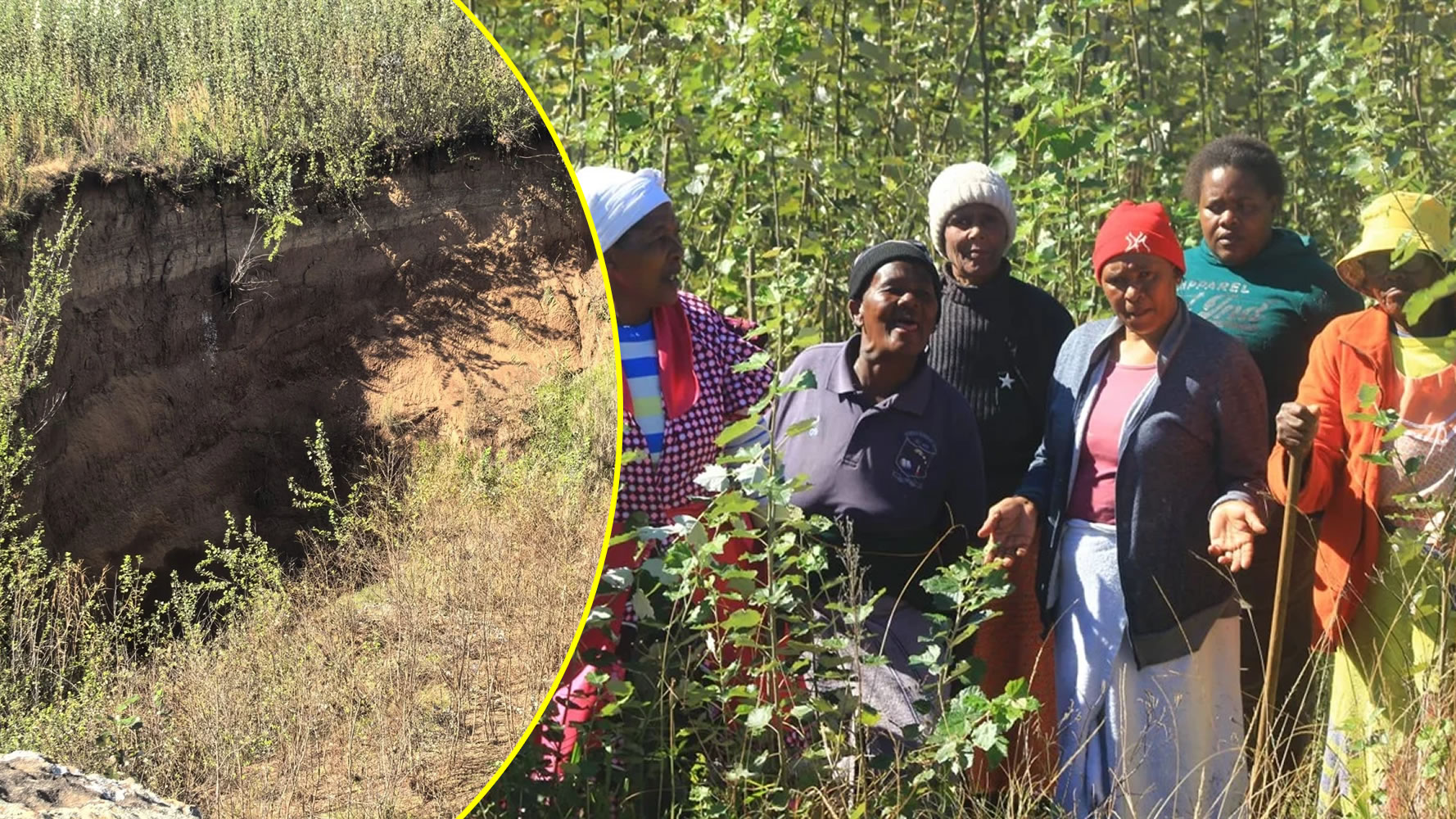
The Vanishing Dead: How Floods and Neglect are Erasing QwaQwa's Ancestors
NALEDI VILLAGE, QWAQWA – In the quiet village of Naledi, nestled beneath the shadows of the Maluti Mountains, the living are haunted by the sight of the dead returning to the surface. It is not a ghost story, but a grim reality of environmental decay and municipal failure. Here, the Elands River is no longer just a source of water; it has become a thief of memories, slowly swallowing the local cemetery and scattering human remains along its muddy banks.
Following a period of relentless, heavy rainfall that lashed the Free State province, the riverbanks adjacent to Thabo Mbeki in QwaQwa have finally buckled. The result is a scene of desecration that has left families in a state of profound desperation. Graves that once stood as permanent monuments to loved ones have been reduced to gaping holes and piles of unstable silt. For the residents of Naledi, the nightmare is not just that their relatives are gone, but that they are literally being washed away.
The scale of the destruction is still being tallied, but the emotional toll is already immeasurable. Residents who frequent the river to collect firewood have reported stumbling upon human bones protruding from the eroded earth. These are the physical fragments of a community's history, unceremoniously unearthed by the gushing waters.
Madala Tebello Mofokeng, 78, is one of those who has witnessed the horror firsthand. During a tense meeting with Maluti-a-Phofung Municipality officials on Tuesday, 19 May, he spoke of the burden of carrying this secret from the youngest members of his family.
"We collect wood from the river where we often come across human bones," Mofokeng said, his voice heavy with the weight of his years. "My grandsons always ask me where the bones came from. I usually answer them lightly, trying to protect them from the painful truth as they're still too young to understand."
For Mofokeng and others like him, the riverbank is no longer a place of utility, but a site of trauma. The sight of a femur or a skull among the driftwood has become a common, yet no less jarring, occurrence.
The crisis at Naledi is not an isolated incident of nature's fury; it is the culmination of years of ignored warnings. Gogo Regina Tahleho Borinate, a resident who has buried four family members in the now-collapsing graveyard, including her own daughter, says the tragedy was entirely preventable.
"We've been sent from pillar to post by the village chief and the ward councillor for five years," Borinate told investigators. "This tragedy could have been prevented if our leaders had listened to our concerns. We humbly appeal to the municipality to close this cemetery and exhume our loved ones to a safer graveyard."
Her grief is layered with the frustration of a citizen who has watched the ground literally disappear beneath her family's feet. "The graves of my four family members are now on the brink of collapse, and we have grandsons and daughters who deserve to know and visit the resting places of their elders," she added.
The situation is equally dire for Gogo Mapaseka Letsaba, 62. For her, the erosion is a ticking clock. Her brother's grave is currently the last one standing at the very edge of the precipice.
"The grave of my brother is dangerously exposed to disappearing completely," Letsaba said. "We have been seeking help for years, including from the municipality, but our pleas were never given the attention they deserved."
This pattern of neglect is a recurring theme in the Maluti-a-Phofung Municipality, an area that has become synonymous with infrastructure failure and service delivery crises. For over a decade, QwaQwa has grappled with persistent water shortages and crumbling roads. In January 2022, flash floods in the region claimed three lives, highlighting the vulnerability of the local infrastructure to extreme weather events.
The cemetery crisis in Naledi mirrors similar disasters across South Africa, most notably the 2022 KwaZulu-Natal floods, where dozens of skeletal remains surfaced at the Ntuzuma Cemetery north of Durban after mudslides uprooted graves. In both cases, the common denominator is a lack of proactive management and the failure to reinforce burial sites located in high-risk geographical areas.
The geological instability of the Naledi cemetery is exacerbated by the lack of proper riverbank reinforcement. As the Elands River swells with each seasonal storm, the soft soil of the graveyard offers little resistance. What remains is a landscape of "sinking" graves, where the earth has become so saturated and unstable that headstones are tilting at impossible angles, and the very coffins beneath are being shifted by the subterranean flow of water.
The Maluti-a-Phofung Municipality has finally begun to acknowledge the scale of the disaster, though many residents feel the response is too little, too late. Bridgett Lebesa, the Member of the Mayoral Committee (MMC) for Community Services, confirmed that the local government has started engaging with the affected families.
"We've requested families to submit the names of their deceased together with the grave numbers to the village king," Lebesa stated. "This is part of the formal process required to apply for the exhumation and relocation of the graves to a safer cemetery."
However, the "formal process" of exhumation in South Africa is notoriously complex and expensive. It requires permits from the provincial Department of Health, the local municipality, and often the police, especially when remains have already been disturbed. For the impoverished families of Naledi, the administrative hurdles are as daunting as the physical erosion.
The broader context of this disaster is one of systemic municipal failure. Maluti-a-Phofung has been under various forms of provincial intervention for years due to financial mismanagement and its inability to provide basic services. A 2024 report on infrastructure in the municipality noted that "deteriorating roads and unreliable water provision" were symptoms of "poor municipal planning and governance." The failure to maintain the cemetery's integrity is simply the latest chapter in this ongoing saga of administrative collapse.
Environmental experts warn that such incidents will only become more frequent as climate change drives more intense rainfall patterns in the Free State. Without significant investment in "grey" infrastructure—such as gabions and retaining walls—and "green" infrastructure—like indigenous vegetation to bind the soil—the Elands River will continue its slow march through the village's history.
For now, the people of Naledi wait. They wait for the bureaucracy to move, they wait for the next rain cloud to gather, and they wait to see if they will be the next ones to find a relative's bone on the riverbank.
The "amadlozi"—the ancestors—are supposed to be at rest, watching over the living. In QwaQwa, however, it is the living who must watch over the dead, desperate to save what remains of their heritage before the river takes it all.
As the sun sets over the Maluti Mountains, casting long shadows across the broken headstones of Naledi, the silence of the graveyard is broken only by the steady, rhythmic rush of the river—a sound that used to be peaceful, but now sounds like a countdown.
The municipality's promise of exhumation offers a glimmer of hope, but for Gogo Mapaseka and Gogo Regina, the time for promises has long since passed. They do not want more meetings or more forms to fill out. They want their brothers, daughters, and parents moved to a place where the earth is solid and the water stays where it belongs.
Until then, the Elands River remains a graveyard in motion, a liquid tomb that refuses to let the dead stay buried. It is a stark reminder that when the infrastructure of the living fails, even the peace of the dead is no longer guaranteed.