

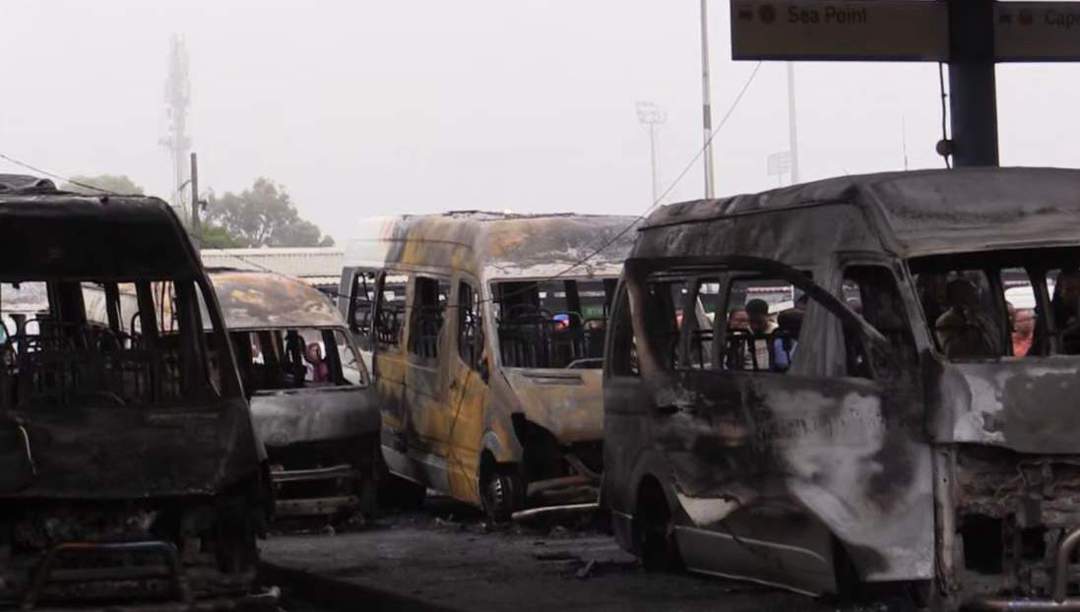
The South African taxi industry — long essential to daily life, yet shadowed by violence — has a new and unsettling chapter. A police investigation now suggests that Vusimuzi “Cat” Matlala’s alleged attempted assassination of Joe “Ferrari” Sibanyoni in August 2022 was not an isolated act of gang violence. Instead, investigators say it formed part of a deadly succession struggle inside a criminal network reportedly known as the Big Five cartel — a Gauteng-based syndicate accused of reach across the country.
The alleged cartel is said to operate as a criminal empire with deep links into the taxi industry, politics and law enforcement. According to testimony to the Madlanga Commission and police statements, the Big Five’s activities included drug trafficking, tender fraud, kidnappings, extortion, contract killings and cross-border vehicle hijackings. The group’s leadership, the commission heard, included the late taxi boss Jotham “Mswazi” Msibi, Sibanyoni, a shadowy businessman called Steve Motsumi, Matlala and Katiso “KT” Molefe.
At the heart of the current case is a bitter falling out between Msibi and Sibanyoni. Sibanyoni told police that the pair had for years worked closely together — Msibi as the powerful mentor and Sibanyoni as his second-in-command. A verbal deal, Sibanyoni claims, once promised that Msibi would step down as president of the South African Local and Long Distance Taxi and Bus Organisation (SALLDTBO) when he turned 60. But when Msibi refused to vacate his post in 2019, tensions spiralled. Sibanyoni told police he began to fear for his life.
“He became aware that I was avoiding him and confronted me about it … I also reminded him that he sent people to kill me back in 2007. I was shot and injured, and I survived. He became angry and told me to take my taxis out of the rank,” Sibanyoni said in his police statement.
Police describe Msibi as the president of “The Firm”, an alleged umbrella group that some witnesses say sits above or alongside the Big Five. As Msibi sought to retain control of the taxi structures that handed him power and access to contracts, he reportedly surrounded himself with armed men — “izinkabi” — and recruited Matlala and Katiso Molefe among others to bolster his protection.
The attempted killing of Sibanyoni outside Centurion Golf Estate on 10 August 2022 is part of that succession fight, the police say. CCTV footage from the estate and toll gantry camera evidence trace the movement of accused gunmen who allegedly followed him from a restaurant in Bryanston to Centurion late that night. Sibanyoni was shot twice in the stomach but survived after estate security guards returned fire, according to investigators.
The broader police probe has connected this attack to several related shootings between August 2022 and January 2024. Matlala; his wife Tsakane; Musa Kekana; Danny Tiego Floyd Mabusela; and Mabusela’s daughter Zandile Nthabiseng Nzama face 25 counts, including multiple counts of attempted murder. The state also alleges money-laundering and fraudulent invoicing connected to the plots.
The revelation of alleged cartel activity raises serious questions about the role of criminal networks within the taxi industry. The taxi sector has historically been a vital, informal economy for many South Africans, but it has also long battled criminality and violent competition. Where leaders of formal taxi bodies — like SALLDTBO and the South African National Taxi Council (Santaco) — intersect with informal power brokers, the line between legitimate representation and criminal enterprise becomes perilously thin.
The Madlanga Commission has already heard testimony suggesting deep entanglements between taxi bosses, politicians and police. Such links, if proven, would explain how the Big Five may have operated across provinces and sectors, protecting and expanding its interests through influence and intimidation. Police evidence presented to the commission also underlines how dangerous internal politics can be: succession fights for control of lucrative routes, ranks and tenders can become fights over life and death.
For communities and commuters, the upshot is grim. Violence within the taxi industry invariably spills into the streets, harming innocent passengers and drivers. For reformers and law-enforcement agencies, the challenge is to strip the criminal elements out of an industry that provides livelihoods to millions.
The unfolding prosecution of Matlala and his co-accused will test the state’s ability to hold alleged cartel members to account. It will also test the credibility of policing and oversight bodies tasked with rooting out collusion between officials and criminal networks. If the Madlanga Commission and the criminal courts can connect the dots from alleged crimes to the people and structures that enabled them, this could be the start of a rare reckoning in South Africa’s taxi underworld.