

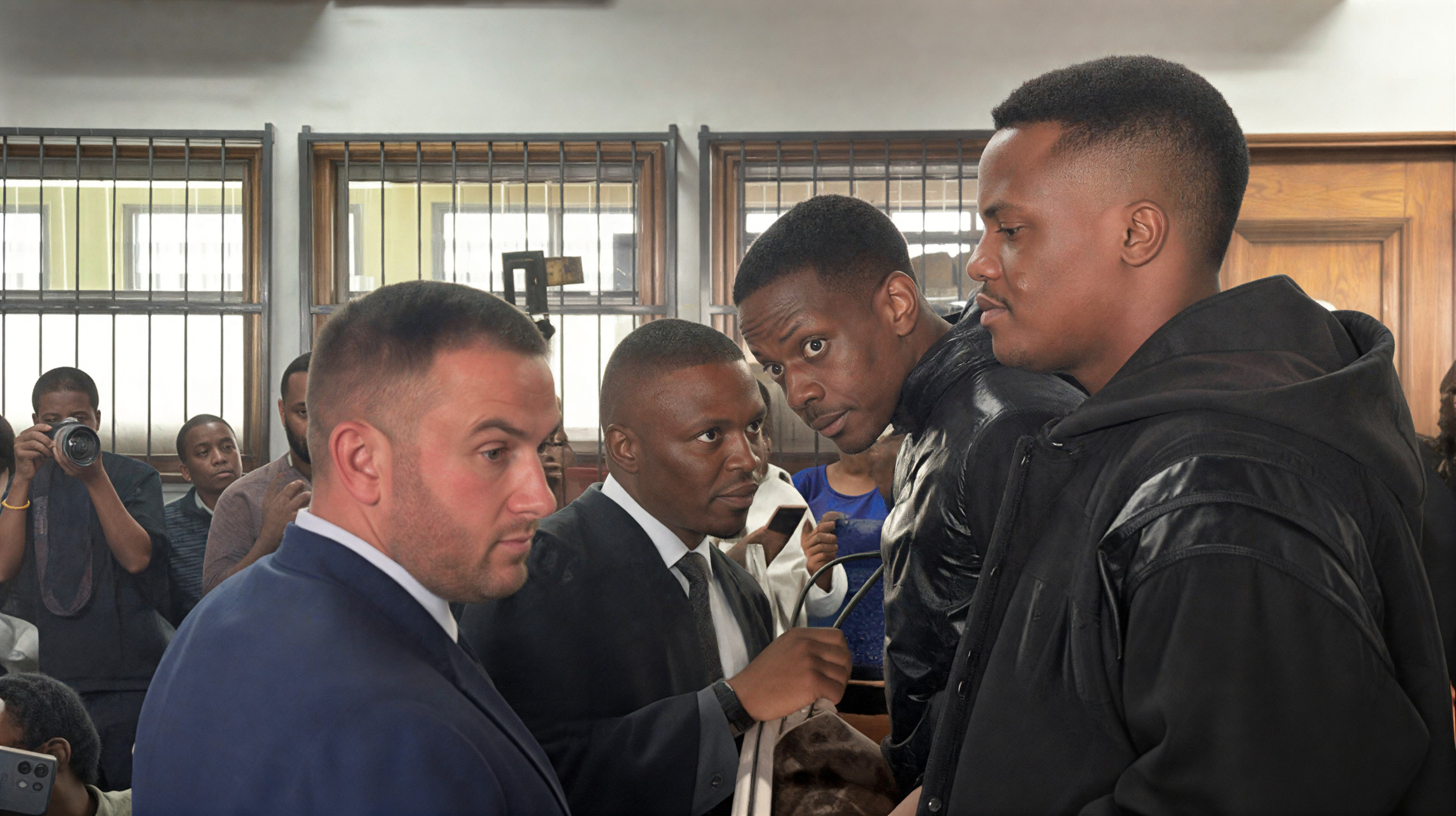
JOHANNESBURG – In a case that has gripped both South Africa and Zimbabwe, the youngest son of the late Zimbabwean president Robert Mugabe, Bellarmine Chatunga Mugabe, finds himself at the centre of a legal storm. What began as a charge of attempted murder has now escalated, with prosecutors adding more charges, including defeating the ends of justice. The state’s determination to keep the 28-year-old behind bars has shone a spotlight on the Mugabe family’s controversial history with the South African legal system, particularly the spectre of his mother, Grace Mugabe, and her own dramatic escape from justice in 2017. As Chatunga’s legal team prepares for a bail hearing, the question on everyone’s lips is whether history is about to repeat itself.
The saga began last week on Thursday when Chatunga Mugabe and a co-accused, Tobias Mugabe Matonhodze, were arrested following a shooting incident at an opulent Hyde Park residence in Johannesburg. A 23-year-old employee at the property was shot and left in a critical condition. Initially, both men faced charges of attempted murder. However, the plot thickened significantly during their appearance at the Alexandra Magistrate’s Court on Monday, 23 February 2026. The prosecution, it emerged, was not content with the initial charge.
Sources close to the investigation, speaking to IOL, revealed that additional charges were on the table: defeating the ends of justice and pointing a firearm. The crux of these new charges lies in the elusive nature of the weapon allegedly used in the shooting. Despite extensive searches, including the deployment of police units and K9 teams to the Hyde Park property, the firearm has yet to be recovered. Gauteng provincial police spokesperson Colonel Dimakatso Nevhuhulwi confirmed that the circumstances surrounding the shooting were still “a bit sketchy” and that preliminary investigations were ongoing. She also noted that cartridges were recovered at the scene, which would form a crucial part of the evidence. The failure to locate the weapon has become a central pillar of the state’s case, transforming what might have been a straightforward bail application into a complex legal battle.
For the prosecution, the missing firearm is more than just a piece of evidence; it is a strategic advantage. If the police were to find the weapon, it could potentially simplify the case, perhaps even leading to a quicker resolution. However, its absence allows the state to argue that the accused are actively obstructing justice, thereby strengthening the argument against bail. Conversely, for Chatunga’s defence, the missing firearm presents a double-edged sword. If it remains unfound, there is a possibility of a technicality leading to his release. Yet, the current legal manoeuvre by the state suggests they are determined to prevent such an outcome, using the very absence of the weapon to their advantage.
The state’s hardline stance against granting bail to Chatunga Mugabe is deeply rooted in the family’s notorious history of evading justice, particularly the high-profile incident involving his mother, Grace Mugabe, in 2017. This past event casts a long shadow over the current proceedings, with prosecutors determined not to let history repeat itself. The term “flight risk” is not merely a legal phrase in this context; it is a potent reminder of a diplomatic imbroglio that saw the former First Lady of Zimbabwe leave South Africa under controversial circumstances.
In August 2017, Grace Mugabe was accused of assaulting a young model, Gabriella Engels, at a luxury Sandton hotel. Engels sustained injuries that required medical attention, including gashes to her face and scalp. Despite the gravity of the allegations and a pending arrest warrant, Grace Mugabe was controversially granted diplomatic immunity by the South African government, allowing her to depart the country without facing charges. This decision sparked widespread outrage and a legal challenge by the Democratic Alliance (DA) and AfriForum, who argued that the immunity was unconstitutional and an abuse of power.
In July 2018, the North Gauteng High Court indeed overturned the government’s decision, ruling that the diplomatic immunity granted to Grace Mugabe was unlawful and unconstitutional. Subsequently, in December 2018, South African police issued an arrest warrant for her. This warrant remains active, meaning Grace Mugabe faces immediate arrest if she were to set foot in South Africa. This historical precedent is undoubtedly a significant factor in the prosecution’s current approach to Chatunga’s bail application, painting a clear picture of the family’s perceived propensity to circumvent legal processes.
The parallels are stark and undeniable. The Mugabe family’s perceived ability to leverage political influence to avoid legal repercussions has instilled a sense of caution, if not outright suspicion, within the South African legal establishment. The prosecution’s argument that Chatunga Mugabe poses a flight risk is therefore not an abstract legal theory but a concern grounded in recent, well-documented events. The state is acutely aware that granting bail, especially in a case involving a high-profile individual with international connections, could open the door for another “vanishing act,” a scenario they are evidently keen to prevent.
Adding another layer of complexity to the unfolding drama are concerns over Chatunga Mugabe’s health while in custody. Reports emerged that he allegedly collapsed twice in police holding cells, necessitating urgent medical attention. While the exact nature of his medical condition has not been publicly disclosed, such incidents often become a point of contention in bail applications, with defence teams arguing for release on humanitarian or health grounds. However, given the state’s unwavering resolve, it remains to be seen how this aspect will influence the court’s decision.
Amidst the legal proceedings and public scrutiny, the Mugabe family released a statement through their attorneys, Mnguni Attorneys Incorporated, expressing concern over what they termed “various information circulating in the media ‘purporting’ to represent the views or positions of the family.” The statement unequivocally denied appointing or authorising any public relations firm, media consultant, spokesperson, or other third party to speak on their behalf. It further warned that any statements made by individuals or entities claiming to represent the family were “false, unauthorised, and must be disregarded in their entirety,” reserving all rights in relation to unauthorised statements or conduct that might prejudice their interests. This move suggests an attempt by the family to control the narrative surrounding Chatunga’s arrest and to distance themselves from potentially damaging public commentary.
The implications of the missing firearm extend beyond the immediate charges. In South African law, the possession of an unlicensed firearm carries severe penalties, and if the weapon used in the shooting is indeed found to be unlicensed, it could lead to even more serious charges for Chatunga Mugabe and his co-accused. Furthermore, the inability to produce the weapon could be interpreted by the court as an attempt to conceal evidence, further bolstering the prosecution's argument against bail. The police’s continued search, involving specialised units, underscores the gravity with which the authorities are treating this aspect of the investigation. The outcome of this search, or lack thereof, will undoubtedly play a pivotal role in the trajectory of the case.
The Mugabe family, particularly the sons of the late Robert Mugabe, have long been associated with a lavish lifestyle and, at times, controversial behaviour. Reports from Sowetan’s sister publication TimesLIVE have previously described Robert Mugabe Jnr and Bellarmine as “ticking PR time bombs,” known for their extravagant parties and unruly conduct, which even led to their eviction from luxury Sandton flats. This public perception of the family’s younger generation, coupled with their mother’s past legal troubles, contributes to the narrative that the state is keen to avoid any perception of preferential treatment. The court’s decision in this case will be scrutinised not only for its legal merits but also for its symbolic message regarding equality before the law, regardless of one’s family name or political connections.
The bail hearing, now postponed until 3 March 2026, will be a critical juncture in this unfolding drama. The defence will likely argue for Chatunga’s release, possibly citing his medical condition and the presumption of innocence. They may also challenge the strength of the state’s case, particularly regarding the direct link between Chatunga and the shooting, especially if the firearm remains unfound. However, the prosecution, armed with the additional charges and the historical precedent of Grace Mugabe’s departure, will undoubtedly present a compelling argument against bail, emphasising the flight risk and the need to ensure the integrity of the judicial process. The Alexandra Magistrate’s Court faces a delicate balancing act: upholding the rights of the accused while also addressing the public’s demand for justice and preventing any perceived manipulation of the legal system.
This case is more than just a criminal proceeding; it is a test of South Africa’s legal system and its commitment to applying the law equally to all, irrespective of their lineage. The world watches as the Alexandra Magistrate Court navigates the complexities of this high-profile case, with the fate of Chatunga Mugabe, and perhaps the broader reputation of the Mugabe family, hanging in the balance.