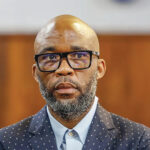
KwaZulu-Natal, South Africa – In a dramatic escalation of tensions within South Africa’s law enforcement agencies, KwaZulu-Natal Police Commissioner Lt-Gen Nhlanhla Mkhwanazi has sensationally declared that the police are “facing a war.” His startling pronouncement comes amidst intelligence reports alleging a concerted effort by the Investigating Directorate Against Corruption (IDAC) to arrest him and Lt-Gen Dumisani Khumalo within a mere 48 hours, painting a chilling picture of inter-agency conflict at the highest levels.
The extraordinary claims unfolded when Mkhwanazi rushed to the Brooklyn Police Station after receiving a call from Khumalo, who had been summoned to report there. This development, Mkhwanazi asserted, appeared to confirm intelligence he had received just the previous day, suggesting a targeted operation against senior police officials. The scene outside the police station became a focal point for media, where Mkhwanazi openly addressed the unfolding crisis.
“Well, I wanted to see for myself what was unfolding here today, simply because yesterday we received intelligence,” Mkhwanazi told reporters, his words laden with gravity. He elaborated on the nature of the intelligence: “The intelligence was that IDAC had given itself 48 hours to bring General Khumalo and me to the cells.” This revelation suggests a deeply fractured relationship between two critical arms of the state, tasked with upholding the rule of law.
Mkhwanazi admitted that he had initially dismissed the intelligence as improbable. However, his scepticism evaporated when Khumalo’s call confirmed that the alleged plot seemed to be in motion. “I thought, okay, let me come here and see if I can see it myself,” he explained, his presence at the station a clear act of solidarity and defiance. “I thought if indeed it is true, then perhaps they might also be looking for me, so I might as well be close by to make it easy.” This calculated move by the provincial commissioner underscores the seriousness with which he views the alleged threats.
The commissioner’s remarks elevate the situation far beyond a mere legal dispute, transforming it into a dramatic confrontation between powerful law-enforcement figures. Mkhwanazi explicitly suggested that police structures and IDAC are now locked in a “dangerous conflict,” a statement that will undoubtedly send ripples through the country’s security apparatus. He further revealed that the same intelligence also alleged panic within IDAC itself, over claims that warrants had been secured against IDAC leaders – a tit-for-tat scenario that speaks volumes about the depth of animosity.
However, Mkhwanazi was quick to deny that the police had secured any such warrants against IDAC officials. “We do not issue warrants of arrest. We work with prosecutors and lawyers if there is anything,” he clarified, emphasising adherence to due process. “But there is nothing. There is nothing that we are investigating that involves them.” This denial, while attempting to distance the police from similar tactics, highlights the volatile atmosphere of suspicion and counter-allegations.
Mkhwanazi recounted first hearing the claims earlier in the week from a friend in Durban, which he initially dismissed. The matter only became serious, he stated, when Khumalo reported receiving the call to report to the police station. Intriguingly, according to Mkhwanazi, both Khumalo and Maj Gen Nosipho Madondo later received calls telling them not to come anymore. “They got phone calls to come to the police station, and an hour later they got phone calls not to come because of some intervention from some senior people somewhere,” he revealed, posing a rhetorical question that cuts to the heart of the matter: “It is quite interesting. The question is: is this how justice is served?”
When pressed on whether the incident supported his earlier claims that IDAC had been weaponised against certain police officials, Mkhwanazi’s response was unequivocal and chilling: “We are facing a war. That is all I can say. We are facing a war and there are many players in this game.” This declaration suggests a deep-seated power struggle, with various factions vying for control and influence within the state’s security architecture.
Mkhwanazi also linked the current tension to previous clashes involving police work around figures like Mr Adams and Mr Matlala – referring to the attempted murder-accused businessman Vusi “Cat” Matlala and the National Coloured Congress MP Fadiel Adams. “When we arrested Mr Adams, you know what happened and how IDAC responded to that,” he said, implying a pattern of retaliatory actions. He further cited the case of Mr Matlala: “We took Mr Matlala to prison. Everyone knows. A year later, IDAC went to prison to charge him without talking to us. He is sitting in custody because of the police, but IDAC is owning him now.” Such conduct, Mkhwanazi warned, risks creating unnecessary conflict and undermining the collaborative efforts essential for effective law enforcement.
Asked if the incident could have been sparked by claims that police were on the brink of arresting at least three IDAC officials, Mkhwanazi admitted he suspected a connection. “I suspect that is because that is how the information came to us earlier in the week and was confirmed yesterday,” he stated. However, he insisted that the police would always adhere to legal protocols and professionalism if they were planning to arrest anyone in a legal structure. “We are going to follow the law and do it professionally,” he affirmed.
Despite the turmoil, Mkhwanazi vowed that the police would not be distracted from their duties. He maintained that while the police are not immune from investigation, any such process must be handled properly. “If there are things we did wrong, by all means, investigate. But it has to be executed properly,” he asserted. He also highlighted that the alleged calls made to the generals were on record and could be verified, adding another layer of intrigue to the unfolding saga.
When asked directly if IDAC was being vindictive, Mkhwanazi carefully sidestepped a direct accusation. “I would not say that,” he responded. “To me, it seems like officials were carrying out that which they were supposed to do from IDAC, but they were stopped. Who stopped them and why were they stopped?” This pointed question leaves a significant void, hinting at powerful, unseen hands influencing the course of justice. He concluded by urging South Africans not to forget his previous public warnings about the “players” involved in these complex power dynamics. “I have presented a sketch that has got some players in the game,” he reminded the public. “I want South Africans not to forget that sketch – that there are players everywhere.” The implications of this internal “war” for the country’s fight against crime and corruption remain profoundly uncertain.