

Durban’s anti-immigration protests have turned deadly after a Ugandan national was allegedly assaulted and stabbed during a march, while police arrested people in connection with attacks on foreign nationals and public violence.
The fatal assault is the first reported death linked to the latest protests, which have involved incidents of intimidation, looting, property damage and violence in parts of the city.
KwaZulu-Natal police spokesperson Colonel Robert Netshiunda said a group of people was marching along Dr Pixley kaSeme Street, formerly West Street, towards Maud Mfusi Street on Thursday when two men allegedly broke away from the group and approached a man on the roadside.
“Two men reportedly pulled off from the group and approached a man who was on the roadside. It is further alleged that the victim was then assaulted by a group of people,” he said.
The victim was allegedly assaulted and stabbed. Police have not released his identity or detailed the evidence linking any particular person to his death.
Five held for questioning
Police in KwaZulu-Natal detained five men, aged between 19 and 46, during protests outside the Home Affairs offices on Che Guevara Road in Umbilo on Friday.
Netshiunda said the men were persons of interest in investigations into the murder, attempted murder and assault of foreign nationals.
“Information at hand at this stage suggests that the five persons can assist police in solving cases in which a foreign national was assaulted on Wednesday, another was assaulted to death on Thursday morning, as well as a case of assault with intent to inflict grievous bodily harm where two foreign nationals were allegedly assaulted by a group of people who were marching in Berea, also on Thursday morning,” Netshiunda said.
Being detained as a person of interest does not mean that a suspect has been charged or that guilt has been established. Police will still need to investigate the allegations and place sufficient evidence before prosecutors.
Three Ethiopian men appear in court
Three Ethiopian nationals appeared in the Durban Magistrate’s Court in connection with an alleged assault during the protests.
Kebede Belachew, 38, Getachew Tirikaso and Wodaje Girma, 29, face charges of attempted murder and public violence arising from an incident on Thursday.
The supplied court information gives inconsistent details about Getachew Tirikaso’s age. He was described as 48 in one account and 55 in another. His age should therefore be confirmed through the court record before publication of a final version.
Girma described Durban as tense during his bail proceedings. He told the court that he had been attacked on Dr Pixley kaSeme Street during protests on 8 October.
Prosecutor Zakhele Nzuza said the men were accused of attacking a man who had been walking along the road while looking for a shop to repair his cellphone.
The prosecutor said the victim was allegedly assaulted until he fell unconscious. The assault was allegedly committed in the presence of police officers who were nearby monitoring the protests.
Nzuza also told the court that 14 cars were later set alight and about a dozen shops were damaged during a subsequent protest on Dr Pixley kaSeme Street.
He said Home Affairs officials could not find a record for Girma in the department’s system. That information needed to be verified before the court could make a decision on bail.
The case was therefore subject to further verification and court proceedings. The accused remain presumed innocent and the charges have not been proven.
Protest movement’s campaign
The protests were associated with the March and March Movement, which had warned foreign nationals living in South Africa, particularly people from neighbouring African countries, to leave the country by 30 September.
The movement’s campaign focused on undocumented immigration and alleged pressure on public services and employment. Its supporters also accused foreign nationals of using constitutional protections to remain in South Africa.
The accusations are broad and do not establish that individual foreign nationals have acted unlawfully. Immigration status and criminal conduct are separate issues that must be determined through the relevant legal processes.
In Durban, refugees and asylum seekers had gathered at Sherwood Park in Sydenham and outside the Home Affairs Durban Refugee Reception Centre on Che Guevara Road while seeking assistance with documentation and immigration matters.
More than 400 documented refugees reportedly began living outside the reception centre from 22 May. The protest movement later shifted its focus from the Point area to the reception centre, where clashes between protesters and asylum seekers continued for months.
The refugees were from the Democratic Republic of Congo, Burundi, Uganda, Mozambique and Tanzania. They were transported by bus to the Lindela Repatriation Centre in Gauteng in September, according to the supplied account.
March and March and other anti-immigration groups then made the reception centre a base of their activities and prevented people from entering, according to the report.
Visa centre attacked
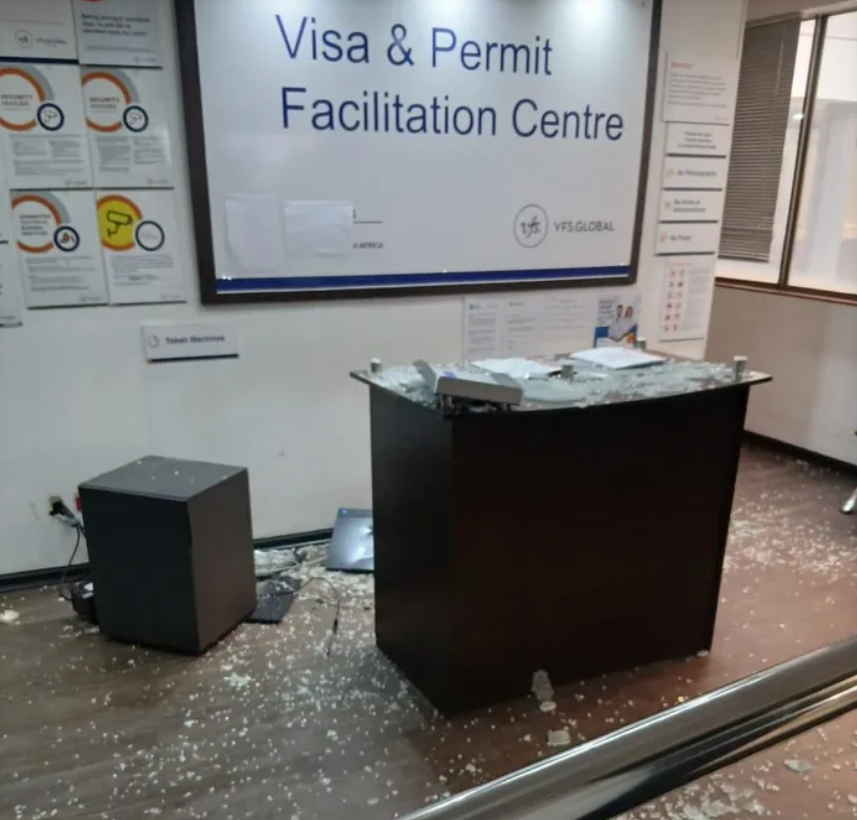
On Thursday, protesters also attacked the VFS Global Home Affairs Visa Application Centre on Linden Road in Berea.
Netshiunda said Berea police were investigating an incident in which a building near Problem Mkhize Road was allegedly broken into and ransacked by a group of people who were marching that day.
“Police's efforts to identify the culprits are underway,” he said.
The attack affected a facility used by people applying for visas and related documentation. Police had not announced arrests in connection with the alleged break-in and ransacking at the latest update.
In Durban’s central business district, about 80% of shops were reportedly closed. Some businesses operated behind half-closed shutters while workers watched the streets for signs of further unrest.
The closures and damage have affected business owners, employees, commuters and residents regardless of their nationality.
Earlier arrests and bail
After 10 October, 19 people who were allegedly involved in public violence appeared in the Durban Magistrate’s Court and were released on bail of R1,500.
Members of the March and March Movement, including Wandile “Method” Nsibande, Sphelele “Magolide” Shinga and Malizo Dzanibe, were also charged with incitement to commit public violence, public violence and acting in a riotous or physically threatening manner.
The charges remain before court and have not been proven.
Nsibande was reportedly on parole when the alleged offences occurred. He had previously been sentenced to 25 years’ imprisonment in 2009 after pleading guilty to robbery with aggravating circumstances and kidnapping.
The sentence followed an incident involving teacher Kavisha Seevnarain, who was hijacked by four armed men in Durban, had money withdrawn from her accounts and was then thrown from a 60-metre-high bridge on the N2 highway. She survived but suffered serious injuries.
Nsibande, who was 20 at the time, pleaded guilty to the charges. He was released on parole on 15 April 2022 and was expected to remain under correctional supervision until 2034.
His parole status may be relevant to the court’s consideration of the newer allegations, but it does not by itself prove that he committed the alleged offences.
Deportation figures and public debate
In July 2026, the South African government reported that 53,449 foreign nationals had been processed for deportation and repatriation.
The majority were Malawian nationals, followed by Zimbabwean and Mozambican nationals. Repatriations beyond the Southern African Development Community included 431 people returned to Kenya, 1,159 to Nigeria, 86 to the Democratic Republic of Congo and 939 to Uganda.
The figures have contributed to wider debate about immigration enforcement, documentation backlogs and the capacity of the Home Affairs system.
However, government deportation figures do not justify attacks on foreign nationals or property. Alleged criminal conduct must be investigated and prosecuted through the courts, while immigration matters must be handled through lawful administrative processes.
Taxi and community safety concerns
The latest protests have raised concerns about the safety of foreign nationals, commuters, business owners, police officers and residents in affected areas.
The reported death of the Ugandan man has intensified calls for accountability. Police must still establish the circumstances of the assault, identify those responsible and determine whether the killing was directly connected to the march.
The attempted-murder case involving the three Ethiopian men must likewise be decided on the evidence presented in court. The VFS attack, property damage and alleged looting require separate investigations unless police establish a common plan or group of perpetrators.
At the latest update, five people had been detained for questioning, three Ethiopian men faced attempted-murder and public-violence charges, and 19 people previously released on bail remained before court on public-violence-related charges.
The protests have now moved beyond an immigration debate and into a criminal-justice crisis, with one man dead, several people injured and businesses damaged. Police and prosecutors will have to establish individual responsibility while authorities address the underlying immigration and documentation disputes through lawful channels.