

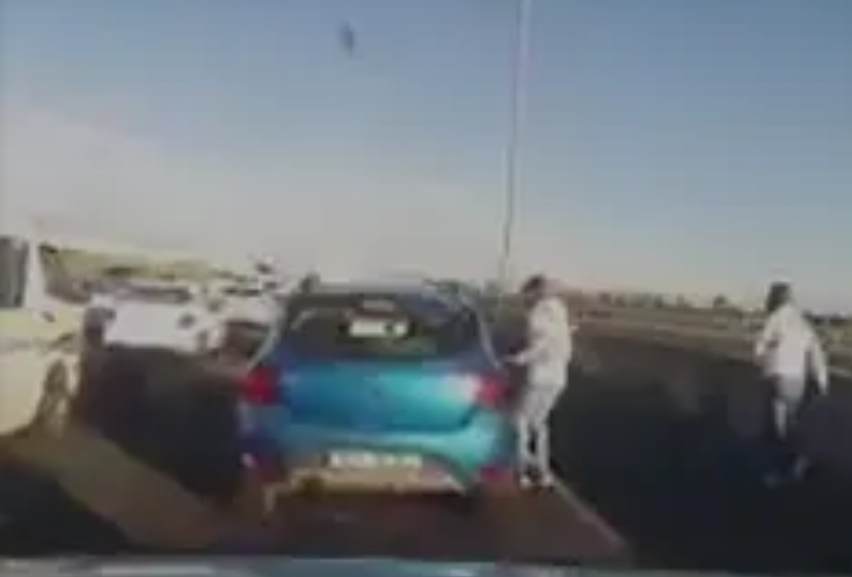
A dashcam recording of two men attacking a motorist near the Borcherds Quarry turn-off has renewed debate over Cape Town’s planned R114 million safety project along the N2.
The incident happened on Wednesday, 14 October 2026, when two men were seen crossing the barrier in the middle of the highway before approaching a blue Renault Sandero. One of the men allegedly smashed the driver’s-side window with a projectile, reached into the vehicle and grabbed belongings after a brief struggle with the motorist.
The driver of the vehicle fitted with the dashcam then accelerated towards the two men. They ran away from the car and disappeared from the immediate area.
The footage has drawn attention to the risks faced by motorists travelling along the section of the N2 commonly known as the “Hell Run”. Western Cape police had not confirmed by the time of publication whether a case had been opened in connection with the incident. It was also not immediately clear whether the motorist or any passengers were injured, or how much property was taken.
The attack happened on the same day that mayoral candidates debated the City of Cape Town’s proposed N2 Edge Safety Project at a local government election debate in Cape Town. The project, which has been allocated R114 million, is intended to improve safety along about 9km of the N2.
The City says the work will include repairs and reinforcements to safety barriers, improved lighting, new pedestrian crossings and better access control. It has also said the project aims to reduce pedestrian deaths, limit uncontrolled access to the highway and improve safety for motorists and communities living alongside the route.
Support for the wall
Freedom Front Plus councillor Emre Uygun, who supports the proposed wall, said his party was angered by the latest attack.
“These attacks are a recurring problem,” he said.
Uygun said smash-and-grab attacks were often carried out when motorists were trapped in slow-moving or stationary traffic.
“They are often well coordinated and deliberately timed to exploit motorists trapped in peak-hour traffic.”
He said the latest incident showed that motorists remained vulnerable on the N2.
“The latest incident is another reminder that the N2 remains a dangerous stretch of road where motorists continue to be robbed, injured and left severely traumatised.”
Uygun said there was evidence of suspects using informal settlements near the highway as escape routes after attacking motorists.
“We have photographic and documented evidence of how smash-and-grab perpetrators routinely flee into the informal settlements after attacking motorists.”
He said the City, Nyanga police and drone operators had already been working together to respond to attacks along the route.
“The City’s resources, together with Nyanga SAPS and drone operations, have been deployed to address the problem, and arrests have been made through these operations.”
Uygun said the planned structure would make it harder for suspects to reach the highway and escape after attacks.
“A properly constructed wall would close that escape route.”
“The wall is the most immediate and practical step available right now to protect motorists,” he said.
City defends safety project
DA deputy mayor Eddie Andrews also defended the proposed wall. He said the project was not only about protecting motorists from smash-and-grab attacks, but would also improve pedestrian safety and conditions for people living and working near the N2.
The City has said the project will include better lighting and controlled access points for residents who need to reach nearby industrial areas. Andrews also raised concerns about road accidents involving vehicles and children who may be playing near the highway.
The City’s official project description says the work will include safer pedestrian crossings, improved lighting and access control, safety barriers near recreational spaces, and measures to reduce illegal dumping.
Cape Town Mayor Geordin Hill-Lewis has also linked the project to expanded highway patrols. The City says more than 40 Metro Police officers have been deployed to the N2, with support from CCTV cameras, automatic number-plate recognition and digital systems intended to improve response times.
The latest dashcam footage has, however, also highlighted the limits of relying on a wall or other infrastructure to deal with organised and opportunistic crime.
Calls for more policing
Build One South Africa Cape Town mayoral candidate Roger Solomons said the attack reflected a wider failure to keep motorists safe.
“Every smash-and-grab is a failure of public safety. Motorists have a right to travel without fear,” he said.
Solomons said the City should focus on preventing attacks and ensuring that offenders were arrested.
“The City must focus on measures that prevent crime and apprehend offenders, rather than relying on infrastructure alone.”
Asked whether he believed the wall was a valid solution, Solomons said it could not be treated as a complete answer to the problem.
“No single intervention can solve crime.”
He added: “The Acting Police Minister has confirmed that infrastructure cannot replace core policing functions.”
Solomons rejected the suggestion that opposing the wall meant accepting continued attacks on motorists.
“Motorists are already exposed to crime. Opposing the wall does not mean opposing action. It means demanding action that works.”
The argument over the N2 project has been growing since the City announced its plans. Supporters say a physical barrier would restrict access to the highway, reduce escape routes and make it more difficult for criminals to approach vehicles during traffic congestion.
Opponents argue that a wall alone cannot replace visible policing, proper investigations, rapid-response teams and prosecutions. They have also questioned whether public money should be spent on major infrastructure when police resources and crime-prevention operations remain under pressure.
The Wednesday attack has added fresh urgency to the debate. The footage appears to show how quickly an ordinary journey can turn into a robbery, with the attackers moving from the roadside barrier to the vehicle within seconds.
For motorists, the incident is another reminder to remain alert when travelling through areas where traffic slows or comes to a standstill. Police have not yet confirmed whether arrests have been made or whether the suspects seen in the footage have been identified.
If a case is registered, the investigation will need to determine what was taken, whether other motorists witnessed the attack and whether similar incidents have been linked to the same area.
In the meantime, political parties remain divided over whether the R114 million N2 Edge Safety Project will provide the protection motorists need. What is not in dispute is that the latest attack has once again placed the N2’s security problems in full view.