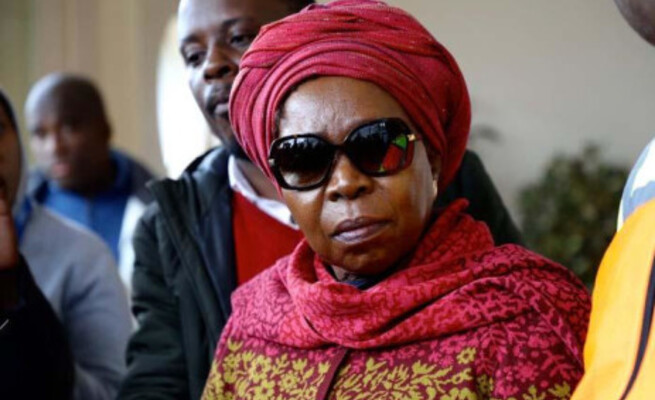
ANC national executive committee member Nkosazana Dlamini-Zuma has refused to retract vote-buying allegations she made against the party’s secretary-general, Fikile Mbalula, and has taken her dispute into the courts—standing by the substance of her claims and challenging Mbalula to prove her wrong under oath.
Dlamini-Zuma has filed court papers in which she reiterates that Mbalula distributed money to delegates at the ANC’s 2022 conference, alleging that half a billion rand was found in a room and later distributed at a clinic. She has also indicated that she intends to contest every aspect of Mbalula’s application, including questions of urgency, a move that could force Mbalula into prolonged litigation rather than swift court relief.
The Cabinet veteran’s stance is set against Mbalula’s demands for an unconditional apology, a retraction across her media platforms, and an interdict preventing her from making similar statements, alongside damages. In her filings, Dlamini-Zuma makes clear she has not stepped back.
The matter was filed at the Gauteng High Court in Johannesburg on 4 September 2026, according to the papers.
What Dlamini-Zuma alleges about the 2022 conference
Dlamini-Zuma has maintained her claim that during the 2022 ANC conference at Nasrec, money was discovered on the first morning—specifically, that “half a billion rand” in cash was found in someone’s room and then distributed at the conference medical clinic.
She alleges that Mbalula was directly involved in handing out the money at the clinic.
In court papers, and as reflected in a transcript annexed to Mbalula’s application, Dlamini-Zuma’s position is that the money was intended to serve a dual purpose: securing Mbalula’s election as ANC secretary-general and ensuring President Cyril Ramaphosa’s re-election as ANC president.
When she was asked why she did not take the concerns to the party’s integrity commission, she said the vote-buying was not a secret.
“If you ask anyone who worked at the clinic at the time, they’ll tell you,” she said.
She also said the matter had been widely reported in the media, and suggested there was therefore no need for confidential internal processes where—according to her—information was already in the public domain.
Dlamini-Zuma challenges Mbalula to prove her wrong under oath
Instead of retracting or apologising, Dlamini-Zuma filed an answering affidavit that effectively sets a challenge to Mbalula: if he wants to silence her and put paid to her claim, he should prove her wrong under oath.
Her stance comes after Mbalula moved to court demanding immediate correction of the allegations he said were damaging to him.
In her answering affidavit, Dlamini-Zuma tells Mbalula that he should prove her wrong under oath if he wanted to end her claims.
The approach signals a wider battle over credibility and evidentiary readiness rather than a simple dispute about whether the statements should be withdrawn.
The podcast that sparked the legal action
The controversy dates back to statements Dlamini-Zuma made on the African Renaissance Podcast, hosted by former EFF MP Mbuyiseni Ndlozi, on 3 August 2026.
After those comments, Mbalula went to court seeking an unconditional apology within 24 hours and a retraction on all of Dlamini-Zuma’s media platforms. He also asked the court for an interdict to prevent her from making similar statements and for damages.
At this stage, Mbalula has not obtained the relief he sought, at least according to what is set out in the subsequent court papers now before the court.
Dlamini-Zuma’s response includes a notice of opposition and an answering affidavit that indicates she will contest every aspect of Mbalula’s case. Her filings also include a procedural move—raising the question of whether the matter qualifies as urgent—potentially shifting the dispute away from a fast-track outcome.
A defiance strategy aimed at slowing the pace of Mbalula’s case
The court papers indicate Dlamini-Zuma wants the matter determined on the merits, with particular attention to Mbalula’s urgency application.
By reserving the right to challenge whether the case meets the threshold for urgency, she is effectively arguing that Mbalula should not get swift relief. The procedural approach, if successful, could lead to a longer process—meaning the court fight could take months rather than days.
Her position, as reflected in the answering affidavit, is that the allegations were not defamatory because they were true—and that the underlying information was public.
She argues the vote-buying was public knowledge, already reported in the media, and allegedly witnessed by clinic staff and conference attendees. She says her statements were therefore not an attempt to invent allegations behind closed doors, but a claim about events she says others were already aware of.
“Anyone who worked at the clinic”: Dlamini-Zuma’s evidence line
Dlamini-Zuma’s defence strategy rests heavily on her confidence that proof exists to support specific details she has given.
In her papers, she points to potential witnesses—specifically “anyone who worked at the clinic” during the conference—and indicates that the evidence can substantiate both central claims: that “half a billion rand was found in somebody’s room” on the first morning of the conference, and that Mbalula was “dishing out money at the clinic” to secure his election as secretary-general.
She also references media reports and continues to stand by the amount and the location where the cash was allegedly found.
In essence, her strategy is not to dismiss the dispute as a political smear, but to insist that the factual content can be tested through evidence and testimony.
Mbalula denies the claims; he calls them spurious
Mbalula, in his application, denies the allegations. He characterises the claims as “spurious, defamatory, malicious and reckless”.
He argues the statements are false, made without basis, and designed to expose him to public hatred and contempt.
But the thrust of Dlamini-Zuma’s opposing papers is that she believes the proof exists and is ready to be produced, at least in principle, through testimony and corroboration.
Extending the issue beyond Mbalula: the Ramaphosa factor and CR17
A key feature of Dlamini-Zuma’s position is the linkage she makes between the 2022 conference vote-buying and the president’s political trajectory.
In both her podcast statements and her court papers, she alleges that the money used in 2022 was intended not only to secure Mbalula’s role but also to ensure Ramaphosa’s re-election as ANC president.
She links this to the CR17 campaign—associated with Ramaphosa’s 2017 bid that propelled him into his first term as ANC and national president. Dlamini-Zuma, who ran against Ramaphosa in that period, frames the dispute as connected to how political power was allegedly secured through similar methods.
This is one of the reasons her argument is more than a personal attack dispute: it potentially broadens the context of the case into a wider question about the legitimacy of the current ANC leadership.
From defamation claim to leadership legitimacy dispute
With these allegations, what begins as a clash between two senior party figures takes on a larger political dimension.
Dlamini-Zuma’s filings suggest she sees the matter as an evidentiary challenge that could implicate a broader political narrative about how power is acquired within the ANC—especially under leadership that she claims was also supported through campaign dynamics such as those linked to CR17.
As the court fight continues, the case will likely turn on whether Dlamini-Zuma can substantiate her allegations with credible evidence, and whether the procedural questions—such as whether Mbalula can demand urgent relief—limit what can be decided quickly.
For now, Dlamini-Zuma has made her position clear: she refuses to retract, refuses to apologise, and is challenging the secretary-general to disprove her claims under oath.