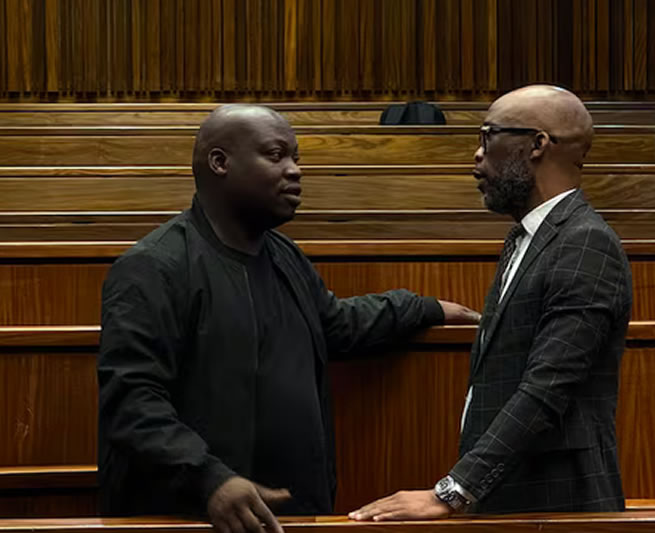
An officer who was present when Musa Kekana — a co-accused of Vusimusi “Cat” Matlala — was arrested for the murder of Vereeniging engineer Armand Swart, has given evidence virtually in the Johannesburg high court.
Sgt Mayisela Ledwaba told the court about the events of that day in April 2024 as the trial-within-a-trial continues in the case against Matlala and four others, who are each facing serious allegations connected to alleged underworld activity.
Kekana is challenging whether evidence obtained after his arrest can be admitted in the current matter. In his version of events, police assaulted him and failed to properly explain his constitutional rights. The state, however, maintains that the information gathered following his arrest should be usable in the trial currently before the court.
At the centre of the proceedings is a narrower question: whether information recovered after Kekana’s arrest for Swart’s murder can be relied on in the case against Matlala and co-accused. The outcome of the trial-within-a-trial will determine what can be put to the trial court as part of the prosecution’s case.
Kekana, Matlala, Matlala’s wife Tsakane, Kekana’s daughter Nthabiseng Nzama, and Floyd Mabusela face 25 charges, including attempted murder. The charges relate to high-profile plots allegedly targeting Matlala’s former partner, actress Tebogo Thobejane, taxi boss Joe “Ferrari” Sibanyoni and music producer Seunkie “DJ Vettys” Mokubung.
As evidence is tested, the court is also scrutinising the defence’s broader claim that key police actions surrounding the arrest and transport of Kekana were unlawful or improperly documented — a claim that, if accepted, could strip the prosecution of critical material.
AVL records under scrutiny: was Kekana transported in a Fortuner or a Golf?
One of the most significant disputes raised in court concerns automated vehicle location (AVL) records and the defence’s challenge to the police version of events around Kekana’s arrest and transportation.
According to the issues led into evidence, the question boils down to which vehicle was used to transport Kekana after his arrest on April 17 2024. Kekana claims that he was handcuffed and placed in the boot of a Toyota Fortuner. The police version, as presented through Ledwaba, is that Kekana was transported in a Golf 7.
Ledwaba told the court that police left 8th Road within minutes of arriving, and that Kekana was transported in a Golf 7. She also denied allegations that police fired warning shots when they arrived at the scene. The defence’s approach, now, is to examine Ledwaba’s account alongside vehicle-tracking data to test whether the narrative offered by the state aligns with what the records show.
When the vehicles arrived and left: records show a limited window
As part of the continuing examination, the court heard that the AVL report indicates police vehicles arrived before 9am on the day of Kekana’s arrest. The records, however, show that the vehicles only left the area shortly after midday.
This timing matters for the trial-within-a-trial because it provides a competing timeline to what the defence claims are inconsistencies in the police narrative — particularly concerning the manner of transport, duration of activity at the scene, and the sequence of events following Kekana’s arrest.
Cross-examination turns to witness conduct and alleged irregularities
The dispute over vehicles did not exist in isolation. During cross-examination, Matlala’s lawyer, Annelene van den Heever, pressed Ledwaba on her account and raised questions about the state’s handling of witness statements.
Van den Heever accused Ledwaba of protecting Capt Phimi Sekgobela, another state witness. She questioned why Sekgobela had contacted Ledwaba to draft a late statement, describing the circumstances as highly irregular and suspicious.
Van den Heever also suggested that Ledwaba had been brought into the trial-within-a-trial at a late stage to cover for Sekgobela and corroborate his version. Ledwaba denied this. She said that Sekgobela was simply passing on an instruction from the prosecutor.
The exchange highlighted the central tension in the proceedings: whether the defence can persuade the court that the state’s evidence is not only inconsistent, but also was shaped in a way that undermines its reliability and the fairness of the process.
A trial-within-a-trial built on contradictions
As the matter unfolds, the court is being asked to decide more than a simple disagreement about a vehicle. The defence is effectively arguing that the accounts given by police officers cannot both be true, and that the AVL records and witness testimony do not align.
That, in turn, feeds into Kekana’s constitutional challenge to the admissibility of evidence obtained after his arrest. If the court finds that evidence was gathered unlawfully or that procedure was violated, it could restrict what the prosecution can rely on when presenting the wider case.
With multiple charges and alleged plots spanning prominent figures in entertainment and transport circles, the stakes are high. For Matlala’s group, the trial-within-a-trial may determine whether key evidence survives the challenge — and whether the state can present its narrative with the credibility it needs to secure convictions on the many counts laid before the court.
As the defence continues probing vehicle records and timing, and the state answers with witness testimony, the hearing remains at the heart of a case that has drawn extensive attention.