

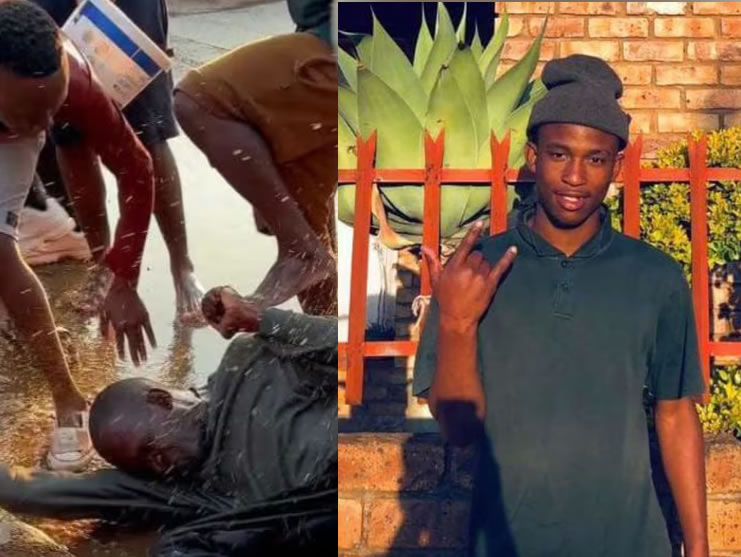
Man stabs young neighbour to death after being drenched with water
Spring Day tradition that had long been associated with children playing in the streets ended in tragedy when 21-year-old Tshepang Nyathi was stabbed during an argument over water near Cullinan, east of Pretoria.
Tshepang was killed in Refilwe on Tuesday, September 1, after a confrontation with a 53-year-old neighbour who allegedly accused him of splashing him with water.
The older man has been arrested and was expected to appear in court on Thursday on a charge of murder.
For Tshepang’s family, the death has been difficult to understand because it happened on a day that was meant to be filled with fun and celebration.
His aunt, Monino Nyathi, said the family was struggling to come to terms with the circumstances surrounding his death.
She said children in the community had enjoyed the water-splashing tradition for years, but that adults had increasingly become involved in confrontations connected to it.
Tshepang’s death has now placed the spotlight on the risks created when a playful activity spills into the paths of motorists, workers and people who do not want to take part.
Family Finds Tshepang Bleeding
Nyathi said she rushed to the scene after hearing that her nephew had been stabbed.
When she arrived, she found Tshepang bleeding on the floor and still breathing. He had suffered a stab wound to the chest.
“There was lots of blood and we battled to find an ambulance over the phone,” she said.
A passing car eventually took Tshepang to Refilwe Clinic. However, he was declared dead by a doctor after arriving at the facility.
Nyathi said she could not understand how an argument over water could have escalated into the death of a young man.
She also said that children she spoke to after the stabbing told her Tshepang may not have been the person who splashed the neighbour.
“Even when I went to ask the other kids to find out what really happened, they said it was actually not Tshepang who splashed the neighbour with water. I am still puzzled at how he could grab a knife and stab a child in the heart, leaving him dead over a water game,” she said.
Her comments reflect the family’s account of what happened before the stabbing. The full circumstances will have to be established through the police investigation and court proceedings.
The family is also waiting for answers about the moments leading up to the confrontation, including who was involved, what was said and how the knife was allegedly produced.
Suspect Arrested After Alleged Escape
SAPS spokesperson Colonel Dimakatso Nevhuhulwi confirmed that the 53-year-old suspect had been arrested.
According to police, the man attempted to flee after the stabbing, but community members caught him a short distance away.
Nevhuhulwi said the suspect was assaulted before police arrived. He was taken to a local clinic for medical attention and later placed under arrest.
“Members of the community apprehended the suspect a short distance away and he was assaulted before police arrived. The 21-year-old victim was unfortunately declared dead. The suspect was taken to a local clinic for medical attention and was subsequently placed under arrest,” she said.
Police have not released the suspect’s name.
The arrest means the matter will now move into the court process, where the State is expected to present its allegations and the accused will have an opportunity to respond.
The murder charge relates to Tshepang’s death. Police have not indicated whether additional charges will be added in connection with the alleged assault by community members.
It is also not clear whether the suspect remained in hospital overnight or when he was discharged into police custody.
Spring Day Celebration Changes

Spring Day is celebrated in South Africa on September 1. In many communities, children mark the day by carrying water and splashing their friends.
The activity is often carried out in groups and can involve children throwing water at pedestrians, passing vehicles and delivery riders.
In recent years, some of these celebrations have created tension when motorists or members of the public are unexpectedly drenched.
Videos shared online showed children splashing cars and delivery bikes. Some vehicles appeared to move suddenly as drivers tried to avoid the water.
Other footage appeared to show children attempting to take items from vehicles, while delivery riders were seen losing their balance as they tried to avoid groups of children.
The videos sparked concern about road safety and whether the tradition was becoming dangerous in some areas.
For community leader Mpho Sehalahala, the Refilwe stabbing was a warning about the need for adults to avoid turning a children’s activity into a confrontation.
She said Spring Day had traditionally been enjoyed by children and young people among their peers, rather than becoming a source of conflict between adults and children.
“This is quite unfortunate, really. You can’t discourage a community when they come out in their numbers to play. You can’t tell them what to do,” she said.
Sehalahala said the incident should also remind people to control their tempers, regardless of the circumstances.
The community leader’s comments underline the tension between preserving a popular tradition and ensuring that it does not put people in danger.
Buses Damaged In Tshwane
The Refilwe stabbing was not the only serious incident reported during this year’s Spring Day celebrations.
Two Tshwane Bus Service buses were damaged in separate incidents in Lotus Gardens and Danville.
City of Tshwane spokesperson Lindela Mashego said a group allegedly blocked a road in Lotus Gardens at about 16:50, verbally abused a bus driver and demanded that the doors be opened.
Some members of the group then climbed onto the roof of the bus, causing damage to the vehicle.
“In a separate incident at about 5.10pm in Danville, a group allegedly poured water on bus number 1111 and threw buckets at the vehicle. A stone was also thrown at the bus, shattering one of its side windows,” he explained.
The city condemned the conduct and warned that such behaviour placed passengers, drivers and other road users at risk.
The incidents raised concerns about the effect of water-splashing crowds on public transport. Bus drivers cannot always change direction quickly, and passengers may be put at risk if a vehicle is blocked or attacked.
A stone striking a bus window also creates the possibility of injuries to passengers and the driver.
The city has not suggested that the bus incidents were directly linked to the Refilwe stabbing. They formed part of a wider pattern of disruption reported during the celebrations.
A Tradition Under Pressure
The water-splashing tradition has become more difficult to manage as celebrations have expanded beyond children playing with one another.
When water is thrown at a moving vehicle, a driver may struggle to see the road. A motorist could brake suddenly, swerve or collide with another vehicle or pedestrian.
Delivery riders face similar dangers because water can affect visibility, balance and control of a motorcycle or bicycle.
The involvement of adults has also created the risk of confrontations that are very different from the original children’s game.
In Tshepang’s case, the allegation is that a dispute over splashing water ended with a fatal knife attack.
His family is now left grieving while investigators work to establish exactly what happened.
The aunt said the family could not accept that a young life had ended over an activity that was supposed to bring enjoyment.
The children who witnessed the events may hold important information about the confrontation. Their accounts could help determine who splashed the neighbour, how the argument developed and what happened immediately before Tshepang was stabbed.
Police will also need to collect statements from adults who were at the scene, establish the route taken by the suspect after the stabbing and examine any available video footage.
The knife allegedly used in the attack may also form part of the investigation.
Court Appearance Awaited
The suspect was expected to appear in court on Thursday on a murder charge.
The first appearance is likely to deal with the formal reading of the charge, the accused’s legal representation and possible bail arrangements.
The State may oppose bail, depending on the circumstances of the case and the evidence gathered so far.
The court will also record the identity of the accused and set a date for the next stage of the proceedings.
Tshepang’s family is expected to continue with funeral arrangements while waiting for the legal process to unfold.
The incident has left the Refilwe community confronting the consequences of a confrontation that began with water and ended with a young man’s death.
It has also raised a wider question about how Spring Day celebrations can continue without endangering children, passengers, motorists, delivery workers or residents.
For now, police are investigating a murder, one man is in custody and a family is mourning Tshepang Nyathi.
The celebration that was meant to welcome spring has instead left the community asking how a moment of play became a fatal dispute.