

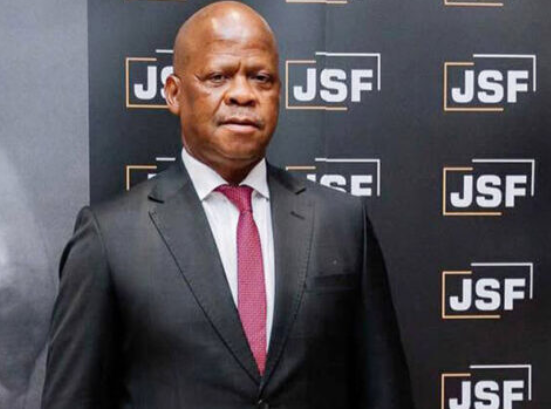
Taxi boss Joe “Ferrari” Sibanyoni has denied being a member of the alleged Big 5 cartel and told the Madlanga Commission that the late Jothan “Mswazi” Msibi allegedly worked with Vusimusi “Cat” Matlala in a plot to have him killed.
Sibanyoni gave evidence on Friday as the commission examined allegations of taxi violence, criminal networks and political interference in policing.
He said Msibi, who was allegedly regarded as a leader of the Big 5 cartel, had identified him as the last obstacle to Matlala taking over his position in the taxi industry.
Sibanyoni declined to give evidence about the failed August 2022 attempt on his life. He said he was exercising his constitutional right not to be compelled to give self-incriminating evidence.
However, he told the commission that Msibi had allegedly communicated to Matlala that he was his “only remaining threat”.
“Mr Msibi did not merely harbour ill-will toward me. He did not merely wish me harm in some abstract sense. He communicated to a specific individual – a man with access to weapons and to a criminal network – that I, Madoda Johannes Sibanyoni, was the obstacle that stood between that individual and the inheritance of Mr Msibi’s position of leadership within the taxi business,” he said.
“The inducement was explicit: eliminate me, and Matlala would receive the prize. This was a directed, incentivised assassination commission. A named commissioner. A named hitman. A named target. A specified reward. That is not general taxi industry violence. That is a murder contract.”
Sibanyoni said the alleged attempt by Matlala, who is standing trial in the Gauteng High Court in Johannesburg, was the result of a campaign against him after his relationship with Msibi broke down.
He described the alleged attack as “the culmination of a deliberate and escalating campaign directed against me following the breakdown of my relationship with the late Mr Msibi”.
The claims made in Sibanyoni’s testimony remain allegations. Msibi died in early 2024, while Matlala is before the court in a separate criminal case.
Relationship With Msibi Collapses
Sibanyoni said he had previously left the taxi industry for two years after the first attempt on his life in 2006. He later returned and built what he described as a working relationship and friendship with Msibi, despite believing that Msibi had earlier wanted him dead.
He said the relationship lasted for more than two decades and was based on an agreement that Msibi would retire when he turned 60 and allow Sibanyoni to take over the leadership of the Gauteng taxi industry.
According to Sibanyoni, the agreement ended when Msibi changed his position.
“His words, as I clearly recall them, were to the effect that ‘this is taxi business, we die working’. I received those words not merely as a change of plans. They were spoken by a man who had, years earlier, already sent people to kill me. In that context, ‘we die working’ was not simply an expression of commitment to the industry,” he said.
“It communicated, with unmistakable implication, a changed disposition toward me: that the agreed-upon terms of our coexistence were being unilaterally revoked and that the protection I had understood to exist within the framework of our mutual agreement could no longer be assumed. I received those words as a communication of renewed and escalating danger.”
The following year, Sibanyoni said he used the Covid-19 lockdown as a reason to distance himself from Msibi. He said Msibi had already removed him from his responsibilities as second-in-command.
“Mr Msibi became aware of my deliberate withdrawal and confronted me directly. He telephoned me, questioned why I was avoiding contact, demanded to know why I was not taking his calls and challenged me to explain the distance. I did not equivocate. I told Mr Msibi plainly that I saw no reason to continue the relationship and requested him to cease contact,” he testified.
Sibanyoni said he later confronted Msibi about the 2006 shooting, during which he was injured. He said Msibi did not deny the accusation but told him to remove his taxis from the rank.
“That instruction was, in effect, the formal and final severance of a professional and personal relationship spanning more than two decades. From that moment, the relationship was over,” he said.
Claims About The Farm
After the relationship ended, Sibanyoni alleged that Msibi turned to Matlala for security services and surrounded himself with people known in the taxi industry as izinkabi, a term used in isiZulu to refer to hitmen.
“Among those whom Mr Msibi engaged for this purpose were Mr Vusimusi ‘Cat’ Matlala and Mr Katiso Molefe.”
Sibanyoni alleged that Molefe had relocated to Msibi’s farm outside Pretoria in 2021 and established drug-related operations there. He said the farm was near Matlala, whose company, Cat Security Services, allegedly provided protection at the property.
“The farm was not a passive venue. It was a command centre. And the command that would be issued from it would bear my name,” Sibanyoni stated.
He said his information came from intelligence provided by a now-deceased taxi business associate and unnamed people who had visited the farm. He did not identify the police officers he later alleged were part of the network.
Sibanyoni also said he had repeatedly tried to alert authorities about what he believed was happening at the farm.
Warning To Bheki Cele
On May 5, 2022, three months before the failed attempt on his life, Sibanyoni said he sent a message to then-police minister Bheki Cele about the growing number of taxi killings.
“As I send you this message, minister, be aware that the service delivery around greater Tshwane and surroundings is highly disturbed by the same cartel which I have solid facts on,” he stated in the message.
“Minister, you are the relevant person to get the first-hand information from me. One of the very disturbing facts is that very, very senior SAPS [South African Police Service] officials are in this cabal.”
When asked which officers were allegedly involved, Sibanyoni said he did not know. He told the commission that he had hoped Cele would investigate the allegations and identify those responsible.
Sibanyoni said Cele later called him and responded in isiZulu: “Ufuna ngenzeni mina ngoba vele niyabulalana ematekisi?”
He translated the words as a rhetorical question about what the minister was expected to do when people in the taxi industry were killing one another.
After Msibi’s death in early 2024, Sibanyoni said KwaZulu-Natal police commissioner Nhlanhla Mkhwanazi asked to meet him about taxi violence.
“The discussion I had with General Mkhwanazi about izinkabi was the discussion of a victim who had survived being targeted by contract killers, who was reporting the ongoing and dangerous deployment of those killers, and who was pressing a senior law enforcement official to do something about it,” he said.
“He listened attentively and completely. He asked questions. He took extensive and careful notes of every concern I raised.
“He treated every matter I brought to him as deserving of serious professional attention. To a man who had spent years reporting taxi violence to officials at various levels, including a minister of police who had responded with the moral equivalent of a shrug, General Mkhwanazi’s engagement was qualitatively and materially different. It was the first occasion, I record with candour, on which a senior law enforcement official responded to my concerns with the diligence and commitment they deserved.”
Sibanyoni’s Own Criminal Case
Sibanyoni is himself facing trial on charges of extortion and money laundering linked to the Moloto Road aggregate supply project. He has maintained that he is innocent.
He also faces accusations that he held discussions with South African National Taxi Council president Motlhabane Abnar Tsebe between 2024 and 2026 about the employment, assessment or support of izinkabi.
Sibanyoni invoked his right against self-incrimination in relation to those issues, but denied discussing the commissioning or support of people to carry out murders or other unlawful violence.
“I note and strongly highlight the bitter irony: I was myself the victim of assassination attempts. Once in 2006 and once in 2022, involving precisely the kind of contract violence that the term ‘izinkabi’ denotes in its criminal sense,” he said.
“Any suggestion that I was involved in commissioning such violence must be assessed in the light of the indisputable fact that I was twice on the receiving end of it and that I have cooperated with the State as a witness in the prosecution of those responsible.”
Sibanyoni is expected to return to the Madlanga Commission on September 21, when he will face questioning about his evidence.