

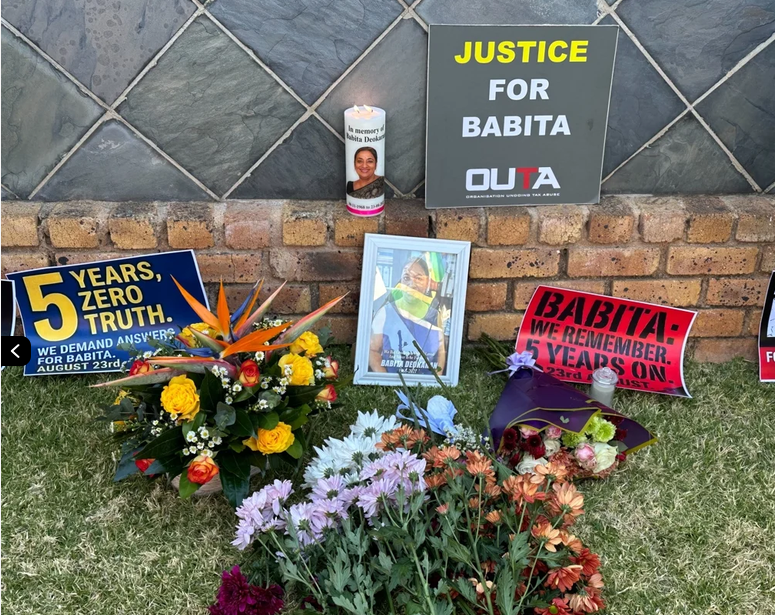
Five years after corruption whistle-blower Babita Deokaran was assassinated outside her Johannesburg home, her family is still asking the question that has haunted them since the morning she was killed: who ordered and financed the hit?
Family members, friends and civil-society organisations gathered on Dungarvan Avenue in Winchester Hills on Sunday to remember the senior Gauteng Department of Health official and renew demands for the people behind her murder to be brought to justice.
At exactly 08:20, the time Deokaran was gunned down on August 23, 2021, her family lit a candle, knelt before her photograph and observed a moment of silent prayer.
Six men have been convicted and sentenced for their roles in the killing.
However, the family says the case remains unfinished because investigators have not publicly identified or prosecuted the person or people who allegedly commissioned and funded the assassination.
Acting Police Minister Firoz Cachalia, who attended the commemoration, shared the family’s frustration and said law-enforcement agencies still had a duty to find the “kingpins”.
“Our work is not finished. Justice has not been done. The people behind the killing, who funded the killing, haven’t been brought to book, and as long as that’s the case, we have to continue our efforts to secure justice for Babita and her family,” he said.
A Candle At The Place Where She Died
The Sunday gathering returned Deokaran’s loved ones to the home where she was attacked five years earlier.
She had just returned after taking her daughter to school when gunmen opened fire on her vehicle outside the Winchester Hills property.
The remembrance was quiet and deeply personal.
At the precise time of the shooting, the family gathered around her photograph and marked the moment with a candle and prayer.
The ceremony honoured Deokaran as a sister, mother, relative and dedicated public servant, but it also served as a reminder that the central question in the case remains unanswered.
Her brother, Rakesh, said the family had never considered the conviction of the six men to be the end of the matter.
“I’ve said it from day one, we are not interested in the six that were arrested. All we want is the mastermind and the masterminds, because at the end of the day, the reality of life is a hitman does not hire himself.
“There is someone who actually did it, and it’s rather unfortunate that it’s five years later. It makes us wonder as to how much Babita could have changed if she were here,” Rakesh said.
His words captured the pain of a family that has seen some people held accountable while still waiting for an explanation of who ultimately wanted Deokaran dead.
Six Men Convicted — But Who Ordered The Hit?
Six men were arrested four days after Deokaran’s murder.
They later pleaded guilty under plea-and-sentence agreements in the Johannesburg High Court and were sentenced in August 2023.
The prison terms ranged from six to 22 years for offences that included murder, attempted murder and the unlawful possession of firearms and ammunition.
The convictions established the criminal responsibility of members of the group involved in the assassination.
They did not publicly reveal the ultimate person or people who ordered and financed the killing.
That gap has remained at the centre of the family’s campaign for justice.
The family’s position is simple: the people who carried out the attack did not independently decide to target a senior health official who had been raising concerns about suspicious public spending.
Investigators must therefore trace the planning, communications and money behind the assassination.
No court has convicted an alleged mastermind in the case.
Any claim about the identity of the person who ordered the hit must remain an allegation until supported by evidence and tested in court.
Minister Says ‘That’s Just Not Good Enough’
Cachalia said he had taken a particular interest in the case and met Hawks investigators about three weeks before the commemoration.
He said investigators told him their work was continuing and that the case had not reached a stalemate.
However, he said the failure to arrest and prosecute the people who financed the assassination after five years was unacceptable.
“They reported to me that they are continuing their efforts, but the real question is why the kingpins, the people who financed this brutal murder, haven’t been brought to book. From my point of view, five years later, that’s just not good enough,” Cachalia said.
He said the people who benefited financially from Deokaran’s death or were responsible for it had still not been brought to justice.
“The people who were involved, people who benefitted financially from her death or were responsible for her death, have not been brought to justice yet.
“There were officials in the department at the highest levels, an embedded network of co-conspirators who are involved in creating and benefitting from a corrupt system in Tembisa Hospital,” Cachalia said.
The minister’s remarks were his assessment of the corruption network and the unresolved murder investigation.
They were not a court finding against any unnamed official or individual.
He also said people who benefited from Deokaran’s death were in positions of power and could protect themselves.
That claim raises serious concerns about possible interference and institutional protection, but investigators would still need admissible evidence before criminal charges could be brought against any person.
The Corruption Deokaran Tried To Stop
Deokaran was a senior financial official in the Gauteng Department of Health and had spent decades in public service.
Before she was killed, she flagged approximately R850 million in suspicious payments linked to Tembisa Hospital.
Her concerns focused on patterns in purchase orders, suppliers and payments that appeared to require investigation.
The Special Investigating Unit later expanded the inquiry and, in a September 2025 interim report, said it had uncovered extensive alleged corruption at the hospital.
The SIU said it was examining matters worth more than R2 billion and had identified three major syndicates.
Its investigation involved hundreds of service providers and thousands of purchase orders.
The SIU described alleged procurement fraud, fronting, money laundering, collusion and corrupt payments involving officials and service providers.
It also said some orders had been split into amounts below R500,000 to avoid stricter procurement processes.
The investigation led to disciplinary referrals, criminal referrals, civil-recovery work and efforts to preserve assets allegedly linked to unlawful activity.
Those findings show the scale of the system Deokaran had begun questioning.
However, the existence of corruption at Tembisa Hospital does not by itself prove who ordered her murder.
The motive and the identity of the commissioning person or people must be established through the murder investigation and tested in court.
An ‘Embedded Network’ Under Scrutiny
Cachalia’s reference to an embedded network reflected broader concerns about how corruption can survive inside public institutions.
A corrupt procurement system may involve officials who approve orders, suppliers who submit quotations, intermediaries who move money and beneficiaries who receive the proceeds.
Uncovering such a network requires investigators to trace bank accounts, contracts, communications, assets and relationships.
The same approach may be necessary to identify the mastermind behind a contract killing.
The investigation cannot stop with those who allegedly followed instructions.
Detectives must determine who selected the target, who provided information about her movements, who arranged payment and who benefited from silencing her.
Cachalia said the police investigation was continuing, but the five-year delay has weakened public confidence.
The family has heard repeated assurances that work is under way.
What it wants now is a clear breakthrough that reaches beyond the convicted hit team.
‘Who Exactly Paid Her Killers?’
Ahmed Kathrada Foundation executive director Neeshan Bolton said many of the questions raised immediately after the assassination remained unanswered.
“I was here five years ago, standing next to the bullet-ridden car and the questions we asked then and are still asking now are who exactly paid her killers?” he said.
Bolton also questioned whether the corruption Deokaran exposed had been adequately addressed.
He suggested that evidence emerging at the Madlanga Commission might provide leads relevant to those behind the killing and urged authorities to examine that possibility.
The commission has heard allegations about corruption, criminal networks and interference in policing.
However, no confirmed finding cited in the supplied material establishes a direct link between its evidence and the person who commissioned Deokaran’s murder.
Any possible connection would need to be investigated rather than assumed.
The importance of Bolton’s call lies in asking investigators to follow every credible lead and compare information across different inquiries.
Cachalia Slams Damage To Corruption Fight
Cachalia also addressed broader concerns about corruption and accountability within the police service.
He said progress had been made but that serious institutional problems remained.
“We are watching the Madlanga Commission carefully and taking steps. I just feel completely outraged that people in positions of leadership have behaved with a shocking combination of incompetence, at the very least.
“The damage that they have done to the fight against corruption is enormous,” he said.
The minister’s comments placed the Deokaran case within a larger crisis of trust in law-enforcement institutions.
If powerful people can block or delay investigations, ordinary detectives may struggle to reach those who plan and finance serious crimes.
The public does not yet know whether interference occurred in Deokaran’s case.
But the failure to identify the mastermind after five years has raised legitimate questions about resources, leadership, cooperation and possible obstruction.
Why The Case Matters Beyond One Family
Deokaran’s assassination became a symbol of the dangers faced by whistle-blowers in South Africa.
She used her position inside government to flag transactions that she believed required investigation.
Instead of being protected, she was killed outside her home.
Her death sent a damaging message to public servants who might consider reporting corruption.
If whistle-blowers believe they will be exposed, abandoned or targeted, many may remain silent.
That silence allows money intended for hospitals, schools, housing and public safety to be stolen without detection.
Protecting whistle-blowers is therefore not only about personal security.
It is also about protecting the State’s ability to discover corruption and recover public funds.
Deokaran’s family has repeatedly said her work must not be reduced to a name used in speeches.
Justice requires both consequences for the corruption she exposed and accountability for everyone involved in her assassination.
Convictions Were Important But Incomplete

The six convictions were a major step because they ensured that members of the murder group received prison sentences.
Plea agreements also brought the criminal case to a conclusion without a lengthy trial.
But the agreements did not provide the family with the answer it wanted most.
The person or people who allegedly issued the instruction and paid for the killing were not brought before the court.
That means the convictions, while significant, addressed only part of the criminal chain.
A contract killing can involve several levels: the person who wants the target dead, an organiser or middleman, the people who arrange logistics and the gunmen who carry out the attack.
Successful investigation requires police to move upward through that structure.
The family’s fear is that the investigation stopped with those who were easiest to arrest and prosecute.
Cachalia’s presence at the commemoration and his demand for the “kingpins” may increase pressure on investigators to demonstrate progress.
What Has Happened At Tembisa Hospital?
The wider corruption inquiry has produced major findings since Deokaran’s death.
The SIU’s interim report described alleged syndicates, manipulated procurement processes and suspicious money flows involving officials and businesses.
It said the hospital received no value in some transactions and that money moved through fronts or conduits before reaching beneficiaries and being used to acquire assets.
The SIU prepared disciplinary referrals and referred suspected criminal matters to the National Prosecuting Authority.
It also worked with law-enforcement bodies and asset-forfeiture authorities to trace and preserve property.
Those processes remain separate from the murder investigation, although evidence about money and relationships could potentially assist detectives if a lawful link is established.
The SIU investigation was still continuing, with further findings and enforcement action expected.
The work shows that Deokaran’s concerns were not trivial.
They opened a path towards uncovering a far larger system of alleged wrongdoing.
Five Years Of Waiting
For Deokaran’s family, institutional reports and investigations cannot replace the person they lost.
The anniversary marked five years of birthdays, family events and ordinary moments without her.
Rakesh’s words reflected not only anger but also the lost possibilities of what his sister might have achieved had she lived.
“It makes us wonder as to how much Babita could have changed if she were here,” he said.
The family’s gathering at the murder scene turned that loss into a public demand.
They want investigators to identify the people who planned the assassination, uncover the source of the payment and explain why Deokaran was targeted.
They also want the State to ensure that other whistle-blowers are not left as vulnerable as she was.
What Happens Next?
Cachalia said the Hawks investigation was active and that he had been briefed by investigators.
The minister did not announce a new arrest, identify a suspect or provide a timetable for a breakthrough.
The case therefore remains open at its most important level.
Investigators must continue tracing financial records, communications, witness accounts and any links between the convicted men, suspected middlemen and possible beneficiaries.
Information emerging from the Madlanga Commission or other corruption investigations should be assessed where it provides credible and lawful leads.
The family and civil-society organisations are likely to continue pressing the police, the Hawks and political leaders for answers.
Cachalia’s commitment will now be measured against whether the investigation produces evidence strong enough to bring alleged organisers and financiers before a court.
Five years after the candlelit moment marking the exact time of Deokaran’s death, the family’s central question remains unchanged.
A hitman does not hire himself.
Until the people who ordered and paid for the assassination are identified and prosecuted, the family believes justice for Babita Deokaran will remain incomplete.