

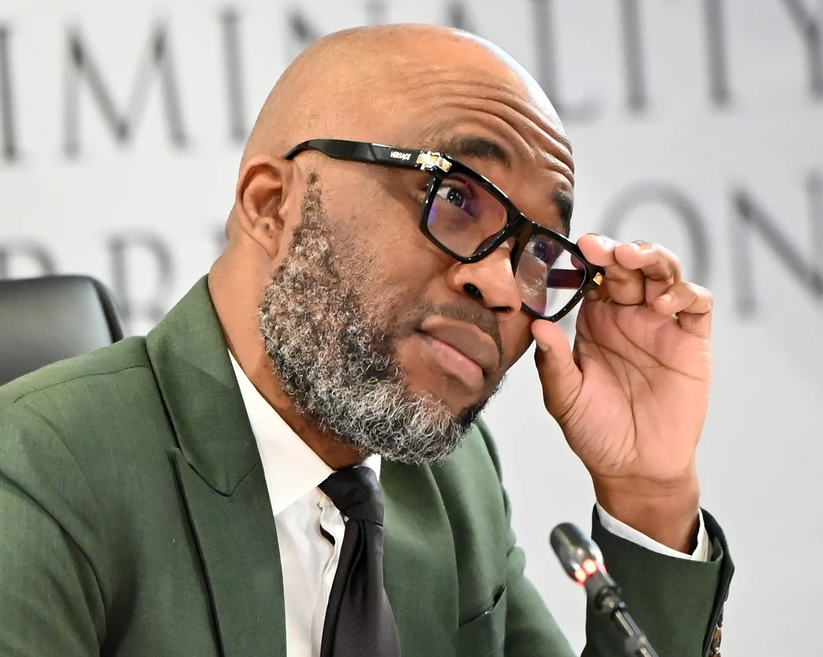
Vusimuzi “Cat” Matlala repeatedly relied on his constitutional right not to answer questions as the Madlanga inquiry examined the R228 million South African Police Service tender, an alleged impala gift and an alleged R15 million loan.
At the same time, a separate parliamentary committee weighing evidence linked to the wider police corruption scandal rejected claims that suspended police minister Senzo Mchunu was controlled by outside forces when he ordered the disbandment of the Political Killings Task Team (PKTT).
Matlala’s refusal to answer questions led to a heated clash between his lawyer and the inquiry’s evidence leader. His legal team argued that answering questions could expose him to further criminal charges, while evidence leader Mahlape Sello challenged the blanket use of his constitutional protection.
The businessman is already facing criminal proceedings linked to the controversial SAPS tender. His lawyer argued that Matlala should not be forced to give evidence that could later be used against him in a criminal case.
The legal argument centres on Section 35 of the Constitution. In simple terms, the provision protects an accused or detained person from being forced to provide answers that may incriminate them.
Matlala Refuses To Answer Tender Questions
The inquiry has been examining the awarding of an R228 million SAPS health and wellness tender linked to Matlala’s company, Medicare24. It has also heard allegations involving political connections, possible corruption and benefits allegedly provided to people in positions of influence.
Questions put to Matlala included matters surrounding the tender, an alleged impala gift and an alleged R15 million loan. He repeatedly declined to answer when his legal team believed a response could place him at further legal risk.
His lawyer maintained that the pending criminal case had to be considered before Matlala could be expected to give full answers. The defence position was that the inquiry could not separate questions about the tender from the criminal allegations already before the courts.
Sello pushed back against that argument. The evidence leader questioned why Matlala could not answer questions that did not directly relate to the criminal case or expose him to possible prosecution.
The clash came as the inquiry continued its attempt to establish how political influence, police decision-making and public money may have intersected in the tender process. Matlala’s refusal to answer has made his evidence one of the most closely watched parts of the inquiry.
The inquiry has not found Matlala guilty of the allegations being examined. The evidence and claims still have to be dealt with through the proper legal processes.
MPs Split Over Mchunu’s Decision
While the inquiry dealt with Matlala’s legal rights, members of an ad hoc parliamentary committee met virtually to review and evaluate their draft report before it is submitted to the National Assembly.
The committee considered witness testimony and political party submissions based on the evidence heard so far. One of the main disagreements was whether Mchunu had been influenced by people outside the SAPS when he wrote the letter ordering the PKTT to be disbanded on 31 December.
The MK Party argued that Mchunu had been influenced by outside forces. It specifically pointed to violence monitor Mary de Haas and businessman Brown Mogotsi, and called for a harsher finding against the suspended minister.
ANC chief whip Mdumiseni Ntuli rejected that wording. He said the evidence did not support the strong claim that Mchunu had been influenced or controlled by other people.
“I don’t agree with the strong assertion that the minister has been influenced,” Ntuli said. “It’s a very strong assertion. My own reading of events and the reports before us is that the minister also considered various interventions coming from different people.”
The ANC’s position was supported by the DA. The two parties argued that the MK Party’s claim went further than the evidence presented to the committee.
However, the EFF, PA and ActionSA supported the MK Party’s position. EFF MP Leigh-Ann Mathys argued that Mchunu’s own testimony showed that complaints from outside the police service had played a role in his decision.
“It was the minister’s testimony before the committee that he was influenced by the complaint of De Haas,” Mathys said.
MP Vusi Shongwe also maintained that Mchunu had been influenced by people such as De Haas, who had sent complaints about the task team before the disbandment letter was issued.
Freedom Front Plus MP Wouter Wessels suggested that the wording in the draft report should be changed. He said it should reflect that Mchunu’s decision was informed by the complaints he received, rather than making a stronger claim that he was controlled by outside people.
Mchunu Denies External Control
Mchunu previously told the committee that he had received letters alleging human rights abuses and misconduct within the PKTT. The complaints came mainly from De Haas and former administrative figure Patricia Mashale.
However, Mchunu rejected claims that he acted under the control of outside people. He maintained that he wrote the disbandment letter independently and within the powers attached to his position as police minister.
The committee’s latest discussions also considered whether there was evidence that Mchunu had acted for criminal networks. Members found no clear evidence that he had disbanded the task team on behalf of such networks.
That finding does not end the political disagreement over the decision. Some MPs believe the complaints received by Mchunu influenced the timing and content of his decision. Others say there is a difference between taking complaints into account and being influenced in a way that compromises the minister’s independence.
The committee agreed that its role was to assess the evidence and make findings about governance, leadership and institutional failures. It cannot decide whether a person is criminally guilty or innocent.
Report Moves Towards National Assembly
The committee is now working through its draft report before it is formally adopted. The document is expected to reflect areas where members agree, as well as areas where political parties remain divided.
The report will examine how the police service, political office bearers and other institutions dealt with complaints, allegations of misconduct and claims involving organised crime.
Members are also expected to consider whether the disbandment of the PKTT followed proper procedures and whether the process weakened efforts to investigate political killings.
The committee’s conclusions will be closely watched because they could shape the political response to the allegations and influence calls for further investigations. However, the report will not replace criminal proceedings or determine the guilt of Matlala, Mchunu or any other person mentioned during the hearings.
For Matlala, the immediate battle remains over how much he must reveal before the inquiry. His lawyer says the Constitution protects him from answers that could deepen his criminal exposure. The evidence leader insists that the inquiry must still be allowed to obtain answers to questions that fall outside that protection.
For Mchunu, the central question is whether the PKTT was disbanded after an independent ministerial decision or whether complaints and interventions from outside the police service carried too much weight.
As the committee prepares its report and the inquiry continues to test difficult evidence, both disputes remain unresolved. The final findings will have to separate political disagreement from proven facts and allegations from conclusions that can be supported by the evidence.