

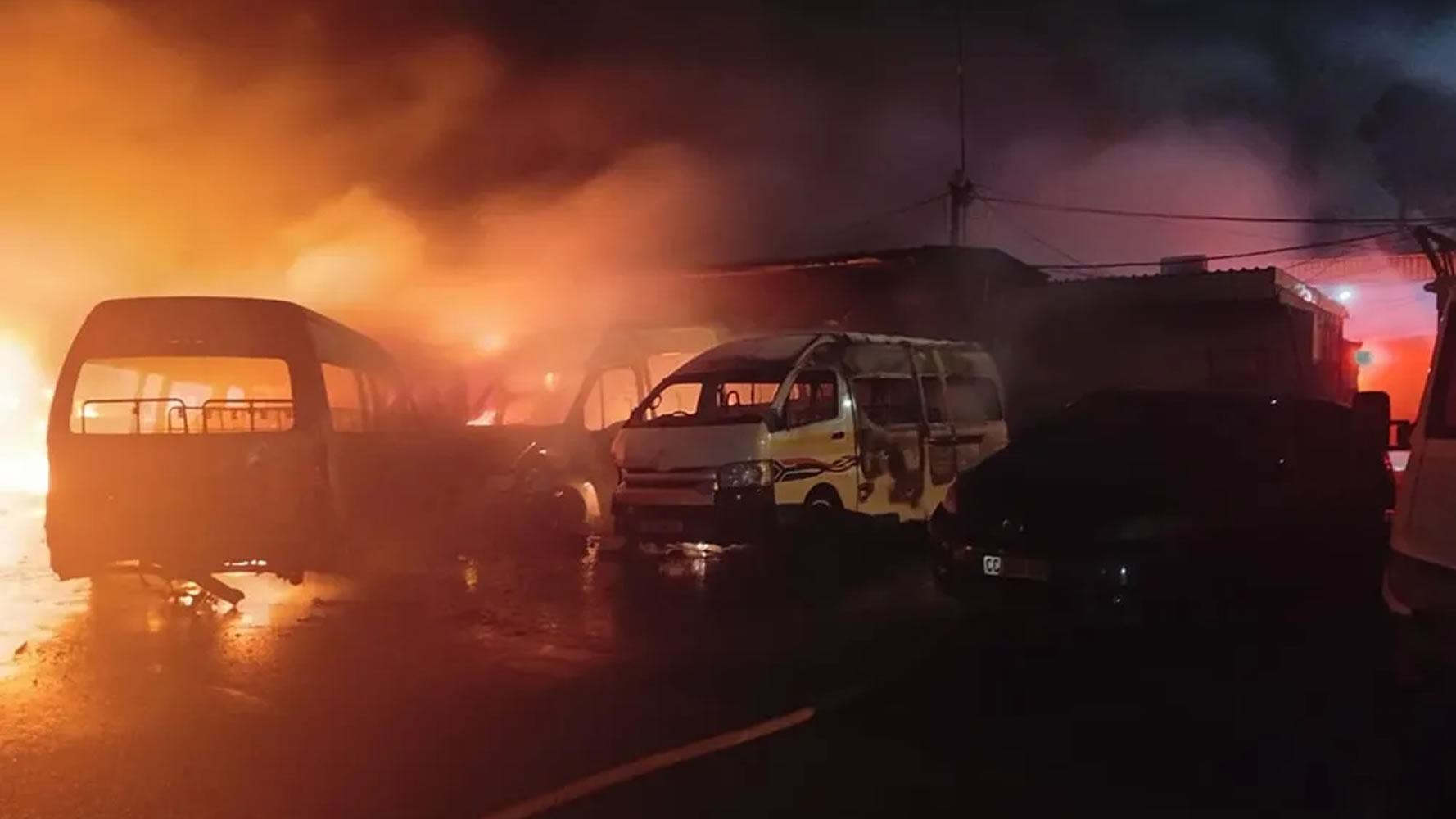
Arson Attack Rocks Nyanga Taxi Rank as Violence Continues
Cape Town – Three more taxis were set ablaze at the volatile Nyanga Taxi Rank in the early hours of Friday, 12 July 2026, marking another grim chapter in the ongoing saga of taxi violence that has plagued the Western Cape for years. The incident, which saw vehicles engulfed in flames, has once again brought to the fore the deep-seated conflicts within the province's taxi industry and the devastating impact on operators and commuters alike.
According to initial reports, the City of Cape Town’s Fire and Rescue Service received calls around 01:05 regarding vehicles on fire at the Emms Drive rank. Firefighting crews were swiftly dispatched, managing to contain and extinguish the blaze by 02:00. While no injuries were reported in this latest attack, the destruction of the three vehicles adds to a growing tally of taxis lost to arson in the area.
This incident follows a pattern of violence that has seen numerous vehicles torched and lives lost. Just four months prior, on 6 March 2026, nine taxis – five Toyota Quantums and four Iveco Sprinters – were similarly set alight at the same Nyanga rank. That attack, which occurred shortly after 01:00, also saw no injuries but resulted in significant financial losses for the affected operators. CATA spokesperson Nkululeko Sityebi, at the time, stated that the owners were assessing their losses and appealed to the police for assistance in the investigation.
The recurring acts of arson and violence are widely believed to be linked to the fierce rivalry between the Cape Amalgamated Taxi Association (CATA) and the Cape Organisation for the Democratic Taxi Association (CODETA) over contested routes. This long-standing dispute has frequently escalated into deadly confrontations, with both operators and innocent bystanders falling victim.
Indeed, the taxi industry in the Western Cape has been a hotbed of conflict. In June 2026, a chilling video surfaced showing gunmen opening fire in Nyanga, resulting in the deaths of four people and critical injuries to two others. Provincial police spokesperson Colonel Andrè Traut confirmed that the shooting was believed to be taxi-related. The South African National Taxi Council (Santaco) Western Cape condemned the incident, with PRO Makhosandile Tumana stating, “We strongly condemn all forms of violence, intimidation, and lawlessness. We call on law-enforcement agencies to act swiftly and decisively to bring those responsible to justice.”
Further back, in February 2025, 13 taxis, four Sprinter buses, and a civilian vehicle were destroyed in a fire at the Nyanga taxi rank. The scale of destruction has varied, but the underlying cause often points to the same intractable disputes. The violence is not confined to arson; it frequently involves shootings and assassinations. In November 2025, two women were killed and eight others injured after gunmen opened fire on a bus carrying CATA members at Nyanga Taxi Rank.
The human cost of this conflict is immense. Beyond the financial ruin for taxi owners and operators, there is the constant threat to life. In January 2024, the fatal shooting of two taxi owners in Nyanga renewed fears of a resurgence of violent taxi conflict. These owners, belonging to CATA, were attacked after a meeting near the taxi rank. CATA spokesperson Nkululeko Sityebi urged police to investigate thoroughly, stating, “They were attacked while coming out of a local church near the taxi rank where they had held a meeting. The incident did not occur at the taxi rank.”
The impact extends to the wider community, particularly commuters who rely on taxis for daily transport. School children are often caught in the crossfire or left stranded when services are suspended due to violence. In March 2026, following the torching of nine taxis, commuters in Nyanga and surrounding areas were left without transport as operators suspended services over safety concerns. Parents, like Nomsingathi Vingciza, kept their children home from school, fearing for their safety during such volatile periods.
Taxi drivers themselves have voiced their frustration with the lack of effective policing. In March 2026, dozens of drivers marched to the Nyanga police station, demanding better policing and proper investigation of extortion cases. CATA spokesperson Nkululeko Sityebi highlighted that numerous taxi operators and bosses had been shot dead over the past three years with little to no investigative progress. Mzikayise Ndzuzo, speaking on behalf of the Nyanga police commander, countered that investigations were often hampered by a lack of cooperation from taxi operators, citing the incident where no statements were provided after the nine taxis were torched.
The authorities have attempted various interventions. Western Cape police commissioner Lieutenant-General Thembisile Patekile acknowledged the challenges, noting that despite a R100,000 reward offered by the City of Cape Town, there had been no breakthrough in some taxi-related killings. He also mentioned police working with the provincial Department of Urban Mobility to address route disputes. In September 2025, the Western Cape Transport Department, under Minister Issac Sileku, even resorted to closing several taxi routes between Mfuleni and Somerset West, and Lwandle, for a month due to the ongoing violence between CATA and CODETA.
Despite these efforts, the cycle of violence persists. The latest arson attack at Nyanga Taxi Rank serves as a stark reminder of the deep-seated issues that continue to destabilise the taxi industry in the Western Cape. Until a lasting resolution is found, operators and commuters will continue to navigate a landscape fraught with danger and uncertainty.