

Blood and Banknotes: Inside the Violent Surge of South Africa’s Cash-in-Transit War
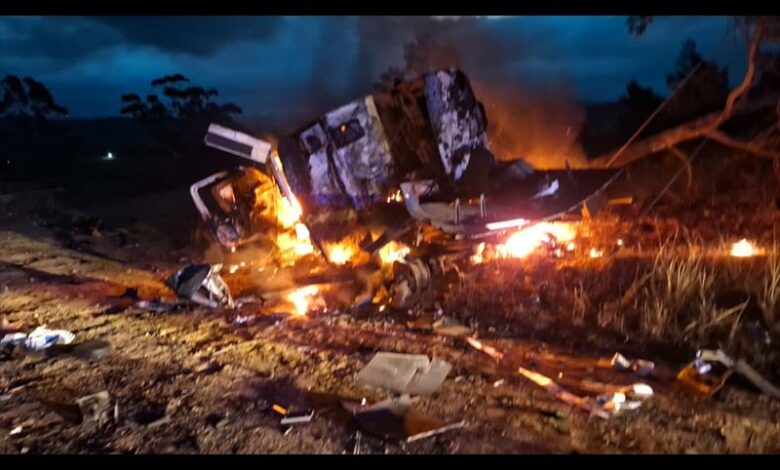
The N2 motorway near Nqabeni, usually a lifeline for commerce and travel outside Izingolweni, was transformed into a tactical battleground on Tuesday, May 19, 2026. In a strike defined by military-style precision and overwhelming firepower, a heavily armed gang of approximately 20 men ambushed an armoured cash vehicle, leaving a trail of wreckage and three people injured in their wake.
The attack at Nqabeni is not an isolated incident of greed; it is a symptom of a sophisticated and increasingly violent industry of crime that has seen South African roads become the front lines of a low-intensity conflict. As the smoke cleared from the N2, the scale of the operation became apparent. This was not a simple robbery; it was a coordinated assault that required multiple teams, high-grade explosives, and a complete disregard for human life.
The Nqabeni Ambush: A Tactical Breakdown
The heist began in the late afternoon, a time when visibility starts to dip and traffic patterns can be exploited. According to initial reports from the South African Police Service (Saps) and emergency responders, the armoured vehicle was intercepted by a convoy of suspect vehicles. The sheer number of attackers—estimated at 20—allowed the gang to establish a perimeter, effectively cutting off the road and isolating their target.
The violence was immediate. The gang used high-calibre firearms to suppress any potential resistance before moving in with explosives. The sound of the blast, used to breach the reinforced hull of the cash van, was heard across the surrounding hills. By the time the dust settled, the vehicle was a charred skeleton, its contents looted by men who moved with the practised ease of professional soldiers.
The chaos did not end on the N2. Emergency services found themselves responding to three distinct crime scenes that branched out from the primary ambush site. One was located on the N2 Izingolweni itself, where the main heist took place. A second scene was identified on the gravel road leading to Celebane, and a third on the KwaNyuswa road. This suggests a complex escape plan where the gang split into smaller groups to evade pursuit, potentially using the secondary roads to switch vehicles or stash their haul.
The Human Cost of the Heist
While the financial loss to the cash-in-transit companies is significant, the human toll is far more profound. Three individuals were injured during the Nqabeni attack. Among them was a member of a private security response unit, believed to be from the Wolf Security team.
The security officer reportedly came under heavy fire at one of the secondary scenes. Reports emerged that he was seriously injured in the shooting, highlighting the extreme risks faced by those tasked with protecting these high-value shipments. The officer’s condition remained a primary concern for colleagues and family as Saps and emergency teams occupied the scenes late into the evening.
The closure of the N2 and the surrounding roads caused significant disruption, but for the residents of Nqabeni and Izingolweni, the primary concern was the brazen nature of the violence. The fact that a gang of 20 men can operate with such impunity on a major national road raises serious questions about the security of the country's infrastructure.
A Pattern of Violence: Recent Heists Across the Country
The Nqabeni heist is part of a disturbing trend that has seen a spike in cash-in-transit (CIT) robberies over the past few weeks. These incidents follow a similar pattern: high-speed chases, the use of commercial-grade explosives, and a willingness to engage in prolonged shootouts with both police and private security.
Just over a month ago, on April 13, 2026, the Kranskop Central Business District (CBD) was the scene of a similarly dramatic encounter. A group of heavily armed suspects targeted a cash vehicle using explosives. However, that incident took a turn that bordered on the macabre. One of the suspects was found dead inside an abandoned vehicle shortly after the heist. Investigations revealed that the man had likely been killed by his own explosives while attempting to rig the cash van.
The Kranskop case provided a rare glimpse into the dangers these criminals face from their own lack of expertise or the volatile nature of the materials they use. Despite the death of their comrade, the rest of the gang managed to engage in a fierce shootout with Saps and private security before making their escape.
Less than two weeks later, on April 24, 2026, the East Rand town of Vosloorus experienced its own afternoon of terror. A CIT robbery there was marked not just by the violence of the criminals, but by the chaotic response of the public. As the cash van lay breached and smoking, video footage emerged showing frantic community members rushing toward the danger.
In a scene that has become tragically common in South Africa, residents were seen scrambling to collect banknotes scattered across the tarmac, seemingly oblivious to the risk of unexploded charges or the possibility of the gunmen returning. The Ekurhuleni Metropolitan Police Department later confirmed that two suspects were apprehended in the aftermath, and firearms linked to the heist were seized in nearby Boksburg.
On April 23, 2026, the community of Moriting in Thembisa was also brought to a standstill. At approximately 09:00, multiple gunshots rang out as an armoured vehicle was targeted in what ultimately became a failed heist. While the criminals did not manage to secure the cash, the psychological impact on the local residents was immense, as the gun battle took place in broad daylight in a residential area.
The Mechanics of the CIT Industry
To understand why these heists are becoming more frequent, one must look at the mechanics of the crime itself. The gangs involved are rarely opportunistic amateurs. They are structured organisations with access to intelligence, often knowing the exact routes and schedules of the armoured vehicles.
The use of explosives is a hallmark of the modern South African heist. Criminals have moved away from trying to force doors open with crowbars or thermal lances. Instead, they use "contact" explosives—often stolen from mines or construction sites—to blow the roofs or sides off the vans. This method is fast, but it is also incredibly dangerous for the guards inside, who are often left with permanent hearing loss, concussions, or more severe physical trauma.
Furthermore, the sheer number of attackers, as seen in the Nqabeni case with 20 suspects, serves a dual purpose. It provides overwhelming force to suppress the guards, and it ensures that there are enough hands to move the cash quickly and enough drivers to manage multiple getaway vehicles. This "swarming" tactic makes it nearly impossible for a single security team or a small police patrol to intervene effectively.
The Response from Authorities
The South African Police Service has been under immense pressure to curb the rise in CIT heists. While there have been successes—such as the arrests in the Vosloorus case and the drop in overall robbery statistics in some regions during the 2025/2026 period—the brazenness of the Nqabeni attack suggests that the gangs are far from deterred.
The Cash-In-Transit Association has noted that while some progress has been made, KwaZulu-Natal remains a particular hotspot for these crimes. The province's geography, with its mix of high-speed motorways and remote gravel roads, provides the perfect environment for ambushes and quick escapes.
For the private security industry, the cost of doing business is rising. Companies like Wolf Security are forced to invest in better-armoured vehicles, more advanced tracking technology, and higher levels of training for their staff. Yet, as the Nqabeni incident proves, even the best-prepared teams can find themselves outgunned when facing a small army of determined criminals.
Conclusion: A Road to Nowhere?
As the sun set over the N2 on May 19, the investigators at Nqabeni were left to piece together the fragments of another violent day. The three injured people face a long road to recovery, and the community is left to wonder when the next explosion will echo through their hills.
The battle for South Africa's roads is not just about the money. It is about the rule of law and the safety of every citizen who uses these thoroughfares. Until the supply of illegal explosives is choked off and the high-level organisers of these gangs are brought to justice, the armoured vans will continue to run the gauntlet, and the N2 will remain a place where commerce and carnage meet.
The investigation into the Nqabeni heist continues, with Saps calling on anyone with information to come forward. For now, the scorched tarmac near Izingolweni stands as a silent witness to a war that shows no sign of ending.