Faisal ul Rehman laid to rest in Lahore as Emmarentia road rage case stalls
The funeral of 48-year-old father of two, Faisal ul Rehman, tragically killed in a road rage incident in Emmarentia, Johannesburg, was held in his hometown of Jamia Tul Muntazar in Lahore, Pakistan, on Friday – even as legal uncertainty continues to surround the man who shot him.
Rehman’s killing, following what began as a minor collision on Barry Hertzog Avenue, has reverberated from the streets of Johannesburg to the suburbs of Lahore, where relatives, friends and community members gathered for his burial prayers a week after the incident.
His nephew, Muhammad Wasi Haider, confirmed that the funeral proceeded according to Islamic rites after Friday prayers.
“Everything went well and the burial was done after jumma in Pakistan.
“The family is still traumatised. My aunt still cannot breathe properly for long periods of time without oxygen. She has been shot very close to her lung.
“This whole ordeal is one messed up avoidable situation and I pray that no one has to go through this kind of situation.”
Haider’s words reflect a family trying to process both profound loss and the shocking circumstances under which Rehman died: on a Johannesburg roadside, in full view of his wife and two young children, far from the community that finally laid him to rest.
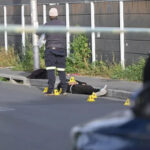
Rehman was killed after a minor collision between two vehicles on Barry Hertzog Avenue escalated into a fight between the two drivers.
What started as a seemingly routine bumper-bashing turned into a deadly confrontation. According to earlier police accounts, a verbal dispute between the two motorists allegedly escalated into a physical altercation, and then a firefight involving both parties.
His wife, Tehseen, was hit in the hand and shoulder, all of it unfolding in full view of the couple’s two young children.
The couple’s children, aged eight and 10, witnessed the entire sequence: the argument, the gunfire, their father collapsing, and their mother injured. Video footage recorded by bystanders and shared widely on social media captured the young son attempting CPR on his father, his hands covered in blood, while his sister screamed beside him. Those images have since come to symbolise the human cost of violent road rage.
Tehseen survived but remains in a fragile condition in hospital. Haider says she is still heavily reliant on oxygen, her breathing compromised by a gunshot wound that came dangerously close to her lung. The family, already traumatised by the shooting and the public circulation of its aftermath, now faces the added burden of a legal process that appears to be in limbo.
A 58-year-old man was arrested at the scene but the National Prosecuting Authority announced on Tuesday that it had decided not to prosecute him, pending further investigation.
“After careful consideration of the evidence of the alleged road rage incident which occurred in Emmarentia, the NPA has decided not to prosecute the matter pending further investigation,” NPA spokesperson Magaboke Mohlatole said.
For Rehman’s family, both in South Africa and Pakistan, the NPA’s decision not to enrol the matter immediately has been difficult to accept. The move does not amount to a clearing of the suspect; rather, prosecutors have opted to return the docket to the police for further investigation. The case may yet be re-enrolled if additional evidence strengthens the prospects of conviction.
In the meantime, the 58-year-old suspect is no longer in custody. His legal team has argued consistently that he acted in self-defence.
The suspect's legal team had argued that he acted in self-defence.
In his warning statement, the man claimed that Rehman and his wife had verbally abused and physically assaulted him after the collision, and that Tehseen had produced a firearm, discharged it, and handed it to her husband, who also fired in his direction.
This version of events, which places the first use of the firearm with Rehman’s wife, diverges sharply from the public perception that emerged in the immediate aftermath, when circulating videos focused primarily on the final moments of the confrontation rather than on how it began.
In a statement, the family of the accused, expressed their condolences for the victim’s family and said he acted in self-defence to protect his life and that of his wife.
The family acknowledged that a life had been lost but said they stood by the actions of their family member, whose identity they asked to be withheld.
The accused’s relatives say he is deeply affected by the shooting, but they insist he was placed in a situation where he believed his life and that of his wife were in immediate danger. They support his claim that he fired only after shots were discharged by Tehseen and then, allegedly, by Rehman himself.
These competing accounts – one from a grieving family who see the killing as a wholly avoidable escalation, another from an accused man and his relatives who insist he was forced to defend himself – now sit at the heart of a complex investigation.
For prosecutors, the decision to hold off on charges underscores the high legal threshold involved in murder cases where self-defence is claimed. The NPA will have to weigh video footage, ballistic evidence, medical reports, eyewitness statements and the sequence in which shots were fired to determine whether there is a reasonable prospect of overturning a self-defence argument in court.
In Pakistan, meanwhile, Rehman’s funeral in Lahore brought a measure of closure but no relief from the questions that remain. Family members there have spoken of his role as a breadwinner not just for his immediate household in Pretoria, but for extended relatives back home.
Rehman, 48, was a car dealer from Pretoria and a father of two, who was a breadwinner for over 15 families in Pakistan.
Relatives say he supported more than 15 families in Pakistan through his work buying, rebuilding and selling vehicles in South Africa. His death, they warn, is likely to have cascading economic consequences for people who depended on him for school fees, food and medical expenses.
In both Lahore and Johannesburg, the sense that the tragedy did not have to happen has been a constant refrain. Haider’s description of “one messed up avoidable situation” echoes a broader concern in South Africa about how quickly everyday disputes on the road can turn lethal, particularly where firearms are present and tempers are high.
For now, Rehman lies buried in Lahore, far from the Joburg avenue where he was killed. His widow remains in a South African hospital, struggling to breathe without oxygen, their children carry the trauma of what they saw, and two families – one in Pakistan, one in South Africa – wait on a legal process still searching for answers about who did what, when, and why.
Whether the NPA ultimately decides to prosecute, and on what charges, will likely depend on the outcome of further investigations into that short but devastating chain of events on Barry Hertzog Avenue.
Until then, a cross-continental family is left to grieve, and a deeply contested road rage case remains unresolved.