

The Bloodied Gravel of Nkandla: Inside the Botched Kranskop Heist and the Shadow of South Africa’s Cash-in-Transit Epidemic
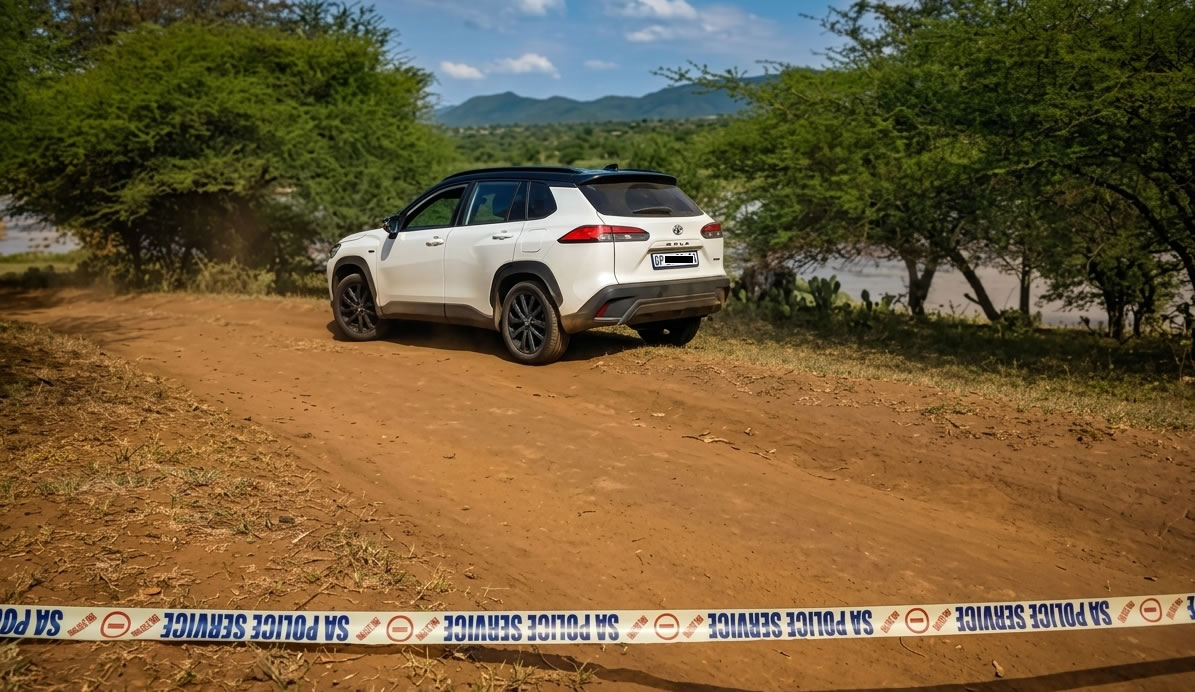
KRANSKOP, KWAZULU-NATAL – The gravel road winding towards the Tugela River is usually silent, a dusty artery through the rural heartland of Nkandla. But on Tuesday, 14 April 2026, that silence was broken by the discovery of a white getaway vehicle, abandoned and carrying a grim cargo. Inside lay the body of a man whose final moments were defined by the very violence he sought to inflict. He was a soldier in an army of twelve, a gang that had, just twenty-four hours earlier, turned the Kranskop Central Business District (CBD) into a war zone.
This was no ordinary robbery. It was a meticulously coordinated strike that saw a cash-in-transit (CIT) vehicle intercepted, security guards disarmed, and four vehicles hijacked in a brazen display of criminal force. Yet, as the dust settles over the hills of KwaZulu-Natal, the story that has emerged is one of tactical retreat, viral controversy, and a suspect who became a victim of his own lethal tools.
The Anatomy of an Ambush
The chaos began on Monday, 13 April 2026. In the Kranskop CBD, a gang of approximately twelve heavily armed suspects executed a clinical ambush on a cash delivery vehicle. The sheer scale of the operation was staggering. According to South African Police Service (SAPS) spokesperson Colonel Robert Netshiunda, the gang managed to rob the vehicle of an undisclosed amount of money and disarm three security guards, taking their firearms as trophies of their dominance.
The suspects did not stop there. To ensure their escape, they hijacked four separate vehicles, creating a chaotic shell game for any pursuing authorities. In a final act of defiance, the gang opened fire on a nearby police station, a move designed to pin down local officers and provide the window needed to vanish into the vast KZN interior.
"The suspects also fired shots towards a police station during the robbery; no police officer or any member was injured," Netshiunda confirmed in a statement that underscored the audacity of the attackers.
The Viral Retreat: Cowardice or Calculation?
As news of the heist broke, a video began to circulate on social media platforms, most notably X (formerly Twitter). The footage, which has since gone viral, allegedly shows SAPS officers in a marked vehicle retreating from the scene as the gang wreaked havoc. The clip ignited a firestorm of debate across South Africa, exposing the deep-seated tensions between a public demanding protection and a police force that often finds itself "outnumbered and outgunned."
Online, the reactions were polarized. Some users were quick to label the retreat as an act of cowardice. @Vaccinations13 argued, "Those police officers should be arrested and charged. Why do they run away?"
However, many within the security sector and the broader public defended the officers' decision as a necessary exercise in risk assessment. "They would be dead if they didn’t," noted @TboozeSA. "Their cars aren’t even armoured. Without backup, there’s nothing they could do. 12 AK-47s vs 2 9mm pistols. This isn’t a movie where a starring gets to shoot all suspects."
@Sabza200BC echoed this sentiment: "They did well. Even good soldiers retreat when they are outnumbered. These 12 criminals were heavily armed; what would two cops in a bakkie do against more than 10 armed suspects, some armed with rifles?"
The debate highlights a harsh reality of modern South African policing: the tactical mismatch between standard patrol units and the military-grade equipment often favoured by CIT syndicates. For the officers in that bakkie, the choice was between a tactical retreat and a near-certain funeral.
A Fatal Miscalculation
While eleven of the suspects managed to evade the initial dragnet, one did not make it far. On Tuesday morning, investigators following leads discovered one of the hijacked getaway vehicles abandoned on a gravel road near the Tugela River, heading towards Nkandla.
Inside, they found the body of one of the suspects. Preliminary investigations have revealed a poetic, if gruesome, irony: the man appears to have been killed by his own hand—or rather, by his own explosives. It is believed he sustained fatal injuries while setting up the charges intended to blast open the cash vehicle or its internal safes.
"Preliminary police investigations revealed the deceased injured himself while setting up explosives during the CIT robbery," reported the Zululand Observer. The man, whose identity has not yet been officially released, bled out in the very vehicle intended for his escape, a casualty of the volatile tools of his trade.
The Broader Epidemic: A National Crisis
The Kranskop heist is not an isolated incident; it is a symptom of a persistent and evolving epidemic. Data from the South African Banking Risk Information Centre (SABRIC) and recent SAPS crime statistics paint a complex picture of the CIT landscape.
While the Acting Minister of Police, Firoz Cachalia, noted in the 3rd Quarter 2025/26 Crime Statistics that CIT robberies had seen a significant nationwide drop—some reports suggesting as much as 51% due to intensified police operations—the nature of the attacks has become increasingly violent.
|
Province
|
Trend (2025/2026)
|
Key Characteristic
|
|
Gauteng
|
25% Increase
|
High-density urban ambushes
|
|
KwaZulu-Natal
|
Persistent Epicentre
|
Use of military-grade rifles and explosives
|
|
Eastern Cape
|
Rising
|
Rural road interceptions
|
The use of explosives has become a signature tactic, often referred to as "ATM bombing" logic applied to moving targets. These devices, while effective at breaching armoured steel, are notoriously unstable. The death of the suspect in Nkandla serves as a rare reminder of the danger these criminals pose to themselves, though more often, it is innocent bystanders and security personnel who pay the price.
The Shadow of Nkandla
The location of the discovery—Nkandla—adds a layer of symbolic weight to the incident. Known globally as the home of former President Jacob Zuma, the area is a mix of deep rural tradition and modern political significance. For a CIT gang to use these winding roads as an escape route speaks to the perceived safety of the rugged terrain.
However, the hills did not hide them for long. The discovery of the body has provided the Hawks (Directorate for Priority Crime Investigation) with a wealth of forensic evidence. From DNA inside the vehicle to the specific type of explosives used, investigators are now working to link this cell to other recent heists in the province, including a brazen robbery in Verulam in February 2026 and a shootout in Durban in June 2025.
The Human Cost
Amidst the high-stakes drama of heists and manhunts, the human cost remains the most tragic element. In a seemingly unrelated but equally chilling discovery on the same Tuesday, the body of a 50-year-old businessman, Navin Shurren, was found on an embankment in Riverview, KZN. Shurren, who had been missing since Monday night, was found with a gunshot wound to the head.
While police have not officially linked Shurren’s death to the CIT gang, the proximity in timing and geography underscores the pervasive atmosphere of violence that currently grips the province. Reaction Unit South Africa (Rusa) spokesperson Prem Balram described the scene: "Reaction officers located the businessman lying face down on an embankment, dressed in a cream jacket and navy blue pants."
The Search Continues
As of today, a massive manhunt remains underway for the remaining eleven suspects. Colonel Netshiunda has urged the public to come forward with any information. "Anyone with information regarding the whereabouts of the suspects is urged to contact the nearest police station or call our Crime Stop number on 08600 10111. Anonymous tip-offs can also be relayed via the MySAPS app," he stated.
For the residents of Kranskop and Nkandla, the events of this week are a reminder that the "front lines" of South Africa’s war on crime are often right outside their front doors. The blood on the gravel of the Tugela River road will eventually wash away, but the questions regarding police capacity, criminal audacity, and the safety of the nation’s roads remain as prominent as ever.
The Kranskop heist was a display of tactical brilliance followed by a fatal error. It showed a gang capable of silencing a town and a police force forced into a controversial retreat. But ultimately, it showed that in the high-stakes world of cash-in-transit robberies, even the perpetrators are not safe from the destruction they unleash.