

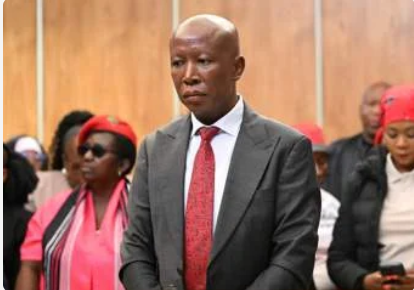
KuGompo, Eastern Cape – The legal and political landscape of South Africa is bracing for a pivotal moment as Economic Freedom Fighters (EFF) leader Julius Malema awaits sentencing today for unlawful firearm possession and discharge. The outcome of this high-stakes hearing in the KuGompo City Magistrate’s Court is not merely about one man’s legal predicament; it is a profound test of accountability, a potential reshaper of the EFF’s future, and a stark mirror reflecting the broader challenges of leadership succession within the nation’s political parties.
Prosecutor Joel Cesar minced no words in his impassioned plea for a custodial sentence, arguing that Malema had “blamed everybody for his actions. He dragged us to be participants in this show. It’s time for this court to tell him that this show is over.” Cesar’s reasoning underscored the State’s insistence on a jail term for Malema’s reckless act of firing a rifle into the air at a political rally, an act they contend posed significant danger to the public.
Malema’s defence team, however, mounted a robust counter-argument, seeking a non-custodial sentence and attempting to contextualise some of his more controversial statements. Advocate Tembeka Ngcukaitobi explained that Malema’s comments needed to be understood against the backdrop of his belief that AfriForum, the lobby group that pushed for his prosecution, was a “political adversary” and that the entire case was “an unfair prosecution because he believes they are behind this prosecution.” Ngcukaitobi urged Magistrate Twanet Olivier not to consider such “political statement” when deliberating on the sentence.
Magistrate Olivier is expected to deliver her sentence today, having heard extensive evidence in aggravation and mitigation from both the State and the defence. The charges against Malema are severe: unlawful possession of a firearm and ammunition, discharging a firearm in a built-up area, failure to take reasonable precautions to protect a person or property, and reckless endangerment. These convictions stem from a widely circulated video recorded during the EFF’s fifth-anniversary celebrations at the Sisa Dukashe Stadium in Mdantsane on 28 July 2018, where Malema was seen firing a rifle in front of thousands of supporters.
Cesar stressed the immense danger Malema’s conduct presented. “The accused did not just fire one shot and [leave] it at that, which we can consider to be an accident. He was malicious to say the least,” Cesar argued. He highlighted the sheer number of people present: “His actions constituted extreme danger to the 20 000 plus people that were present, not even mentioning the community around Mdantsane, which we know is one of the biggest locations in South Africa. It’s condensed, it’s densely populated and especially on a weekend, it is busy in Mdantsane.” The prosecutor contended that a custodial sentence would serve as a crucial warning against reckless firearm use, particularly in crowded environments.
Conversely, Malema’s legal representative, Laurance Hodes, argued that the State had adopted an inconsistent approach by emphasising Malema’s political prominence. Hodes contended that his client’s status as a public figure must be treated consistently, either as a mitigating or an aggravating factor. “So you ask on the one hand to make an example of this accused because he is the current leader of a political party, then they tell you ‘no, there’s an imperative – you must make us all equal before the law’,” Hodes stated, highlighting the perceived double standard.
The defence maintained that no injuries or damage resulted from the incident, urging the court to consider this in determining an appropriate sentence. Hodes rejected the State’s push for a lengthy custodial sentence, proposing alternative penalties. “They seem to imply that to impose a fine would be unconstitutional. That’s not the case, your worship. You can impose a fine,” he asserted, suggesting that a non-custodial sentence was a viable and just option.
Legal experts remain divided on the likely outcome. Cape Town lawyer Lufuno Musetsho believes direct imprisonment is probable, citing the general principle that unlawful firearm possession typically attracts such a sentence, reinforced by a prescribed minimum of 15 years. “While it may well be contended that substantial and compelling circumstances are present in this matter, thereby justifying a departure from the prescribed minimum, I am nevertheless of the view that the court is likely to impose a sentence of direct imprisonment, albeit tempered by partial suspension,” Musetsho commented, suggesting a sentence “in the region of eight years’ imprisonment, with a portion thereof suspended.”
However, celebrated criminal defence attorney William Booth offered a more cautious outlook, acknowledging the seriousness of the charges but stressing the difficulty in predicting the sentence. Booth noted that the court would consider Malema’s personal circumstances, including his status as an MP and lack of previous convictions. “A suspended sentence can still be imposed,” he added, leaving room for a less severe outcome.
The implications for Malema’s political career are profound. Under Section 47(1)(e) of the Constitution, a sentence exceeding 12 months imprisonment without the option of a fine would lead to his disqualification from Parliament. This disqualification, however, would be suspended if an appeal is ongoing, offering a potential reprieve. Should he be disqualified, he would be barred from public office for five years after completing his sentence.
Outside the heavily guarded courtroom, thousands of EFF supporters gathered, singing and demonstrating their unwavering loyalty. Malema, addressing his base after proceedings, accused AfriForum of wanting to “silence the voice of black people” and labelled the case an “injustice.” He vowed that “economic freedom” would be delivered “with or without Julius Malema,” declaring, “I stand before you unshaken by the threats of white supremacists. And because I fought them when I was still young, I’m too old to be shaken.” EFF MP Leigh-Ann Mathys echoed these sentiments, confirming the party’s preparedness to appeal any custodial sentence.
Eastern Cape SAPS spokesperson Brigadier Nobuntu Gantana assured the public of adequate police deployment to maintain order, urging motorists to avoid the court precinct and warning against lawlessness. “SAPS will not tolerate any lawlessness. Anyone found infringing upon the rights of others or engaging in criminal activities will face the full might of the law,” Gantana stated.
Beyond the immediate legal drama, Malema’s sentencing casts a harsh light on the fragility of personality-driven politics and the critical issue of succession within South Africa’s major parties. The EFF, built on Malema’s charisma and defiance, faces a potential leadership vacuum. The article highlights how former deputy president Floyd Shivambu’s impatience led to a fragmented radical left, leaving the EFF heavily reliant on Malema. This crisis, the commentary suggests, is not unique, drawing parallels with the ANC’s own looming succession challenges, where an elderly leadership struggles to groom a new generation.
In stark contrast, the Democratic Alliance (DA) is presented as having quietly demonstrated depth, showcasing a bench of younger leaders at its recent national congress. This comparison underscores the importance of leadership renewal for political survival, suggesting that parties must be bigger than their individual leaders to withstand crises and ensure continuity. The human cost of these political failures, the article concludes, is immense, as ordinary South Africans watch leaders play out dramas of ego and ambition while their daily struggles persist.
Today, as Magistrate Olivier delivers her judgment, it is not just Julius Malema who is on trial. It is the EFF, the ANC, and the very idea of leadership in a nation grappling with profound political and social challenges. The verdict will undoubtedly shape not only one man’s destiny but also the trajectory of South African politics for years to come.