

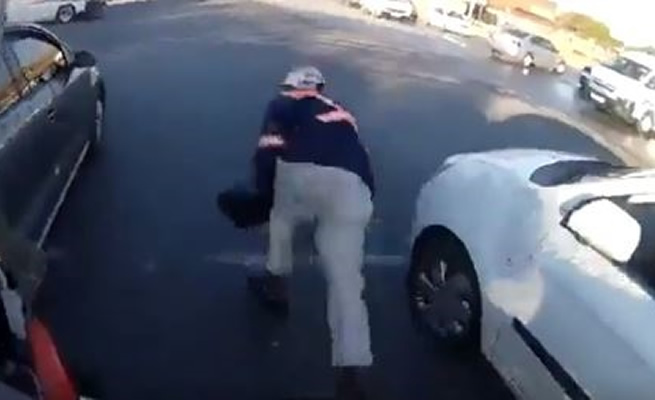
An unknown motorist who allegedly opened fire on a suspected smash-and-grab robber in Bonteheuwel could face a murder charge, as police and legal experts probe whether the fatal shooting can be justified as self-defence.
The incident unfolded last Thursday along a notorious stretch of Jakes Gerwel Drive at the Jakkalsvlei Avenue intersection in Bonteheuwel – a more than 2km corridor long identified as a hotspot for smash-and-grab attacks on motorists.
A motorist could face criminal charges after allegedly opening fire on a 26-year-old man accused of attempting a smash-and-grab robbery along a notorious stretch of Jakes Gerwel Drive and Jakkalsvlei Avenue in Bonteheuwel last Thursday.
The victim was shot multiple times in the back, head and arm, and collapsed in a field nearby, where children were playing. He was declared dead at the scene.
A motorist could face criminal charges after opening fire on a 26-year-old man accused of attempting a smash-and-grab robbery along Jakes Gerwel Drive and Jakkalsvlei Avenue in Bonteheuwel.
Police said the motorist involved has not yet been identified.
The victim was shot multiple times in the back, head and arm.
Western Cape police spokesperson Sergeant Wesley Twigg confirmed that a murder case has been registered and that detectives are hunting for the shooter.
Western Cape police spokesperson Sergeant Wesley Twigg confirmed that a murder case has been registered for investigation, although the motorist involved has not yet been identified.
“As part of the investigation, police are reviewing CCTV footage that may assist in establishing the circumstances surrounding the incident,” said Twigg.
By Wednesday afternoon, no complainant had come forward, and the shooter remained unknown, he said.
Police have also not been able to confirm whether any items were stolen during the incident or whether the motorist’s vehicle was damaged.
“Police members responded to a shooting complaint and, upon arrival at the scene, found the victim with gunshot wounds to his body,” Twigg said.
“The victim was declared deceased on the scene by medical personnel. The circumstances surrounding the incident are under investigation, and no arrests have been made at this stage.”
The killing has sharpened focus on how far civilians can go in using lethal force to protect themselves in high-crime areas – especially where a suspect may have been attempting to flee.
Legal expert and chairperson of the Law Society of South Africa William Booth said any potential prosecution would hinge on whether the driver can show that the shooting met the strict requirements for self-defence under South African law.
He explained that South African law requires an imminent threat to life or serious harm for lethal force to be considered lawful.
Booth said:
If the suspect was indeed running away and no longer posed an immediate threat, it may significantly weaken a claim of self-defence.
He added that investigators – and later the courts – would look closely at forensic and video evidence to determine whether the motorist’s response was proportionate.
He added that factors such as the direction of the gunshot wounds, the number of shots fired, and any available video footage or witness accounts would be critical in determining whether the force used was reasonable or excessive.
“Each case is judged on its own merits, but the courts will look closely at whether there were alternative options available to the motorist at the time,” he said.
According to Booth, the motorist could potentially face a murder charge, but the outcome would ultimately depend on the facts and the available evidence.
“Technically, yes, the motorist could be prosecuted for murder, but it all depends on what actually happened, what the motorist’s version is and what other evidence shows,” he said.
With the shooter still unidentified and no formal complainant stepping forward, police are relying on CCTV, forensics and witnesses to reconstruct the moments before and after the shots were fired.
Booth said in cases like this – where the identity of the shooter is still unknown, and police are relying on CCTV footage and forensic evidence – it is often in the person’s best interest to come forward sooner rather than later.
“If you are involved in an incident like this, you are entitled to consult a lawyer immediately. In fact, that would be my advice – speak to a lawyer and then, with proper guidance, report the matter to the police,” he said.
He warned that failing to report the incident could place the motorist at a disadvantage later on.
Booth said:
You don’t want to be on the back foot, where time passes and you haven’t reported anything, and then suddenly the police identify and arrest you. It’s often better to be upfront and say, ‘Yes, I fired the shots, but this is why… I was acting in self-defence, I feared for my life.
He reiterated that any self-defence claim will turn on whether there was an “imminent threat”, and whether the person who fired genuinely and reasonably believed their life was in danger.
“If the threat has passed – for example, if the person is fleeing – that can weaken a claim of self-defence,” he said.
However, Booth cautioned that such cases are rarely clear-cut.
“The fact that someone is shot in the back can be problematic, but it is not automatically proof that self-defence does not apply. It depends on positioning, movement and what was happening in those moments,” he said.
He added that the courts would also scrutinise the number of shots fired.
“The number of shots is important. If multiple shots are fired, the court will look at whether that was necessary to stop an attack or whether the person exceeded the bounds of self-defence. But it’s not as simple as saying more shots equals guilt: there are cases where multiple shots were justified because the threat continued,” Booth said.
Investigators are expected to rely on a combination of evidence, including CCTV footage, witness statements and ballistic analysis, to piece together what happened – a process that could take months.
Booth said once the police investigation is complete, the case will be handed to prosecutors, who must decide whether there is sufficient evidence to proceed with charges.
“The prosecution must determine whether there is evidence that the person intentionally killed without justification. But even then, the court must still assess whether the accused’s version is reasonably possible,” he said.
He noted that even if a suspect was fleeing, a motorist could still argue that they feared for their life – but that claim would have to be tested carefully.
“The court will look at everything: the environment, the level of danger in that area, what the accused believed at the time, and whether that belief was reasonable,” Booth said.
He urged authorities to do more to warn drivers, particularly visitors, about high-risk corridors.
He said:
People need to be informed about dangerous hotspots. Many incidents occur in areas near key routes, such as the airport. Awareness and proper policing are crucial.
Meanwhile, City of Cape Town metro police spokesperson Ruth Solomons said law enforcement deployments along Jakes Gerwel Drive vary in response to operational demands.
Meanwhile, City of Cape Town metro police spokesperson Ruth Solomons said patrols along Jakes Gerwel Drive are either roving or static, depending on operational demands.
“Given the many priority areas that City enforcement agencies have to attend to, a static presence is not always possible. The City does use CCTV as a force multiplier to monitor for suspicious persons or activities,” she said.
When asked whether the City had provided CCTV footage to police, Solomons said: “The City shares footage only with SAPS (South African Police Service) as part of their investigations.”
She added that smash-and-grab offences are opportunistic and not limited to known hotspots.
She added that smash-and-grab crimes are opportunistic in nature and can occur virtually anywhere.
Ward councillor Angus McKenzie said the particular section of Jakes Gerwel Drive where the shooting took place has long been plagued by organised smash-and-grab gangs targeting vulnerable motorists.
Ward councillor Angus McKenzie said the stretch of road where the incident took place has long been a hotspot for smash-and-grab syndicates targeting vulnerable motorists.
He said a combination of operational challenges and underreporting makes it difficult to police the area effectively.
“We don’t have details about the victim or whether he has family in the area at this stage,” McKenzie said.
He explained that while multiple law enforcement agencies are deployed – including neighbourhood safety officers in Bonteheuwel and Langa, as well as SAPS members from Bishop Lavis – the sheer length of the road presents a major challenge.
He said:
It’s roughly a 2km stretch. If officers are visible in one section, it creates an opportunity for criminals to operate in another.
He added that routine shift changes further complicate consistent coverage, leaving windows of increased vulnerability.
“Whether it’s SAPS or metro police, there are shift changes, and that inevitably creates gaps where the risk increases,” he said.
McKenzie said one of the biggest obstacles remains the reluctance of victims to report crimes.
“When incidents are not reported, it becomes extremely difficult to track suspects using available camera footage. Cases aren’t opened, and as a result, these crimes are not always classified as priority offences,” he said.
He acknowledged the toll the justice system can take on ordinary victims.
“People don’t want to spend years going back and forth to court, reliving the trauma over something like a smashed window or stolen belongings. That’s understandable, but it makes policing and prevention much harder,” he said.
For now, the murder docket remains open, the shooter unidentified, and the case set to test once again where the law draws the line between self-defence and unlawful killing on one of Cape Town’s most notorious commuter routes.