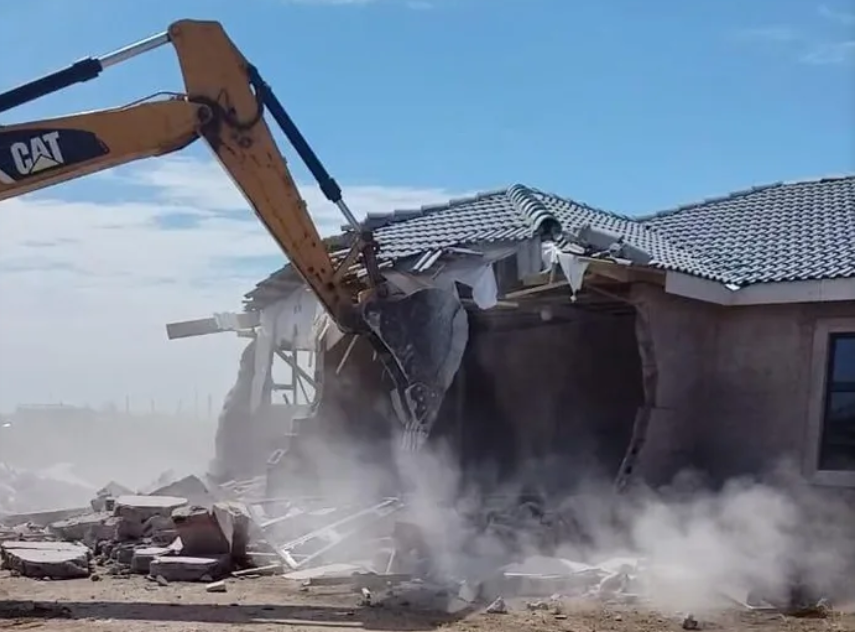
The quiet community of Thornville in Pietermaritzburg was transformed into a scene of devastation this week as heavy-duty bulldozers, flanked by heavily armed police and the notorious Red Ants, moved from yard to yard, reducing dream homes to piles of rubble. For many residents, the roar of the machines marked the end of years of investment and the beginning of a desperate struggle for survival, after they were found to have built their houses on land belonging to the state-owned power utility, Eskom.
The operation, led by officials believed to be from the sheriff’s office, targeted several properties that had been erected illegally on land occupied by an Eskom power station. The scale of the loss is staggering, with some homeowners reporting that they had poured millions of rands into their properties, only to watch them be brought to the ground in a matter of minutes.
Among the victims is Aron Zondi, a man whose ambitious property development was valued at a staggering R2.5 million. Zondi’s investment included the initial R40,000 purchase price for the land, the construction of a substantial main residence, and several additional structures. On Friday morning, he stood amongst the ruins of his hard work, grappling with the reality that his life savings had effectively vanished.
“But my home is no more, as it was destroyed this morning, and my money is down the drain.”
The National Transmission Company South Africa (NTCSA), a subsidiary of Eskom responsible for the land, has remained firm in its stance. The utility revealed that it had obtained three separate eviction orders from the Pietermaritzburg High Court as far back as last year. Despite this, many residents claim they were blindsided by the sudden arrival of the demolition teams.
Mbali Mchunu, 64, is one of those now facing a bleak future. Her house was demolished on Thursday, but the nightmare didn't end there. When she returned to her plot on Friday morning, she discovered that heartless thieves had already descended on the site, stripping away what little was left of her damaged building materials and fencing wire. It is believed the stolen zinc sheets and metal items were quickly sold to local scrap yards.
“Criminals are heartless for stealing from people who have suffered by witnessing their houses being brought to the ground. I was told that these criminals worked the entire night stealing our stuff, leaving me with nothing to start afresh,” said Mchunu.
Mchunu, like many others, blames Eskom for what she perceives as a lack of clear communication. She argues that the power producer did not do enough to warn unsuspecting buyers that the land was strictly off-limits to the public.
“I did not know anything about the eviction notice, which was only shown to me yesterday, just as they were already starting to destroy my house.”
The tragedy is compounded by the fact that many of these homeowners were victims of a sophisticated land-selling scam. Mchunu admitted she had paid R35,000 for her plot to a man who provided no legal documentation or proof of a sale agreement. Despite the loss, she refused to provide the cell number of the individual who sold her the land, though she expressed little hope of ever seeing a refund.
While some of the displaced residents appeared defeated, leaving their rubble neglected, others were seen frantically trying to retrieve whatever materials they could, hoping to salvage enough to rebuild their lives elsewhere. The atmosphere in Thornville remains tense, though the initial anger that greeted the bulldozers on Thursday has largely been replaced by a somber, tearful resignation.
Interestingly, not everyone in the area was surprised by the turn of events. One resident from a neighbouring farm suggested that the writing had been on the wall for a long time. According to this source, many of those who built on the Eskom land were well aware that they were taking a massive gamble and that a forceful eviction was almost inevitable.
The NTCSA has made its position on compensation very clear. In a statement released late last year, the company confirmed that it would not be compensating any individuals for structures demolished on its property. The utility maintains that because these buildings were unlawful and erected without any form of consent, there is no legal obligation to provide financial relief to the owners.
As the dust settles over Thornville, the case serves as a stark and expensive warning about the dangers of illegal land occupation and the ruthless efficiency of the state when it moves to reclaim its property. For the people of Thornville, however, the legal technicalities offer little comfort as they face the reality of being homeless and broke, with their millions of rands literally buried in the dirt.