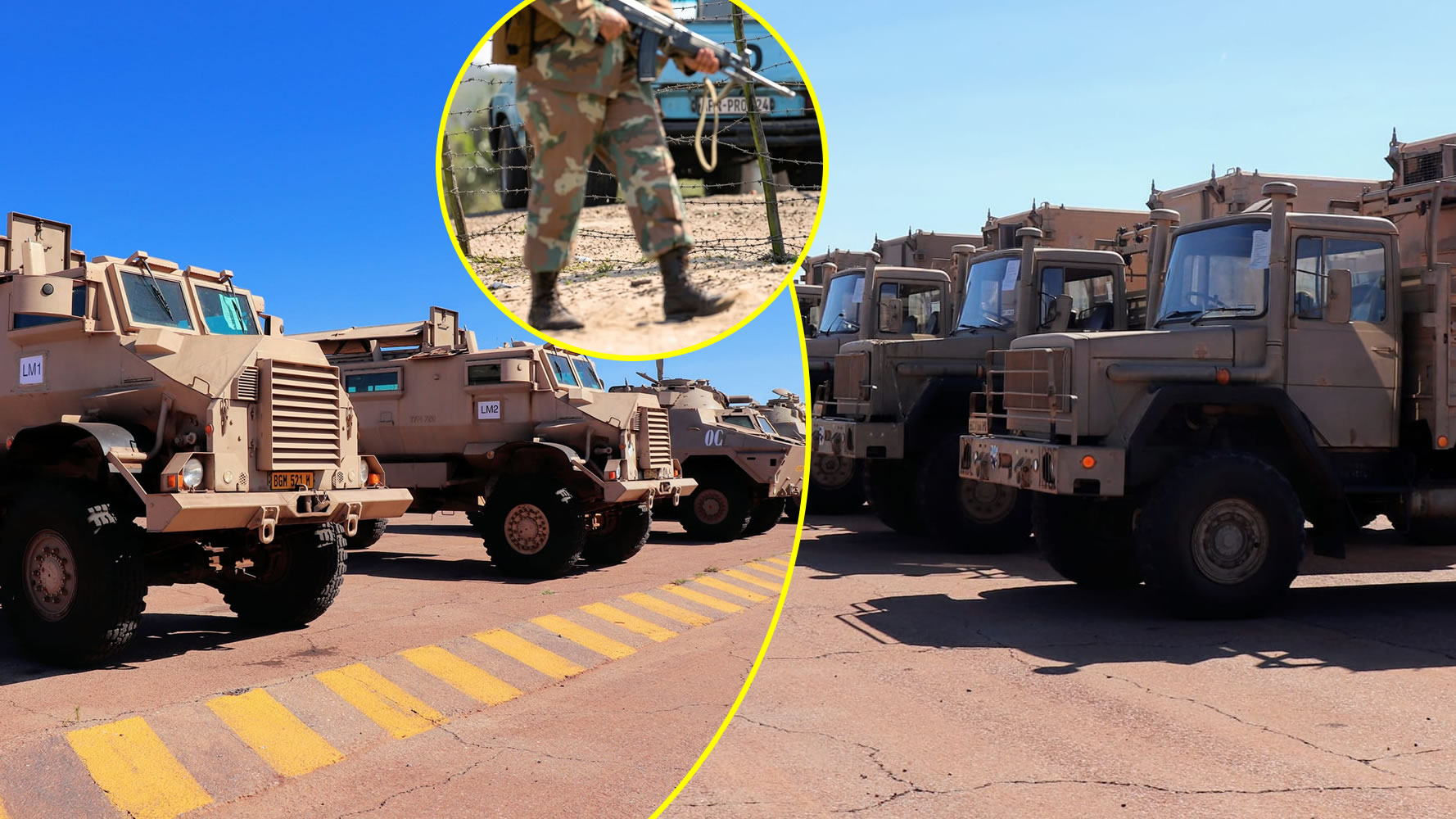
LIMPOPO – The Beitbridge border post, a vital artery connecting South Africa and Zimbabwe, has recently become the stage for a dramatic display of military-style hardware. The sight of amphibious vehicles patrolling the Limpopo River and high-tech drones soaring above has been officially described as a "security upgrade" by South African authorities. However, an in-depth investigation reveals that this formidable deployment is far more than a mere crackdown on illegal crossings; it is the visible front line of a silent, yet brutal, economic war between Harare and Pretoria.
At the heart of this escalating tension lies a complex web of illicit trade, corruption, and geopolitical manoeuvring. The new "tighter controls" are not simply about deterring undocumented migrants, but rather a direct response to a massive gold and cigarette smuggling syndicate that operates with impunity, allegedly under the protection of high-ranking Zimbabwean officials. This investigative piece will delve into the intricacies of this clandestine conflict, exposing how technology is being deployed to circumvent corrupt border officials who have, for decades, been complicit in these criminal enterprises. We will also examine the profound human toll, as ordinary Zimbabweans, whose livelihoods depend on cross-border trade, find themselves caught in the crossfire, becoming unwitting collateral damage in this high-stakes game.
The Iron Fist at the Limpopo
The recent deployment at Beitbridge saw Home Affairs Minister Leon Schreiber, accompanied by Border Management Authority (BMA) Commissioner Dr Michael Masiapato, conducting an oversight visit on 23 March 2026. Their presence underscored the gravity of the situation, as they inspected the newly introduced equipment designed to bolster South Africa's border security. The hardware includes specialised amphibious vehicles, capable of navigating both the waters of the Limpopo River and the challenging terrain along its banks. These vehicles, tested as a "proof of concept," have already demonstrated their deterrent effect, with reports of potential crossers on the Zimbabwean side retreating upon their appearance.
Beyond the ground-level patrols, the skies above Beitbridge are now monitored by advanced drone surveillance systems. Minister Schreiber lauded this technological leap, stating, "For the very first time ever, we have the ability to see people moving kilometres away from Beitbridge port of entry… trying to cross into South Africa." This transformative capability was showcased during the Minister's visit, where 25 undocumented individuals were intercepted and arrested in real-time, a testament to the enhanced detection capabilities. The BMA, backed by a substantial R990 million allocation, is clearly committed to modernising its infrastructure and curbing the persistent surge in illegal crossings that has long posed a threat to South Africa's sovereignty and economic stability.
Unmasking the Shadow Economy: Gold and Cigarettes
The true impetus behind this military-style upgrade, however, lies in the staggering scale of illicit trade. Beitbridge has long been a notorious hotspot for smuggling, with gold and cigarettes forming the bedrock of a multi-billion-rand shadow economy. Al Jazeera's 2023 "Gold Mafia" investigation cast a harsh light on a sophisticated gold smuggling and money laundering network, implicating Zimbabwe's political and economic elite. This investigation revealed how vast quantities of gold are illicitly extracted from Zimbabwe and funnelled into South Africa, effectively draining the former's national wealth.
Cigarette smuggling runs parallel to the gold trade, with massive consignments of illicit tobacco frequently intercepted. Reports indicate seizures of Remington Gold cigarettes worth as much as R14 million, highlighting the lucrative nature of this illegal enterprise. These syndicates are not merely opportunistic criminals; they are highly organised cartels with deep roots, often operating with the alleged protection of powerful figures. The border, therefore, is not just a point of entry or exit, but a conduit for the systematic siphoning of resources, turning it into a battleground for economic control.
The Corrupt Underbelly: A Systemic Challenge
Despite the technological advancements and increased patrols, the fight against illicit trade is severely hampered by pervasive corruption within the border management system itself. Minister Schreiber candidly acknowledged this systemic challenge, stating, "Corruption at the border cannot be addressed through technology alone." This sentiment is echoed by the alarming statistic that over 50 BMA officials have been arrested and convicted for corruption in the past year alone. These figures underscore the deep-seated nature of the problem, where officials, meant to uphold the law, are instead on the payroll of criminal syndicates.
BMA Commissioner Michael Masiapato further highlighted the vulnerability of South Africa's borders, describing their "poorest nature" as a significant threat to both security and legitimate trade. The sheer scale of the problem, spanning across 53 land ports, means that while technology can detect illegal activities, the human element of corruption often allows them to persist. The challenge, as Schreiber articulated, is not merely detection but the capacity to respond and make arrests, a task that requires more than just advanced surveillance; it demands an unyielding commitment to rooting out corruption from within.
The Human Toll: Collateral Damage in an Economic War
While the focus of the security upgrade is ostensibly on combating crime and illegal crossings, the real-world impact falls disproportionately on ordinary Zimbabweans. For many, cross-border trade is not a luxury but a necessity, a means of survival in a challenging economic climate. These informal traders, who transport goods like food and textiles between the two countries, are now finding themselves as "collateral damage" in this intensified border war. The tightened controls, while aimed at criminal syndicates, inevitably disrupt legitimate livelihoods, pushing vulnerable populations further to the brink.
The statistics paint a stark picture: over the recent Easter weekend, more than 1,000 undocumented migrants were arrested at Beitbridge. Furthermore, Minister Schreiber noted that approximately 50,000 individuals lacked the necessary documentation, highlighting the widespread nature of informal cross-border movement. For these individuals, the border is not merely a line on a map but a barrier that increasingly restricts their ability to earn a living and provide for their families. The metaphor of the border as a "cage" becomes chillingly apt – designed to trap the wealth of the nation while simultaneously keeping the poor out, effectively criminalising their struggle for survival.
A Silent Economic War
The deployment of "war machines" at Beitbridge, therefore, transcends the simple narrative of a security upgrade. It is a strategic move in a silent economic war between Harare and Pretoria, a battle for control over resources and the flow of wealth. South Africa, grappling with its own economic challenges and the strain of illegal immigration, is attempting to stem the tide of illicit goods and undocumented individuals that it perceives as a drain on its resources and a threat to its internal stability. The R990 million investment in the BMA and the deployment of advanced technology are clear indicators of this resolve.
Minister Schreiber's comparison with wealthier nations, noting that "America allocated $75 billion to addressing some of their challenges. We don’t have that money," underscores the financial constraints South Africa faces. This necessitates a targeted approach, focusing on vulnerable sections of the border like Beitbridge. The visit by Minister Schreiber and Commissioner Masiapato, therefore, was not just an inspection but a political statement, a declaration that South Africa is prepared to use all available means to secure its borders and protect its economic interests. The border is no longer just a crossing point; it is a fortified frontier in a complex, multi-faceted conflict.
Conclusion
The heightened security measures at the Beitbridge border post, characterised by the deployment of amphibious vehicles and drones, represent a significant escalation in South Africa's efforts to control its porous frontier. While presented as a necessary "security upgrade," the underlying reasons are far more intricate, pointing to a silent economic war against sophisticated gold and cigarette smuggling syndicates, often protected by powerful figures in Zimbabwe. The systemic corruption within border agencies further complicates this battle, requiring more than just technological solutions.
Ultimately, the deployment at Beitbridge highlights a broader struggle for economic sovereignty and stability in the region. As South Africa fortifies its borders, the human cost is borne by ordinary Zimbabweans, whose legitimate cross-border trade is increasingly stifled. The border, once a gateway, has transformed into a complex barrier, a "cage" that seeks to control the flow of wealth while inadvertently trapping the most vulnerable. This ongoing saga at Beitbridge serves as a stark reminder of the intricate interplay between national security, economic interests, and human livelihoods in Southern Africa.