

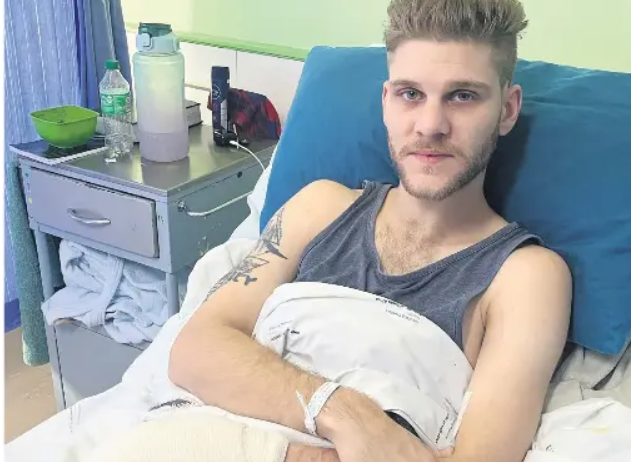
In a harrowing tale of pain and struggle, 24-year-old Jonothan Gerds from Johannesburg is confronting an unimaginable situation. After suffering for eight excruciating months due to complications from a botched medical procedure, Gerds is now contemplating drastic measures, including self-amputation, to escape the agony that has engulfed his life.
"Earlier this week, I wanted to get out of hospital, find the nearest butchery and use a bandsaw to sever my left hand from the rest of my body," Gerds explained through tears during an interview with The Citizen. The pain he endures is relentless, and his hand has deteriorated to a point where he struggles to find hope in recovery. “I feel like I want to just cut it off with the first sharp instrument I can find,” he said. “Or failing that, I am prepared to lie here and chew it off.”
This pain-filled saga began not in Johannesburg, but rather in the coastal town of Saldanha, Western Cape, three years ago. Gerds, who lives with high-functioning autism, found himself in a challenging situation when a night of overstimulation led him to seek relief through magic mushrooms, a decision he later regretted. “My friends suggested I take a small dose,” he said. “They figured it would help me sleep, but it did the opposite.”
Admitted to Vredenburg Hospital, Gerds recalls a young doctor administering an injection against his wishes. “Despite asking the doctor not to inject me with any kind of medication, he insisted. All I wanted was a piece of paper and a pen instead, to write, so that I could calm myself down.” The consequences of that injection were catastrophic. Gerds described feeling something was wrong almost immediately. "I told the doctor straight, you just messed up,” he recalled, highlighting that the injection had nicked his tendon and injected a substance into the brachial artery, a major blood vessel crucial for arm and hand function.
The fallout from this medical disaster was severe, leading to infections in his arterial system. Gerds faced a dizzying array of treatments across multiple facilities, including additional stays in Cape Town where he was placed on a long course of antibiotics. Alongside the physical damage, he found himself in psychiatric care under baffling circumstances, stating, “There was nothing there except a hole in the centre where I could ablute.”
By the time he returned home to Johannesburg, the impact was profound. “I had severe vascular and nerve damage,” Gerds lamented, detailing how his hand had become stiff, and movement was nearly impossible. Recovery, as he discovered, was a slow and painful process, marred by setbacks that would only intensify his plight. An allergic reaction to latex gloves compounded his situation, igniting a severe skin condition that worsened due to the poor blood supply in his arm.
Despite his ongoing ordeal, Gerds and his family encountered bureaucratic hurdles when seeking urgent care. In late August of last year, he was referred to Charlotte Maxeke Johannesburg Academic Hospital, but both he and his family were met with shocking indifference. “They told me it’s not an emergency,” he said.
His mother, Cheryl Gerds, expressed frustration over the systemic failures they faced, saying, “Even with a referral letter saying this is urgent, he was still told it’s not an emergency.” The urgency of Jonothan’s condition ultimately required neighbours to intervene, leading to his eventual admission to the hospital, but the struggle did not end there.
Inside the hospital, Gerds faced a distressing cycle of delays, missed surgery slots, and inadequate pain management. “For about eight months straight, I’ve been dealing with probably the most excruciating and escalating pain I have ever experienced in my life,” he said. His hand deteriorated into a state of necrosis, ravaged by flesh-eating bacteria.
In a rare moment of relief, a private doctor devised a temporary antibiotic treatment. Surgery eventually took place, with multiple procedures performed in one session, restoring partial blood flow to his hand. Yet, the damage inflicted upon his radial artery posed significant barriers to his recovery, and Gerds remains acutely aware of the risks he faces.
“I’m not okay,” Gerds admitted bluntly. “If they can save it, then save it. If they can’t, then just cut it off. I just want normal pain for a change.” His mother, witnessing the rapid deterioration of her son’s condition and the emergence of new complications post-surgery, is left grappling with despair.
As Jonothan Gerds battles unimaginable physical and emotional turmoil, his story serves as a stark reminder of the fragility of life and the dire consequences of medical negligence. The family continues to advocate for answers and timely care, hoping for a resolution to Jonothan’s suffering.