

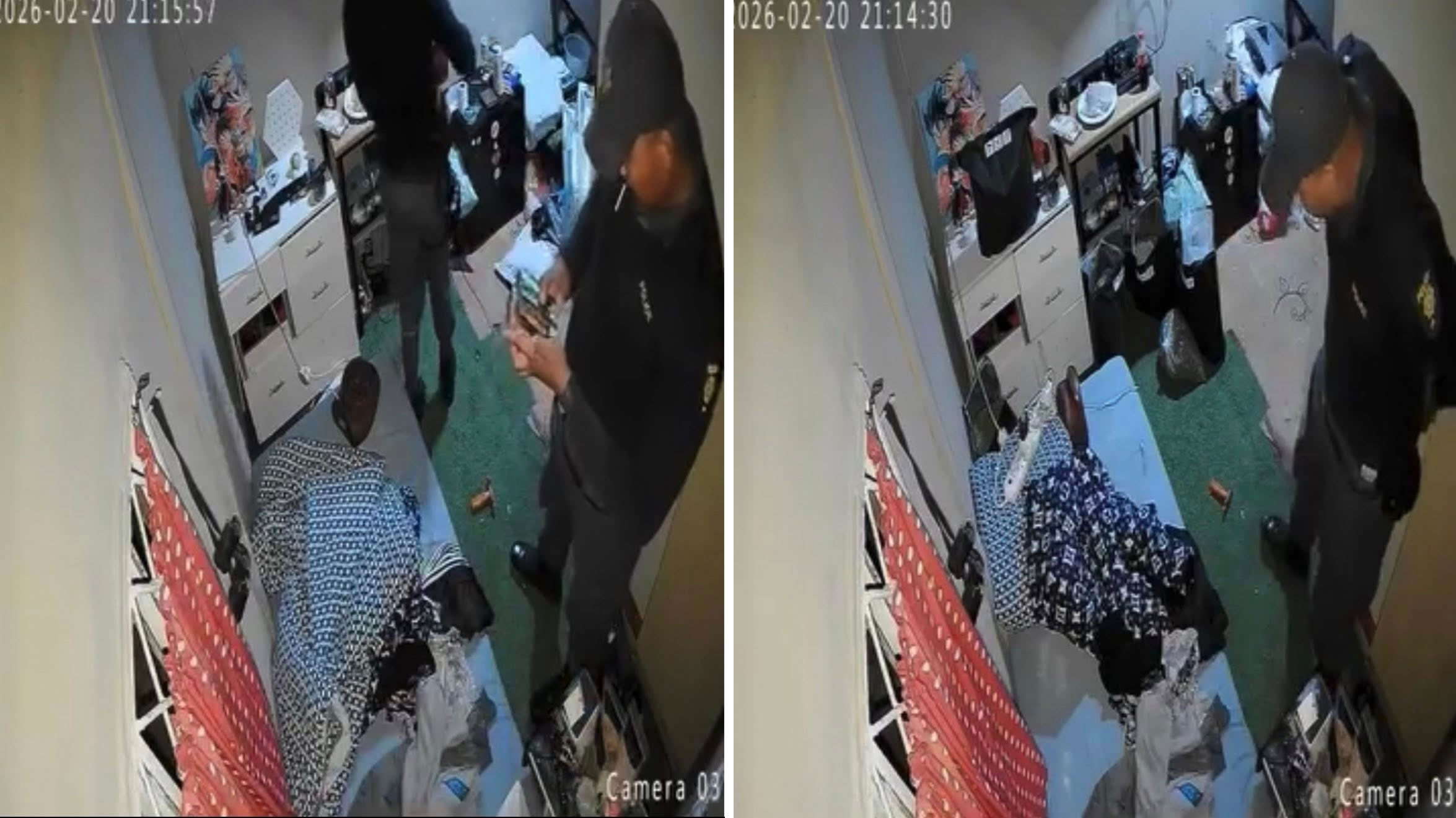

CAPE TOWN – The flickering blue and red lights of a police van usually signal the arrival of law and order, a beacon of safety for communities besieged by the scourge of the drug trade. But for one household in the Western Cape, those lights preceded a different kind of intrusion—one where the boundary between the lawman and the lawbreaker became indistinguishable.
A four-minute video, time-stamped 21:14:00 on 20 February 2026, has begun circulating on social media platforms, stripping away the dignity of the South African Police Service (SAPS) uniform in a matter of seconds. The footage, captured by a discreetly placed CCTV camera, does not show a heroic bust or a tense standoff. Instead, it depicts a police officer, supposedly conducting an official drug raid, repeatedly dipping his hands into a bag of cash and stuffing the proceeds into his pockets.
The incident, which has been dubbed the "Robber Cop" scandal by local residents, has ignited a firestorm of criticism across the province. It comes at a time when public trust in the police is already at a historic low, battered by a relentless tide of corruption allegations and a backlog of over 15,000 cases of police wrongdoing currently sitting with the Independent Police Investigative Directorate (IPID).
The Anatomy of a Theft
The video begins with the officer entering a cluttered room. A marked SAPS vehicle, later linked to the Steenberg police station, is visible outside the premises. Inside, the officer's attention is immediately drawn to a bag. He pauses, his eyes darting around the room to ensure he is unobserved. Satisfied that the coast is clear, he reaches into the bag, pulls out a handful of what appears to be banknotes, and quickly retreats behind a cupboard to conceal the money in his pocket.
The nervousness is palpable. The officer returns to the bag a second time, his movements jerky and hurried. He attempts to hide a second stash under his jersey, but thinking better of it, he pulls it out and tucks it into the back of his trousers.
A third trip to the bag follows. This time, he stuffs more cash into his lower pocket before moving the bag next to a bed, perhaps in a futile attempt to make the scene look less disturbed. When a second officer enters the room, the first officer's demeanour shifts instantly. He can be heard remarking about the “lots of ganja” allegedly found on the premises, his voice maintaining a professional veneer that belies the thousands of rands now hidden against his skin.
But the greed was not yet satiated. Maar die eerste officer was nog nie klaar nie—the first officer was not finished yet. As his colleague began searching the room, seemingly oblivious to the theft occurring inches away, the officer returned to the bag one last time, draining it of its remaining contents and sliding the final notes into his back pocket.
A Systemic Rot
While the Steenberg incident is the latest to capture the public's imagination, it is far from an isolated occurrence. Investigative journalists have tracked a disturbing pattern of "raiding for profit" across the Western Cape. Just months prior, in March 2025, three police constables from the Nyanga SAPS were hauled before the courts on similar charges of corruption. In that instance, the officers were accused of using the pretext of a search to extort money from local business owners.
The statistics paint a grim picture. According to recent reports from the Democratic Alliance and IPID, the backlog of police misconduct cases includes 1,020 allegations of torture, 9,306 assault complaints, and nearly 200 specific cases of corruption.
"This is where the rot begins," a community leader from the Steenberg area remarked, speaking on condition of anonymity for fear of reprisal. "When there are no consequences for small misconduct, it escalates into serious corruption and criminality. If the people who are supposed to protect us are the ones robbing us, who do we turn to?"
The Western Cape police leadership has been forced into a defensive crouch. Police spokesperson Captain FC van Wyk confirmed that an internal investigation is underway, though he noted with some frustration that no formal criminal complaint has yet been lodged by the victims of the raid.
“Kindly be advised that this office has noted with concern a video clip on social media platforms regarding a police officer who is stealing money during an operation,” Van Wyk stated. “The area where it happened and who the officer is are currently under investigation. We want the person who issued the video clip to come forward and open a criminal case for investigation.”
Van Wyk's tone sharpened as he addressed the internal culture of the force. “We want to send a stern warning to corrupt officials, criminal activities within our ranks cannot be tolerated. The status and dignity of the SAPS badge and uniform must at all times be safeguarded and protected with pride, especially by police officers.”
The Silence of the Victims
The lack of a formal complaint highlights a secondary crisis: the fear of the police. In many communities, opening a case against an officer is seen as a dangerous gamble. Whistleblowers often find themselves targeted by the very colleagues of the person they are reporting.
The National Anti-Corruption Hotline (0800 701 701) exists as a secure channel for such reports, but for many, the risk remains too high. The "Robber Cop" video was leaked anonymously, a testament to the fact that the person behind the camera trusted social media more than they trusted the local police station.
This erosion of trust has dire consequences for the fight against actual crime. When the SAPS conducts legitimate raids to remove drugs like "ganja" (cannabis) or "tik" (methamphetamine) from the streets, their efforts are undermined by the perception that they are simply there to "collect their share."
Leadership Under Fire
The crisis of accountability has reached the highest levels of government. In February 2026, during the release of the third-quarter crime statistics, Acting Minister Firoz Cachalia was blunt about the state of the service.
“Those who fraternise with criminals or involve themselves in criminality and corruption have no place in our criminal justice system,” Cachalia said. “The SAPS must be a bastion of integrity, not a sanctuary for thieves.”
Yet, critics argue that the words of ministers rarely translate into action on the ground. The Build One South Africa (BOSA) movement recently slammed the SAPS over what it termed an "accountability crisis," noting that even criminal convictions do not always lead to immediate dismissal from the force.
The Steenberg officer, caught in high-definition greed, now serves as the face of this crisis. In the video, as he stands in the room, his uniform is crisp, his badge is visible, and his authority is absolute. But as he reaches into that bag for the fourth time, the authority vanishes, replaced by the desperate, furtive movements of a common thief.
The Road to Reform
For the residents of the Western Cape, the "Robber Cop" video is not just a news story; it is a confirmation of their daily reality. The "status and dignity" that Captain Van Wyk spoke of feels like a distant memory in neighbourhoods where the police are viewed with the same suspicion as the gangs they are meant to dismantle.
True reform will require more than just the suspension of one officer caught on camera. It will require a clearing of the IPID backlog, a strengthening of whistleblower protections, and a fundamental shift in the "blue wall of silence" that allows such behaviour to persist.
Until then, the footage of the Steenberg raid will remain a haunting reminder of the hollow promise of the thin blue line. The officer in the video may have walked out of that room with his pockets full of cash, but he left something far more valuable behind: the last remnants of his community's trust.
As the investigation continues, the SAPS continues to urge anyone with information regarding corruption to step forward. The National Anti-Corruption Hotline remains open at 0800 701 701, waiting for the voices that are currently too afraid to speak.