

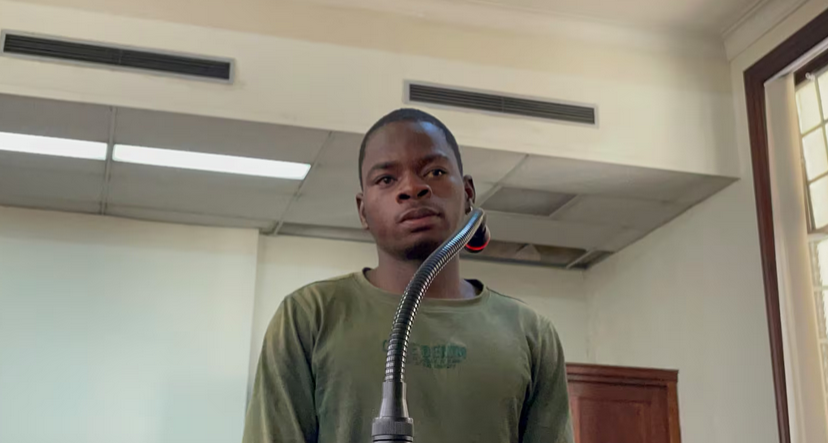
The legal status of a 25-year-old Mozambican man arrested in connection with the murder of popular DJ and broadcaster Warrick “DJ Warras” Stock has become a central issue in the case, after his first court appearance in Johannesburg on Monday raised serious questions about his identity and right to be in South Africa.
Armindo Pacula, who was arrested at the Marathon informal settlement in Primrose at about 8pm on Saturday during a joint crime intelligence and Ekurhuleni Metro Police Department (EMPD) takedown, appeared in the Johannesburg magistrate’s court under heavy guard.
The courtroom was filled with heavily armed EMPD officers, underscoring the seriousness with which the authorities are treating the case and the perceived risk posed by the accused.
Pacula faces multiple charges, including premeditated murder, conspiracy to commit murder and contravention of the Immigration Act. If convicted of murder, he faces the possibility of a life sentence.
He is the second accused in the DJ Warras matter, following the arrest of Victor Majola, who has already been denied bail in the same case. Pacula is expected to appear alongside Majola when the case proceeds.
Identity and immigration status under scrutiny
While Monday’s brief appearance was meant to move the case forward, it quickly became clear that the State could not proceed until basic questions about Pacula’s identity and legal status in South Africa are resolved.
During the proceedings, state prosecutor Vincent Mochabela challenged the reliability of the details supplied by Pacula, saying authorities had struggled to obtain any official documentation for him.
Mochabela told the court that officers had been unable to secure a passport or proof of address, and that there was nothing before the State to confirm who Pacula is or whether he is lawfully in the country.
Pacula, however, insisted that he had handed his identification over to the police at the time of his arrest, and that it had not been returned.
According to what was placed on record, he claimed that his ID had been taken by officers during the weekend takedown operation in Primrose.
Mochabela said that before the case could proceed, verification processes would have to be completed.
“At this stage, your worship, the court asks for a remand. His co-accused is appearing on the 11th, so we’d like to have them appear together, and so we’d like for it to be remanded to then for address verification and legality, because at this stage we have nothing to verify. There is no passport which has been handed to us or asylum seeker [papers],” he said.
The State is expected to use the time before the next appearance to confirm Pacula’s identity, check whether he holds any valid immigration documents and verify the address he has given to the court.
Bail bid stalled – but accused still wants to apply
Because of the uncertainty around who Pacula is and where he lives, the court could not move ahead with any bail application on Monday.
Without a verifiable address or clear indication of lawful residence, it is nearly impossible for the court to assess his ties to the community, risk of flight or likelihood of evading trial – all central issues in bail decisions.
Nevertheless, Pacula’s legal aid lawyer told the court that his client was still determined to apply for bail.
“The address that he [Pacula] has given is not clear, and there is no indication that he has lawful documentation to be in SA, but he still says that he wants to apply for a bail application,” said the lawyer.
This sets up a possible clash in the coming weeks between the accused’s insistence on pursuing bail and the State’s argument that his unclear status and incomplete documentation make him a serious flight risk.
For now, the court has held back on hearing any formal bail application until the outstanding issues around documentation and verification have been addressed.
Next court dates: verification first, joint appearance later
The magistrate agreed with the State that it was necessary to finalise verification before the case moved forward in earnest.
Pacula will be back in court on 9 February for the verification of his address and to determine his legal status in South Africa. This appearance is expected to focus mainly on administrative and procedural matters rather than the substance of the murder case.
Once those checks are complete, he is then expected to join Majola in the dock on 11 February, as the State moves towards consolidating the case against both accused.
The prosecution has already signalled that it wants the two to appear together going forward, reflecting the view that they are jointly implicated in the alleged plot and that the case is better managed as a single matter.
High-profile killing, regional crime concerns
The murder of Warrick “DJ Warras” Stock has added to growing concerns about violent crime targeting high-profile figures in South Africa’s entertainment and media circles, at a time when the country is still grappling with a series of high-impact killings.
While the details of the State’s case against Pacula and Majola are yet to be fully ventilated in open court, the charge of premeditated murder and an additional charge of conspiracy to commit murder point to an alleged planned attack rather than a spontaneous incident.
The arrest of a foreign national and the focus on his immigration status also highlight the wider pattern of cross-border crime in southern Africa, particularly involving Mozambique and South Africa. Over recent years, law enforcement agencies in both countries have had to cooperate more closely to tackle syndicates involved in vehicle theft, cash-in-transit robberies, kidnapping for ransom and trafficking.
Immigration status has increasingly become a factor in serious criminal cases, with prosecutors arguing that undocumented or irregular migrants may pose an added flight risk due to their weaker ties to formal addresses and the potential for slipping back across borders undetected. Defence lawyers, on the other hand, have often countered that immigration irregularities should not automatically disqualify accused persons from being considered for bail, especially where they have family or employment ties in South Africa.
In Pacula’s case, the absence of a passport, asylum seeker permit or other documentation, as recorded in court, has already become a central obstacle to bail and a key point of contention between the State and the defence.
Heavy police presence signals seriousness of case
The fact that Pacula’s first appearance took place in a courtroom “filled with heavily armed EMPD officers” is a clear indication of how seriously the authorities are treating the matter.
Such a show of force is typically reserved for high-risk accused, where there may be fears of escape attempts, interference with witnesses or possible reprisals from rival criminal elements. It also reflects broader efforts by the police and metro authorities to demonstrate a firm stance on violent offences linked to organised or semi-organised criminal activity.
Pacula’s arrest followed a crime intelligence-led takedown operation involving EMPD officers at the Marathon informal settlement in Primrose, an area that has in the past been associated with dense, hard-to-police living conditions and a mix of formal and informal dwellings that can provide cover for suspects.
The operation, conducted at around 8pm on Saturday, suggests that Pacula’s movements were being monitored in the lead-up to his arrest and that authorities were confident of his role in the case before moving in.
Life sentence looming if convicted
Should the court ultimately find Pacula guilty of premeditated murder, he faces a life sentence under South Africa’s minimum sentencing laws, which prescribe life imprisonment for certain categories of planned or aggravated killings unless substantial and compelling circumstances are found to justify a lesser sentence.
The added charge of conspiracy to commit murder further underscores the State’s position that the killing of DJ Warras was not an isolated or accidental act, but the outcome of a coordinated plan involving more than one person.
For now, however, the case is still at an early stage. The next key steps will be the verification of Pacula’s identity and immigration status on 9 February, followed by his joint appearance with co-accused Victor Majola on 11 February.
Only once those procedural hurdles are cleared will the court begin to hear more detailed evidence about what exactly happened to Warrick “DJ Warras” Stock, and what role, if any, the Mozambican accused and his co-accused are alleged to have played in his death.