

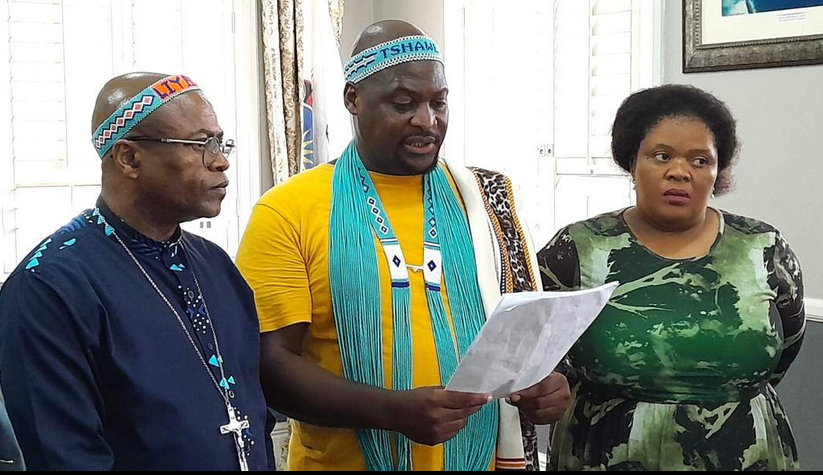
Nigerian national Solomon Ogbonna Eziko has issued an unreserved public apology to South Africans and traditional leaders, insisting he is “not a king and would not purport to be one” after outrage over what was widely described as his “coronation” as an Igbo king in KuGompo (formerly East London).
The ceremony, held on 14 March 2026, sparked protests and a diplomatic backlash, with South African traditional authorities and government officials condemning what they viewed as an attempt to establish a parallel kingship structure on South African soil.
Nigerian national Solomon Ogbonna Eziko apologised to South Africans and traditional leaders, stating “I am not a king and would not purport to be one” following his alleged “coronation” as Igbo king on 14 March.
Eziko denied being coronated, explaining the ceremony was merely his appointment as a senior elder of the Association of Igbo Chapter in the Eastern Cape, with no royal authority conferred.
Nigeria’s acting high commissioner will visit the Eastern Cape on 24 April to formally apologise to King Jonguxolo Sandile, with officials calling the alleged coronation “illegal and unconstitutional”.
The gathering, attended by members of the Nigerian Igbo community, was initially described on social media and in some quarters as the coronation of an “Igbo king” in KuGompo. That framing led to a swift backlash from local traditional authorities, who saw it as a direct affront to the authority of Kumkani Jonguxolo Sandile and the recognised structures of the AmaRharhabe Kingdom.
Nigerian national Solomon Ogbonna Eziko has apologised to the people of South Africa, saying he is “not a king and would not purport to be one”.
Eziko drew controversy following claims that he was “coronated” as the “king” of the Nigerian Igbo community in KuGompo (formerly East London) on 14 March.
The alleged “coronation” prompted local traditional leaders to organise protest marches against the ceremony, with the most recent demonstration taking place in the city on Friday – the same day Eziko issued a public apology.
The apology was conveyed in a formal letter issued on Eziko’s behalf by ABC Okokoh of Ohaneze Ndigbo Association of South Africa, a socio‑cultural organisation representing the Igbo community in the country.
The letter was issued on his behalf by ABC Okokoh of Ohaneze Ndigbo Association of South Africa, a socio-cultural organisation of the Igbo community in South Africa.
“I wish to extend my sincere and unreserved apology to Kumkani Jonguxolo Sandile (Aaaaaa! Vululwandle!) of the AmaRharhabe Kingdom (in Buffalo City) for the Igbo cultural gathering of 14 March 2026 in KuGompo City (East London).
“I further extend my sincere and unreserved apology to the traditional leadership of the Republic of South Africa, the community of KuGompo, and the good people of South Africa at large,” the apology reads.
Speaking to News24 on Friday afternoon, Okokoh confirmed that the apology was indeed from Eziko.
Speaking to News24 on Friday afternoon, Okokoh confirmed the apology was from Eziko.
In the letter, Eziko firmly rejects the characterisation of the March event as a coronation and denies that any royal status was conferred on him.
In the apology, Eziko denied he was “coronated”.
“I am not a king and would not purport to be one,” he stated.
He says what took place was an internal community process: his appointment as a senior elder within a local Igbo association, without any claim to kingship, clan leadership or traditional authority.
“What took place on 14 March 2026 was my appointment as a senior elder of the Association of Igbo Chapter in the Eastern Cape.
This appointment did not confer any authority on me whatsoever to be a king, leader of a clan or chiefdom. I, therefore, state categorically that I remain one of the subjects of Kumkani Jonguxolo Sandile, our pre-eminent king of AmaRharhabe Kingdom.
By explicitly affirming his status as a subject of King Sandile, Eziko appears to be seeking to defuse tensions with the AmaRharhabe royal house and broader South African traditional leadership structures.
The controversy, however, has already escalated to the diplomatic level. Deputy Minister of Cooperative Governance and Traditional Affairs Zolile Burns‑Ncamashe has confirmed that Nigeria’s acting high commissioner, ambassador Alexander Ajayi, will travel to the Eastern Cape to apologise in person to King Sandile.
Deputy Minister of Cooperative Governance and Traditional Affairs Zolile Burns-Ncamashe is expected to hold a meeting to resolve the tension at Mngqesha Great Place in Qonce, Buffalo City, on 24 April.
“The acting high commissioner, ambassador Alexander Ajayi, will be descending to the Eastern Cape to pay a courtesy visit to His Majesty, King Sandile. (The meeting will) include the Premier of the Eastern Cape (Oscar Mabuyane) and the Executive Mayor (Princess Faku) of Buffalo City.
Burns-Ncamashe said:
“(Ajayi is visiting) the Eastern Cape to express an unequivocal apology on behalf of the Federal Republic of Nigeria. We all agreed that the purported coronation of the Nigerian king in South Africa was illegal and unconstitutional.”
The deputy minister said the South African side had insisted on engaging only once the Nigerian High Commission had formally verified Eziko’s status and role.
The deputy minister told the media that Eziko had attempted, “several times”, to reach out to the Rharhabe Kingdom.
“We have insisted that we cannot meet with someone who has not been verified by the Nigerian High Commission. We expect to see (him) on 24 April when ambassador Ajayi visits the palace (in Mngqesha),” said Burns-Ncamashe.
The incident has fuelled broader debates about sovereignty, the recognition of foreign cultural structures on South African soil, and the limits of community‑based leadership arrangements within migrant and diaspora communities.
South African law, through the Traditional and Khoi‑San Leadership Act, recognises specific traditional leadership institutions and prescribes how they are constituted and acknowledged by the state. Any perceived attempt to create “kingships” or royal structures outside that framework is seen by many traditional leaders and government officials as a direct challenge to the constitutional order.
In this context, Eziko’s insistence that he is merely a senior elder within a voluntary association – and not a monarch – is significant. It aligns with the Nigerian embassy’s own effort to frame the matter as a misunderstanding rather than an intentional attempt to undermine local authority.
The forthcoming visit by ambassador Ajayi to Mngqesha Great Place, with the Eastern Cape premier and Buffalo City’s executive mayor expected to attend, underscores how seriously both governments are treating the issue. It also highlights the importance of traditional leadership institutions in South Africa’s governance and social fabric, and the sensitivity around any suggestion that foreign nationals might hold parallel status as “kings” within the country’s borders.
For now, Eziko’s public apology and his affirmation of loyalty to King Sandile may help ease immediate tensions. But the episode has already prompted civil society groups and government officials to call for clearer protocols on cultural titles, community leadership roles and public ceremonies involving foreign nationals – to ensure that respect for cultural diversity does not cross into territory that appears to challenge South Africa’s constitutional and traditional leadership framework.