

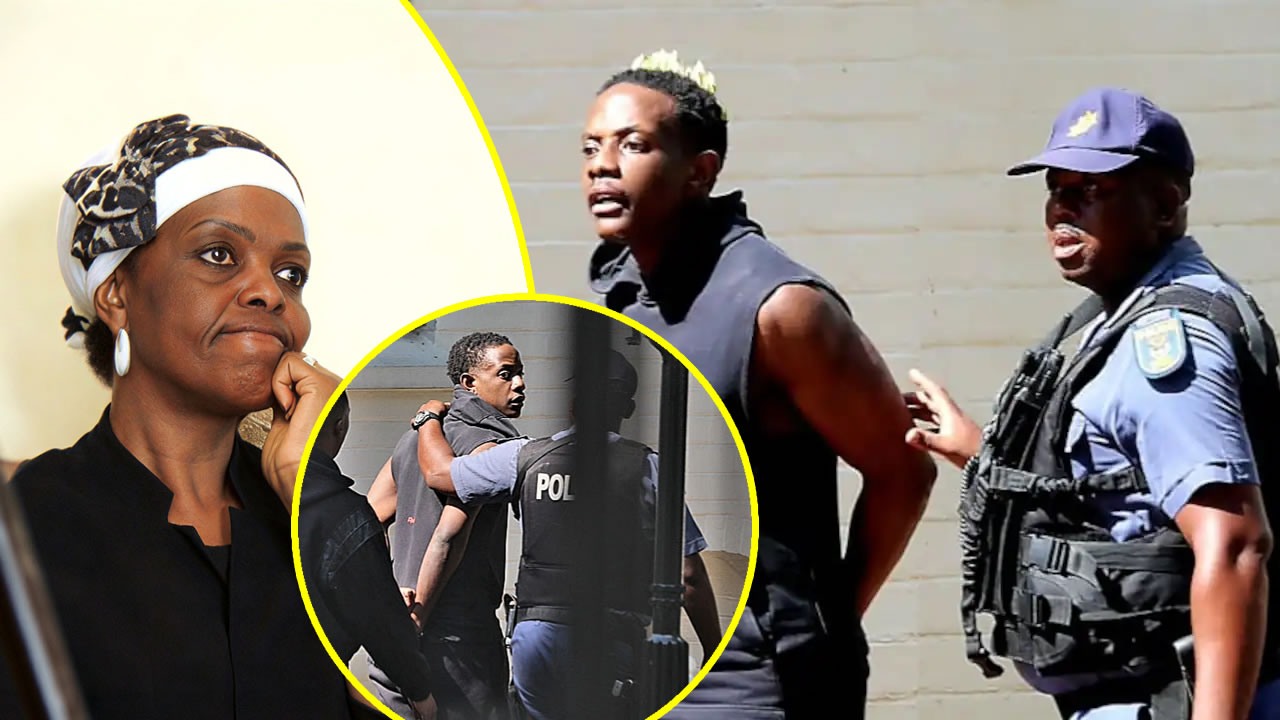
JOHANNESBURG — For years, the name Mugabe was synonymous with an untouchable dynasty, a political fortress that seemed impervious to the laws governing ordinary men. But in the leafy, high-walled suburb of Hyde Park, the "money tap" that has sustained the youngest son of Zimbabwe's late president, Robert Mugabe, may finally be running dry.
The scene at 37 Second Street on Thursday morning, last week, was a far cry from the champagne-soaked parties that have defined Chatunga's social media presence. Instead of designer labels and luxury watches, there were South African Police Service (SAPS) divers, K9 units, and forensic teams scouring the grounds of one of Johannesburg's most exclusive properties. They were searching for a missing firearm after a 23-year-old gardener, an employee of the Mugabe household, was shot and left in a critical condition. Chatunga, the man who once famously poured a bottle of R4,000 Armand de Brignac Ace of Spades champagne over a diamond-encrusted watch, now finds himself in a cold cell, reportedly collapsing twice in custody as the weight of attempted murder charges begins to settle.
How does the son of a deceased president, whose country remains gripped by economic devastation, afford a life of luxury in a neighbourhood where properties range between R10 million and R18 million? This is the question now at the heart of an investigation that could see the Mugabe family's "hidden" wealth in South Africa subjected to the country's stringent asset forfeiture laws. For the first time since the 2017 coup that toppled his father, the youngest Mugabe is facing a justice system that no longer feels obligated to look the other way.
The Blue Roof Legacy
To understand the scale of Chatunga's lifestyle in Johannesburg, one must first look back at the origins of his privilege: the iconic Blue Roof residence in Borrowdale, Harare. A sprawling 25-bedroom mansion set on 44 acres of prime real estate, the Blue Roof was the ultimate symbol of elite disconnect. While ordinary Zimbabweans queued for bread and watched their savings vanish in a whirlwind of hyperinflation, the Mugabe children grew up in a world of manicured lawns, private security, and a sense of absolute entitlement.
When Robert Mugabe died in 2019, his official estate was declared at a relatively modest $10 million, along with 10 cars and several farms. However, investigative journalists and international observers have long suspected that the true figure is closer to £1 billion, much of it stashed in offshore accounts and invested in foreign real estate. The divorce of Mugabe's daughter, Bona, in 2023, offered a rare glimpse into this "hidden" empire, exposing an $8 million home and a portfolio of assets that triggered widespread outrage across the region.
|
Asset Type
|
Reported/Estimated Details
|
|
Official Estate (2019)
|
$10 million cash, 10 cars, several farms, and two houses in Harare .
|
|
Bona Mugabe Assets (2023)
|
$8 million Dubai-style mansion, multiple luxury vehicles, and vast land holdings .
|
|
Chatunga's Lifestyle
|
R100 million estimated expenditure on luxury living, vehicles, and "business interests" .
|
|
Hyde Park Residence
|
Valued between R10 million and R18 million; frequently seen with luxury BMWs and Range Rovers .
|
|
Offshore Links
|
Potential ties to Panama Papers shell companies and high-risk trust funds .
|
The Johannesburg "Money Tap"
Following the 2017 transition of power in Zimbabwe, Chatunga and his older brother, Robert Jr., gravitated towards South Africa's most affluent enclaves. They became fixtures in the Sandton and Hyde Park social scenes, often seen in high-end designer brands and driving luxury vehicles. Their presence was not merely a matter of social curiosity; it was a display of wealth that seemed to defy the gravity of their family's political fall.
The "money tap" that funds this lifestyle is a complex web of offshore accounts and "business interests" that often lead back to the very resources Robert Mugabe once controlled. In 2025, Chatunga was arrested in Zimbabwe following a violent altercation at a gold mining concession in Mazowe—an area deeply intertwined with Mugabe family assets. He was granted bail for a mere US$200, a figure that many saw as a lingering sign of his family's residual influence.
In South Africa, however, the narrative is shifting. The seizure of a BMW equipped with sirens and flashing lights from the Hyde Park residence suggests that the Mugabe family may have been operating under the delusion that they still possessed a form of quasi-diplomatic status. Dr Gideon Chitanga, an expert in international relations, is quick to dismiss such notions. "Robert Mugabe is just a former president and he is gone," he notes. "They [the Mugabe family] reside in South Africa as private individuals rather than accredited representatives of the Zimbabwean government".
A Family Under Fire
The recent shooting incident has not only placed Chatunga in legal jeopardy but has also reignited old fears within the family. His mother, Grace Mugabe, is reportedly "alarmed" and "fears arrest" if she returns to South Africa to support her son. This fear is rooted in the 2017 assault case involving South African model Gabriella Engels. At the time, Grace was accused of beating Engels with an extension cord in a Sandton hotel room. She managed to flee the country after a controversial grant of diplomatic immunity—a protection that was later overturned by the South African courts.
The Mugabe family's history in South Africa is one of recurring conflict with the law, often followed by a hasty retreat or a reliance on political connections. But with the latest charges of attempted murder, the stakes have never been higher.
The victim, a young gardener whose life now hangs in the balance, represents the human cost of a household where "frequent" gunshots were reportedly heard by neighbours who had long grown weary of the Mugabe presence.
|
Incident
|
Year
|
Outcome/Status
|
|
Sandton Assault (Grace Mugabe)
|
2017
|
Diplomatic immunity granted then overturned; warrant issued .
|
|
Mazowe Gold Mine Brawl (Chatunga)
|
2025
|
Arrested for assault; out on US$200 bail .
|
|
Hyde Park Shooting (Chatunga)
|
2026
|
Arrested for attempted murder; currently in custody .
|
|
Asset Investigation
|
2026
|
SAPS probing funding sources and potential for asset forfeiture .
|
The Cost of Being a Mugabe
The investigation into Chatunga's R100 million lifestyle is more than just a criminal probe; it is a documentary-style deep dive into the cost of being a Mugabe in a post-Robert Mugabe world. For decades, the family operated on the principle that the rules were for other people. Now, as the South African justice system closes in, that principle is being tested to its breaking point.
The potential for asset forfeiture is a looming shadow over the family's South African holdings. Under the Prevention of Organised Crime Act (POCA), authorities have the power to seize assets that are deemed to be the proceeds of crime. If the SAPS can prove that the millions funding Chatunga's lifestyle were "stolen" from the Zimbabwean treasury or acquired through illicit means, the Hyde Park mansion and the luxury fleet could soon belong to the South African state.
The "money tap" may not have been shut off entirely, but it is certainly sputtering. Recent reports have even suggested that investigators are looking into potential ties between the Mugabe family's offshore interests and more notorious global networks, including those linked to the late Jeffrey Epstein. While these claims remain speculative, they highlight the level of scrutiny now being applied to a family that once operated in total secrecy.
Conclusion: The End of the Dynasty?
As Chatunga Mugabe awaits his next court appearance, the contrast between his current reality and his former life could not be more stark. The man who once bragged about his father "owning the whole country" is now at the mercy of a legal system that values evidence over lineage. The Zimbabwean community in South Africa, many of whom fled the very economic ruin the Mugabe regime helped create, is watching the case with a mixture of alarm and a quiet sense of justice.
The story of Chatunga's R100 million lifestyle is a cautionary tale of what happens when "stolen" wealth meets a justice system that refuses to be intimidated. Whether this arrest marks the final collapse of the Mugabe dynasty or just another chapter in their long history of legal evasion remains to be seen. But for now, the silence in the halls of 37 Second Street is a powerful reminder that even the most well-funded "money tap" can eventually run dry.
The gardener remains in a critical condition, a stark reminder that behind the champagne and the designer labels, there is often a trail of broken lives. As the investigation continues, the world will be watching to see if the Mugabe name still carries the weight it once did, or if, in the end, they are just another family facing the consequences of their own actions.