

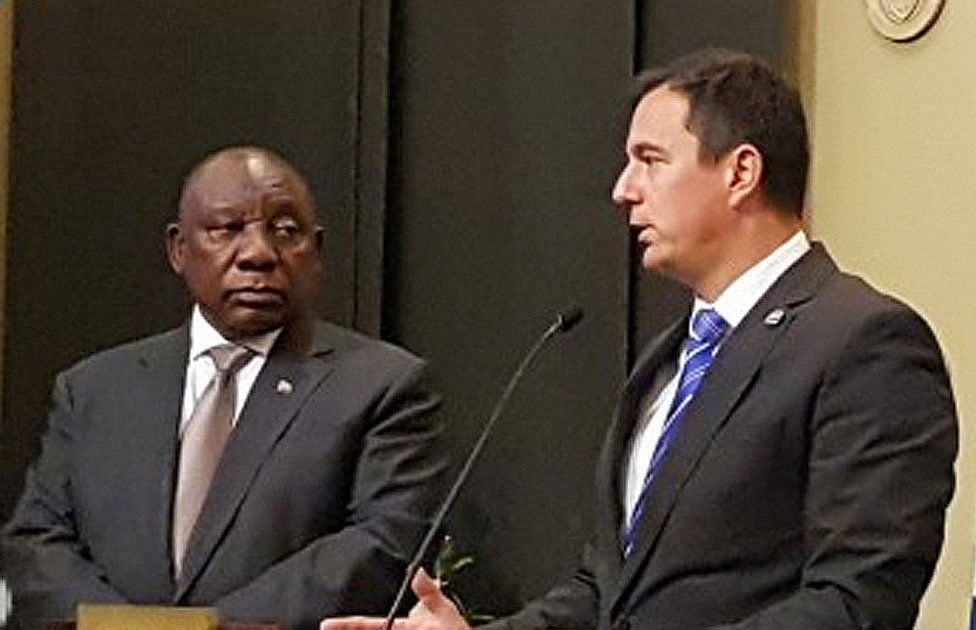
The 2026 State of the Nation Address (SONA) was notable not for what President Cyril Ramaphosa said, but for what he pointedly ignored. While the nation watched the red carpet glamour and the usual parade of high-fashion statements, a political earthquake was swallowing John Steenhuisen. Our investigation reveals that the "Codesa Compromise" – a term now whispered in the corridors of Tuynhuys – has effectively neutralised the DA leader’s influence within the Government of National Unity (GNU).
Insiders suggest a clandestine agreement was reached to sideline Steenhuisen in exchange for stability in key Gauteng metros. This documentary-style exposé peels back the layers of the SONA "speed and action" rhetoric to reveal a president who has masterfully outmanoeuvred his coalition partners. We look at the private meetings held just hours before the speech, where the fate of the DA’s top brass was sealed. Is this the end of the Steenhuisen era, or a calculated retreat? We simplify the complex power dynamics that have left the opposition reeling while the ANC consolidates its grip on the state machinery under the guise of "unity."
The Silence at the Podium
When President Ramaphosa stepped up to the podium at the Cape Town City Hall on 12 February 2026, he spoke of "speed and action." He promised to fix the dry taps in Johannesburg and deploy the army to fight the gang wars on the Cape Flats. But for those who know how to read the room in South African politics, the most striking part of the speech was the absence of any real acknowledgement of his primary coalition partner.
John Steenhuisen, the man who had staked his entire career on the success of the GNU, sat in the audience, a shadow of his former self. Just days earlier, on 4 February, Steenhuisen had dropped a political bombshell at the Riverside Hotel in Durban: he would not be seeking re-election as the leader of the Democratic Alliance.
The official reason given was "internal leadership disputes" and a desire to focus on his role as the Minister of Agriculture. But our investigation suggests a far more cold-blooded reality. Steenhuisen didn't jump; he was pushed by a "hidden fist" that reaches from the Union Buildings all the way to the DA’s federal council.
The "Codesa Compromise" Reborn
In the intellectual ghettos of South African political analysis, the term "Codesa Compromise" is being used to describe the current state of the GNU. It refers to the original 1994 deal that secured economic stability at the cost of deep structural change. In 2026, the new compromise is about survival.
Ismail Lagardien, a prominent political thinker, recently noted that "the system has spat out John Steenhuisen." He argues that the historical forces of the Codesa Compromise require a more forceful person to lead the DA—someone who can manage the "Big Money" interests while keeping the ANC in power just enough to prevent a total collapse. Steenhuisen, with his "cherubic" appearance and conciliatory tone, no longer fits the bill for the powerful conservative lobby groups like AfriForum and Solidariteit, which some insiders have dubbed "AfriMAGA."
These groups, according to DA insider Ryan Coetzee, have "rage and social media platforms" but no real alternative to the GNU. However, their influence was enough to make Steenhuisen’s position untenable. They wanted a leader who would take a harder line against the ANC, and Steenhuisen’s "dove-like" approach to the coalition made him a target.
The Gauteng Metro Trade-Off
The most explosive detail of our investigation involves a secret deal regarding the stability of Gauteng’s major metros—Johannesburg, Tshwane, and Ekurhuleni. For months, these cities have been teetering on the edge of collapse, with residents in parts of Johannesburg going without water for over 27 days.
Sources within the ANC’s provincial leadership in Gauteng, led by Panyaza Lesufi, have long been hostile to the DA. They viewed Steenhuisen as a weak link. The "secret deal" allegedly involved the ANC agreeing to stop its efforts to topple DA-led administrations in certain metros in exchange for the DA "cleaning house" at the top.
By removing Steenhuisen, the DA leadership—now looking towards Cape Town Mayor Geordin Hill-Lewis as the frontrunner—hopes to reset the relationship with the ANC. But this reset comes at a heavy price. It signals that the DA is willing to sacrifice its national leader to save its local power bases.
The Agriculture Ministry: A Job in Jeopardy
Steenhuisen has publicly stated his desire to stay in the cabinet and "finish" fighting the foot-and-mouth disease (FMD) outbreak. But as veteran columnist Justice Malala points out, "that is not his decision to make."
Ramaphosa has previously lashed out at Steenhuisen for issuing "red line" threats. In 2025, the President made it clear that he "shall not yield to threats and ultimatums" after Steenhuisen protested the removal of a DA deputy minister. With Steenhuisen no longer leading his party, his leverage in the cabinet has evaporated.
The FMD crisis, which has seen cattle in the Garden Route test positive and farmers counting mounting losses, is now being used as a stick to beat Steenhuisen with. He is being blamed for the "messy handling" of the crisis and for hiring controversial staff. Insiders suggest that Ramaphosa is already looking for a replacement agriculture minister, someone more aligned with the ANC’s long-term land reform goals.
The Rise of Geordin Hill-Lewis
As Steenhuisen fades into the background, the spotlight has turned to Geordin Hill-Lewis. The Cape Town Mayor is seen as the "golden boy" of the DA, the man who runs "The Best Run City in the Country." But his potential move to national leadership creates its own set of problems.
Hill-Lewis has claimed he wants to remain as Mayor while leading the party. Malala calls this "nonsensical," noting that it would leave the DA’s cabinet ministers "flying solo" without a leader in the room. The ANC has faced this "two centres of power" problem before, and it always ends in a purge. If Hill-Lewis takes the reins, he will be forced into the cabinet sooner rather than later, likely replacing the very man who paved the way for him.
What Ramaphosa Didn't Say
At SONA 2026, Ramaphosa spoke about the R54-billion incentive to fix the water crisis and the deployment of the SANDF to tackle the "mafias" in the construction and mining sectors. But he didn't mention the political mafia that had just carried out a hit on his deputy in the GNU.
By ignoring Steenhuisen’s plight, Ramaphosa sent a clear message: the GNU is about the ANC’s survival, not the DA’s growth. The President has masterfully used the "unity" narrative to consolidate his grip on the state machinery while his coalition partners are distracted by internal civil wars.
The "speed and action" promised by Ramaphosa is, in reality, a slow and calculated dismantling of the opposition from within. The "Codesa Compromise" of 2026 has ensured that while the faces at the table might change, the hands pulling the strings remain the same.
The End of an Era?
Is this the end of the Steenhuisen era? For many, he will be remembered as the man who brought the DA into government but failed to keep his seat at the table. His departure marks a shift towards a more aggressive, perhaps more racially polarised, political landscape.
As the DA prepares for its national elective congress in April, the ghost of the "secret deal" will hang over the proceedings. The party must decide if it wants to be a junior partner in an ANC-led state or a genuine alternative. For now, it seems they have chosen the former, sacrificing their leader for a temporary peace in the metros.
The citizens of South Africa, meanwhile, continue to wait for the water to flow and the lights to stay on. They were promised a "new dawn" in 2018 and "speed and action" in 2026. What they have received instead is a masterclass in political survival, where the only thing that moves with speed is the axing of those who become inconvenient.
John Steenhuisen’s exit is not just a DA story; it is a South African tragedy. It shows that in the game of thrones that is the GNU, loyalty is a rare commodity, and the "Codesa Compromise" always claims its victims in the end.
As we look towards the local elections later this year, the question remains: who will be the next to be spat out by the system? If the secret deal in Gauteng is anything to go by, the political earthquake is far from over.