

Vusimusi “Cat” Matlala, the controversial businessman at the centre of explosive state capture claims in the criminal justice system, is fighting to be moved out of eBongweni Super Maximum Correctional Centre in Kokstad, KwaZulu-Natal – arguing that his current detention is crippling his right to a fair trial.
Matlala, who faces multiple attempted murder charges, was back in the Gauteng High Court in Johannesburg on Thursday. His advocate, Annelene van den Heever, told the court that his recent transfer to the ultra-secure Kokstad prison had “started causing several issues” and made proper legal consultations “nigh impossible”.
The case was postponed to 6 February, to give the defence and the State time to try to reach agreement on where he should be held. If they cannot, Van den Heever indicated the defence would consider launching an urgent court application to challenge his detention at eBongweni.
‘Whisked away in the middle of the night’
Matlala was moved to eBongweni last month from Kgosi Mampuru C-Max prison in Tshwane, where he had been held while testifying last year before Parliament’s ad hoc committee probing alleged capture of law enforcement by drug cartels and shady business figures.
Van den Heever told the court that Matlala “was whisked away in the middle of the night to Kokstad” – which she described as “quite far away”.
She sketched out the practical difficulties of seeing her client:
“To get to this particular Correctional Services facility, you have to take a flight down to Durban. My attorney – I think a week ago – managed, and there were all kinds of issues,” she said, explaining that a rental car was required and that the drive to Kokstad then took some three-and-a-half hours, with another hour-long wait to “get to your client” once you reached the prison.
Once inside, consultations are severely restricted:
“Then, to consult, he sits behind thick glass where you can barely hear each other, with people around you listening to what’s going on,” Van den Heever continued, adding that it was a “well-known fact” that consultations and conversations were also recorded.
Inmates at eBongweni, she said, were housed “in segregated cells for 23 hours a day and only given one hour of exercise”.
Van den Heever said Matlala “for various reasons wishes to have a speedy trial as quickly [as] possible”, but that the Kokstad conditions were undermining this:
“There are numerous issues or scenarios playing out in the background. All of that, we respectfully submit, is causing our client not to get a fair trial,” she said, adding that they would be requesting a preferential trial date once the pre-trial was complete.
“But if our client is again taken back to Kokstad, we are again sitting in a position where we will be effectively barred from doing proper consultation,” Van den Heever insisted.
“We wish [Matlala] to be detained at any facility that makes him accessible for the defence – for us – to prepare for this pre-trial and get proper instructions”.
Judge calls situation ‘untenable’
Acting Judge William Karam appeared to share some of the defence’s concerns.
He described the situation as “obviously untenable” and reacted strongly to the allegation that confidential lawyer–client meetings might be monitored, calling the claims of consultations being recorded “horrendous and horrific”.
Karam agreed that if the State and the defence could not resolve the matter through engagement with Correctional Services, Van den Heever should approach the urgent court.
State distances itself from transfer
The State advocate leading the prosecution told the court she was unable to take the matter further for now, as she had not yet managed to engage with the Department of Correctional Services about Matlala’s placement.
She stressed, however, that Matlala’s transfer to eBongweni had not been done at her request or at the request of the investigating team.
The Department of Correctional Services has previously defended such moves in general terms, stating that “the transfer of remand detainees and sentenced offenders between correctional facilities is a standard operational practice, informed by a range of considerations, primarily security, safety, operational requirements, and effective inmate management across the correctional system”.
The department has also underlined that, in terms of the Correctional Services Act, the National Commissioner can “detain an offender or remand detainee at any correctional centre”.
eBongweni, South Africa’s only super-maximum prison, is designed to house the country’s most dangerous and high-profile inmates under extreme security, including long periods of isolation and limited contact with the outside world. Legal groups and human rights organisations have in recent years raised concerns that such conditions may be incompatible with meaningful access to lawyers and preparation of complex defences in high-stakes trials.
Designer suit, high-profile case
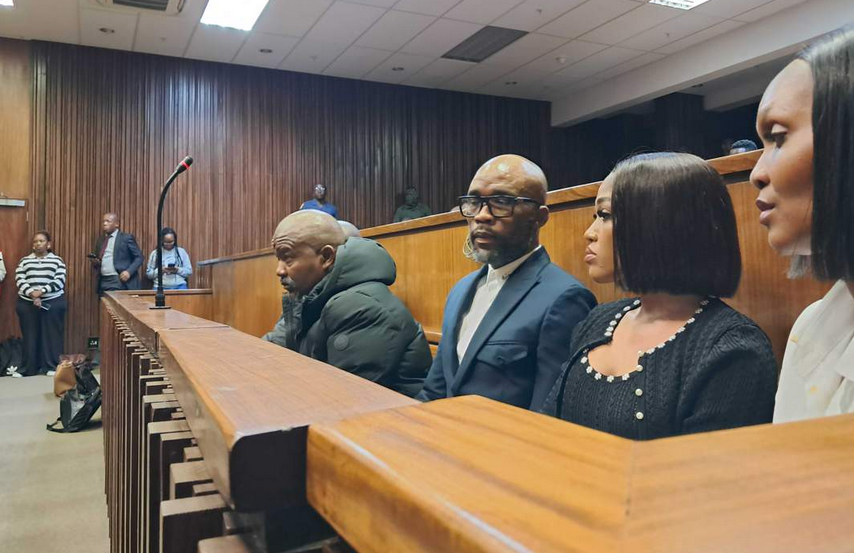
Despite being held in one of the country’s toughest prisons, Matlala again cut a polished figure in court. He was “once again kitted out in designer threads”, this time in a slick navy suit and crisp white shirt.
His wife and co-accused, Tsakani Matlala, arrived in a chic black knitted dress with pearl detailing and a matching cardigan.
Matlala is charged alongside four others: his wife Tsakani, alleged hitmen Tiego Floyd Mabusela and Musa Kekana, and Kekana’s daughter Nthabiseng Nzama. While Tsakani and Nzama are out on bail, Matlala and the remaining accused will stay behind bars until their next appearance.
Matlala faces multiple counts of attempted murder relating to three separate plots targeting his ex-girlfriend Tebogo Thobejane, taxi boss Joe Sibanyoni and Seunkie “DJ Vettys” Mokubung.
The case has drawn intense public interest, not only because of the alleged hit attempts, but also because Matlala surfaced last year as a key figure in claims that powerful criminal networks and politically connected businesspeople had infiltrated senior ranks of law enforcement and even government. His testimony before Parliament’s ad hoc committee added fuel to concerns about how deep that alleged capture may run.
Access to justice vs prison security
Van den Heever’s attack on the conditions at eBongweni places the spotlight again on the tension between high-security incarceration and the constitutional guarantee of a fair trial.
Her account of long travel times, heavily restricted visits, consultations through thick glass, and fears that discussions are recorded is likely to echo in future court challenges by other high-risk remand detainees. Defence teams in several high-profile organised crime and corruption cases have previously raised similar complaints about access to clients held in maximum-security conditions, arguing that it hampers the preparation of complex defences and undermines the right to a speedy trial.
As it stands, however, the law gives Correctional Services wide powers to decide where remand detainees are held, subject to constitutional safeguards. The coming weeks will show whether Matlala’s legal team can persuade either the State, or the urgent court, that his transfer to Kokstad crosses the line from tough security into an infringement of his fair-trial rights.
For now, he remains in eBongweni Super Max, awaiting both a decision on his prison placement and the next steps in an attempted murder case that has become deeply entangled with wider questions about power, money and the integrity of South Africa’s criminal justice system.