

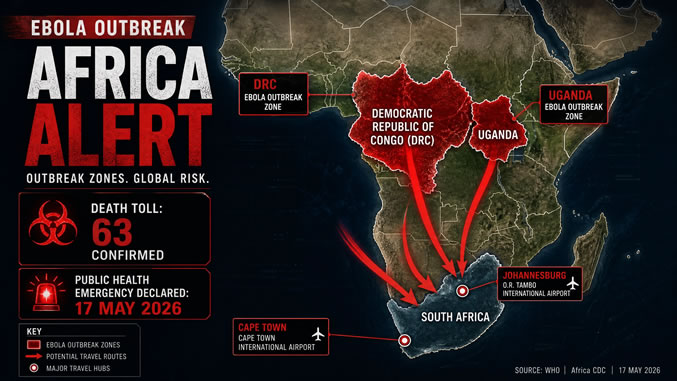
The shadow of a deadly killer is once again looming over the African continent, as health authorities in South Africa scramble to fortify borders against a terrifying new Ebola outbreak. The World Health Organisation has officially declared the current crisis in Central Africa a Public Health Emergency of International Concern, a move that has sent a jolt of anxiety through the local health sector. With confirmed cases rising and a mounting death toll in the Democratic Republic of Congo and Uganda, the question on every South African’s lips is simple: Are we safe?
The current outbreak, identified as the rare Bundibugyo species of the virus, has already claimed at least 63 lives as of early June 2026. Unlike more common strains, this particular version of Ebola is notoriously difficult to track and manage, making the threat of cross-border transmission a very real and present danger. For a country like South Africa, which serves as a major travel and economic hub for the entire region, the stakes could not be higher.
The Invisible Threat at Our Gates
At OR Tambo International Airport and other major ports of entry, the atmosphere has noticeably shifted. Travellers arriving from Central and East Africa are now being met with rigorous health screenings, thermal scanners, and intense questioning. The Department of Health has reportedly placed all provincial emergency response teams on high alert, but behind the scenes, there are whispers of concern regarding the readiness of our public hospitals to handle a high-consequence infectious disease.
"We cannot afford to be complacent," says one senior medical official who spoke to Celeb Gossip News on the condition of anonymity. "Ebola does not respect passports or border posts. One undetected case on a flight from Entebbe or Kinshasa could change everything. We are looking at a virus that causes internal bleeding, organ failure, and has a terrifyingly high mortality rate. The public has every right to be asking tough questions about our containment strategies."
The panic is not just confined to the corridors of power. On social media, South Africans are expressing deep-seated fears that the "June 30th Ultimatum" and other social tensions could be exacerbated by a health crisis. The thought of a viral outbreak hitting during a time of such high national anxiety is a nightmare scenario for many.
A History of Fear and a Race Against Time
South Africa has had its brushes with Ebola before, most notably during the West African epidemic a decade ago. While the country managed to remain largely unscathed then, the 2026 Bundibugyo strain presents a fresh set of challenges. This species was first discovered in 2007 and is known for causing large-scale outbreaks with little warning. The fact that it has now resurfaced with such ferocity in both the DRC and Uganda suggests that the environmental factors driving the virus are becoming more volatile.
In the streets of Johannesburg and Cape Town, the "wow" factor of this story is the sheer speed at which the situation is evolving. Just weeks ago, this was a localized problem in remote villages; today, it is a global emergency. Pharmacies are already reporting a surge in sales of hand sanitisers and face masks, as memories of the COVID-19 pandemic remain fresh in the minds of many.
Government officials have been quick to issue statements aimed at calming the public. "South Africa has some of the best surveillance systems in the world," a spokesperson for the National Institute for Communicable Diseases (NICD) stated. "We are monitoring the situation in the DRC and Uganda around the clock. There is no need for panic, but there is a need for extreme vigilance."
The Economic Shadow
Beyond the immediate health threat, the economic implications are starting to bite. Tourism operators are already seeing cancellations from international travellers who view the entire continent as a single risk zone. For a South African economy already struggling with internal pressures, a full-blown health scare could be the final straw.
As the June 30th deadline for various social movements approaches, the government is walking a tightrope. They must prove they can protect the nation’s health without causing a total shutdown of the economy or sparking further social unrest. The coming weeks will be a true test of leadership, as the country waits to see if the "Ebola Wall" will hold or if the invisible killer will find a way through.