

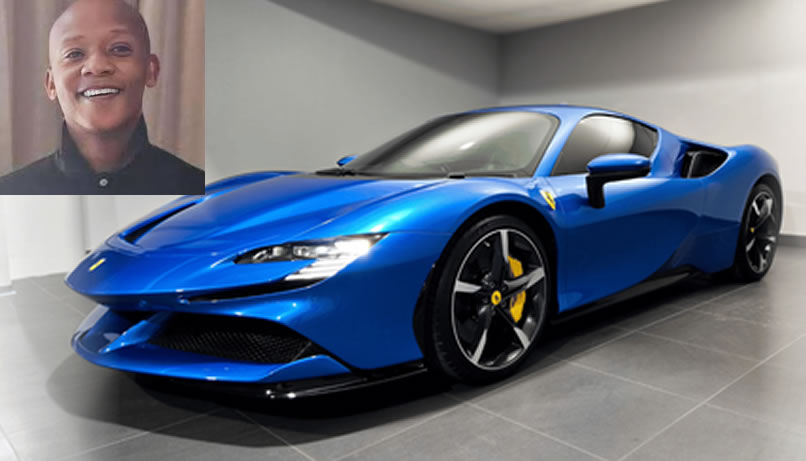
Hangwani Maumela has returned to the Pretoria High Court in a fresh attempt to challenge the sale of his Ferrari SF90 Stradale and uncover the identity of the person who bought the luxury vehicle for R10.1 million.
The Ferrari was sold at auction two weeks ago after a Special Tribunal order authorised the curator to dispose of the vehicle.
Maumela is now seeking details about the sale, including the buyer’s identity, the final selling price, the terms of the agreement and whether the purchase money has been paid.
The court heard on Wednesday that the sale had been completed and that the funds were already in the bank.
The vehicle, however, had not yet been delivered to the buyer.
The curator’s lawyer, Jannie Lubbe SC, told the court: “The sale is complete, and the money is in the bank.”
Lubbe said the curator was prepared to disclose the purchaser’s identity to Maumela in a letter.
Judge Johan Els reserved the order after indicating that he intended ruling in Maumela’s favour. The order was expected to be issued later on Wednesday.
The court battle follows the sale of a 2022 Ferrari SF90 Stradale that had travelled only 311 kilometres.
The vehicle was believed to have a market value of about R14 million but was sold for R10.1 million after an auction process in which bidding opened at R8 million.
The Ferrari was placed under preservation as part of the investigation into alleged corruption and maladministration at Tembisa Hospital.
The Special Investigating Unit has alleged that approximately R2 billion meant for healthcare services was stolen through fraudulent procurement processes. Maumela has been linked to the alleged Tembisa Hospital looting, although the allegations remain subject to ongoing legal proceedings.
The SIU obtained a preservation order over a number of assets connected to Maumela while investigators and the National Prosecuting Authority’s Asset Forfeiture Unit continued efforts to recover money and property allegedly linked to the scandal.
Maumela previously approached the Pretoria High Court to set aside the Special Tribunal order that allowed the Ferrari to be sold.
He argued that the decision to proceed with the sale and advertise the auction had been taken in bad faith and at the curator’s own risk.
In his court papers, Maumela said he had reserved the right to challenge the auction. He also said his application had already anticipated the possibility that the Ferrari could be sold before the court had heard the matter.
He has now vowed to continue pursuing his legal rights over the vehicle.
The SIU has defended the sale, saying it was necessary to comply with the Special Tribunal’s order and prevent further costs from building up.
SIU spokesperson Selby Makgotho said the Ferrari had remained in the curator’s possession for almost a year without being driven.
The vehicle was costly to store, insure and maintain. The SIU’s position is that leaving such an expensive car unused would have placed an unnecessary financial burden on the curatorship.
“Keeping such a vehicle, which is highly expensive, in the possession of the curator for almost a year without it moving is, in itself, inadvertent,” Makgotho said.
He said the proceeds from the auction would help cover the costs involved in managing Maumela’s preserved assets.
Those costs include the legal fees linked to the curatorship and the daily maintenance of properties that remain under the curator’s control.
The money is expected to remain protected in an interest-bearing trust account while the related civil proceedings continue.
Makgotho also explained why the SIU carried out checks on the person who bought the Ferrari.
The unit wanted to ensure that the buyer was not acting as a proxy for Maumela, one of his relatives, a close associate or somebody else connected to the assets under investigation.
According to the SIU, allowing a person close to Maumela to buy the Ferrari back would undermine the purpose of the asset recovery process.
Makgotho said the SIU had reviewed the buyer’s documents and examined the source of the money used in the purchase.
“That would defeat the purpose of what we are trying to do. We have gone through the paperwork and the necessary checks and balances relating to the identity of the buyer. We are happy and satisfied, as he appears to be a person who is not of interest to the SIU,” Makgotho said.
He said the SIU was satisfied that the funds used to buy the vehicle were not linked to corruption or criminal activity.
The identity of the buyer has not been made public.
The question of whether the purchaser’s details should be disclosed has also raised concerns about privacy law.
Legal expert Nthabiseng Dubazana said the position could be different in a public auction compared with a private sale.
Public auctions are advertised and open to members of the public. Information about the items being sold, the process and, in some cases, the successful bidders may be accessible to other people.
“It’s different from a private auction where there may be expectations of confidentiality,” she said. “Much like court-ordered sales, public auctions are advertised and open to public participation, so I don’t believe disclosing that information would necessarily be a violation of [the] Popia.”
The Protection of Personal Information Act, commonly known as Popia, governs the way personal information is collected, stored and shared.
The court will have to consider whether the buyer’s personal details should be disclosed to Maumela and whether the public nature of the auction affects any expectation of privacy.
The matter is also complicated by the fact that the Ferrari has been sold but not yet delivered.
The sale proceeds have reportedly been received, yet control of the physical vehicle has not changed hands.
That leaves Maumela challenging a completed transaction while the buyer waits for delivery.
The court must still deal with his broader challenge to the order that allowed the sale to proceed.
The Ferrari was among several luxury assets preserved during the investigation into the alleged Tembisa Hospital corruption network.
The SIU has said the wider investigation uncovered irregular procurement activity and assets believed to be connected to people and companies that benefited from hospital contracts.
The agency has been working with the Asset Forfeiture Unit to identify and preserve properties, luxury vehicles and other assets that may be recovered if the State succeeds in its civil case.
The Ferrari sale was authorised after the curator argued that holding on to the car could result in mounting costs and a loss of value.
A Special Tribunal order allowed it to be sold for no less than R9.5 million. The R10.1 million sale price exceeded that minimum.
Maumela and the MHR Maumela Family Trust had attempted to stop the auction, but the sale went ahead.
The latest court application now places the identity of the successful bidder at the centre of the dispute.
Maumela wants to know who bought the vehicle and whether the sale was conducted on terms that complied with the Tribunal’s order.
The curator, meanwhile, says the transaction has been concluded and that the funds have been secured.
For the SIU, the priority is to protect the value of assets allegedly linked to the Tembisa Hospital investigation and prevent them from returning to the control of people who may be connected to the alleged wrongdoing.
For Maumela, the legal fight is not over simply because the Ferrari has been sold.
The Pretoria High Court is expected to issue its order on the disclosure of the buyer’s details while the broader legal challenge to the auction continues.