

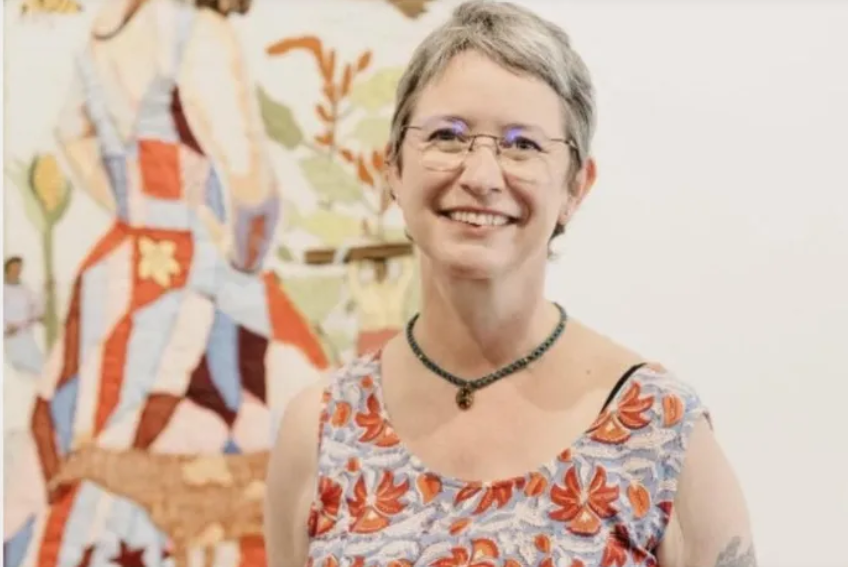
The Swartland community of Riebeek West is mourning the brutal murder of acclaimed mixed-media artist and curator Tamlin Blake, whose death has also triggered renewed calls for a review of South Africa’s parole system.
Blake, 51, was found dead at her home in Church Street on Sunday afternoon. Her body was covered by a mat stained with blood, police said.
A 32-year-old man was arrested on Monday in connection with the murder. He was reportedly released from prison on Wednesday, 18 November, just days before Blake’s body was discovered.
Police have not confirmed the circumstances of his reported release, the offence for which he had previously been imprisoned or when he will appear in court.
Police spokesperson Thembakazi Mpendukana said officers attended the scene at about 3.30pm on Sunday.
“Upon arrival, the members found a 51-year-old female victim covered with a mat that had blood and was declared deceased by medical personnel on the scene.
“A murder case was opened, and a 32-year-old male suspect was arrested and will appear before court once charged. The motive is unknown, and the police are investigating the circumstances surrounding this incident.”
Police could not confirm when the suspect would appear in court. The investigation into the killing is continuing, and the motive remains unknown.
Calls for tougher sentences
Local activist Billy Claassen described Blake’s death as a devastating loss and used the killing to renew his call for harsher sentences and a review of the country’s parole system.
“I am someone who has long called for our country’s parole system to be reviewed and for harsher sentences, or even the death penalty where it can be justified.”
Claassen described Blake as a gentle person who allowed her artwork to speak for her. He said he had planned to take his daughter to visit Blake next month.
“She was truly someone with a heart of gold. Someone who did not want to hurt others or wrong anyone. She was genuinely just a gentle soul who let her art do the talking.”
He urged members of the public to lobby for the accused to remain behind bars and receive a life sentence if convicted.
“He has robbed our communities and the arts industry of a gentle soul.”
The suspect remains an accused person and has not been convicted. The allegations against him will have to be tested through the criminal justice process.
The police have not said what evidence led to his arrest or whether any property was recovered. Investigators are expected to establish what happened at Blake’s home and whether the suspect’s reported release from prison is connected to the circumstances surrounding the murder.
A major loss for South African art
Blake was a respected South African artist whose work explored identity, belonging, memory and cultural heritage.
She held a Master’s degree in Fine Art from Stellenbosch University and served as chief curator of the Spier Arts Trust. In that role, she worked with artists and helped develop creative projects that connected South African art with wider audiences.
Her own practice was rooted in mixed media. She worked with glass beads, fabric, mosaic and recycled newspaper, often transforming ordinary materials into intricate textile and tapestry pieces.
Her work focused on South African symbols of wealth and status, as well as the forces that shape a person’s sense of belonging and identity. She also helped develop specialised beading techniques used by Qaqambile Bead Studio in Cape Town.
Blake’s tapestry collection, Altered Yarns, is on permanent exhibition at Spier Wine Estate. Her work was also shown internationally, including at the African American Museum in Dallas and the Newcomb Art Museum in New Orleans.
She received a Merit Award at the 2003 Brett Kebble Art Awards. Her work was exhibited at the World Expo in Shanghai, the FNB Joburg Art Fair and exhibitions in Europe, Ireland and the United States.
Her artistic career included solo exhibitions and collaborations with the Spier Artisan Studio and the Keiskamma Arts Project. Through her curatorial work, she was also recognised for supporting and mentoring other artists.
The Cape Guild of Weavers described Blake as “a visionary and a deeply connected soul”. The guild said her contribution to the arts, professionalism and smile would be sorely missed.
Family and community shock
The news of Blake’s death has deeply affected the close-knit Riebeek West community. Her work and public role had made her a respected figure in the town and the wider arts sector.
Claassen said her death had taken away a person who had contributed to both the local community and South Africa’s creative landscape.
The killing has also placed renewed attention on the debate around parole, rehabilitation and the protection of communities when people are released from prison. However, the details of the suspect’s previous case and the conditions of his release have not been confirmed by police.
Police said the suspect would appear in court once charged, but no appearance date had been confirmed. Investigators are continuing to gather evidence as they work to establish the circumstances surrounding Blake’s death.
For those who knew her, Blake’s legacy will remain in the artwork she created, the exhibitions she shaped and the artists she supported.
For the Swartland community, however, the immediate focus is on mourning a woman remembered for her kindness, her talent and the quiet power of her work, while waiting for answers about the killing that ended her life.