

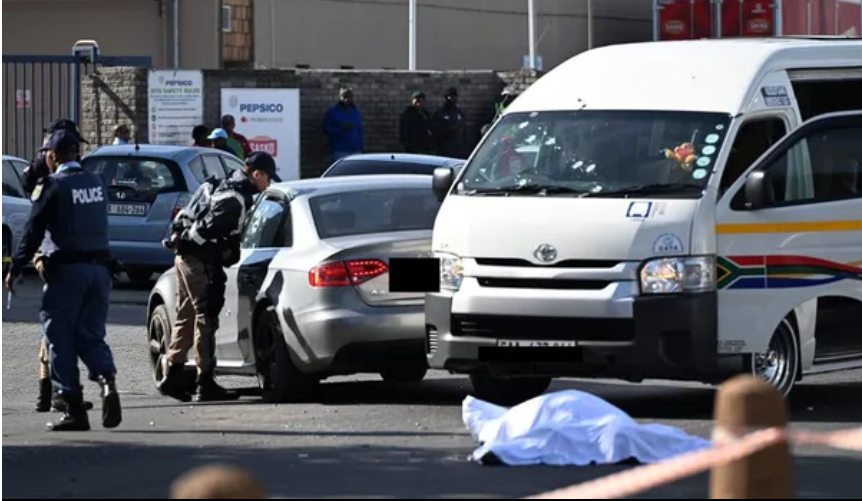
Cape Town commuters are demanding an urgent end to deadly taxi violence after two drivers were shot dead and three passengers wounded in separate incidents in Khayelitsha on Tuesday.
Working-class residents caught in the ongoing route dispute between rival taxi associations CATA and CODETA say they have little choice but to continue using taxis to get to work.
For many commuters, the daily journey now comes with the fear that they may not return home to their families.
The latest bloodshed began on Tuesday afternoon, 10 November, on Pama Road in Site B, Khayelitsha. A taxi driver was reportedly offloading passengers when gunmen opened the vehicle’s door and shot him several times.
Three passengers were wounded during the attack and rushed to a medical facility for treatment.
Police spokesperson Constable Ndakhe Gwala confirmed that Lingelethu West police opened a murder case and three counts of attempted murder.
“According to reports, the deceased was a taxi driver and at the time of the incident, he was offloading passengers. Unknown suspects opened the door of his motor vehicle and shot him multiple times,” said Gwala.
“He was declared deceased on the scene by medical personnel. Three passengers sustained gunshot wounds during the attack and were rushed to a medical facility for treatment. The motive for the shooting is taxi violence related.”
The violence continued later that night.
At about 22:30 on Ntlazana Road in Harare, a 39-year-old taxi driver was shot dead inside his home. His wife was also wounded in her left arm and taken to hospital.
Gwala confirmed that no arrests had been made in connection with the attack at the time of reporting.
The two shootings have deepened fears among commuters who depend on taxis to travel between their homes and workplaces. Residents say they are exposed to the conflict even though they have no role in the dispute between the taxi associations.
One single mother from Delft said she survived two separate taxi-related shootings in October. She said the experiences had left her haunted by the fear that she might not make it home to her three young children and grandchild.
She said she had been travelling in a taxi from Palm taxi rank when gunfire erupted and passengers were forced to run for their lives.
“I took the taxi at Palm taxi rank and had to run for my life when that people started shooting. It was very hectic and traumatising. The next day, there was another shooting on the R300. I was in a taxi at the time when we had to turn around because they just shot on two taxis,” she said.
The commuter said she had no option but to keep travelling to work because she was the sole provider for her family.
“I am a single parent and have no other choice but to go to work. I have such fear when sitting in a taxi, fearing if I will make it home to my babies.”
Her account reflects the difficult position faced by residents who rely on public transport but cannot simply stop commuting. For many families, missing work could mean losing income, while travelling exposes them to the risk of being caught in attacks linked to a conflict they do not control.
Another commuter described her shock after learning that a driver who regularly transported workers had been shot dead at Bellville taxi rank on Sunday.
The driver was known to the workers he transported and had become part of their daily routine. His death left one passenger struggling to process the news when she arrived at work.
“He was our work transport driver and such a cool guy. I was not aware that he was shot until I got to work… I was so shocked that I broke down in tears,” she said.
The latest attacks have placed renewed pressure on taxi industry leaders to resolve the dispute between CATA and CODETA. The associations have been linked to a long-running route conflict that has repeatedly affected drivers, passengers and other road users.
The violence has also raised concerns about the safety of passengers being transported through areas where rival groups are fighting for control of routes. In Tuesday’s Pama Road shooting, the driver was attacked while passengers were inside the vehicle and three of them were wounded.
The later shooting in Harare showed that the danger was not limited to taxi ranks or vehicles. A driver was killed inside his own home, while his wife was wounded in the attack.
When approached for comment, SANTACO Western Cape spokesperson Makhosandile Tumana said the provincial body had decided not to engage with the media until it had reached a conclusion.
SANTACO’s national leadership has since stepped in to mediate the CATA-CODETA dispute. The national body has indicated that it will not rush the negotiations and is seeking a lasting solution.
For commuters, however, the promise of negotiations offers little immediate comfort. They continue to board taxis each morning, often knowing that the same journey that takes them to work could place them in the middle of another shooting.
The Delft mother said her deepest fear was not simply being injured, but failing to return to the children who depend on her. Other commuters are also mourning drivers they knew personally, including the Bellville work transport driver whose death left passengers in shock.
Police investigations into the Khayelitsha shootings are continuing. The suspects involved in the Pama Road and Harare attacks had not been arrested at the time of reporting.
As the dispute continues, commuters are calling for urgent action to prevent more deaths and ensure that taxi passengers can travel to work without fearing that a route dispute will turn their journey into a life-threatening ordeal.