

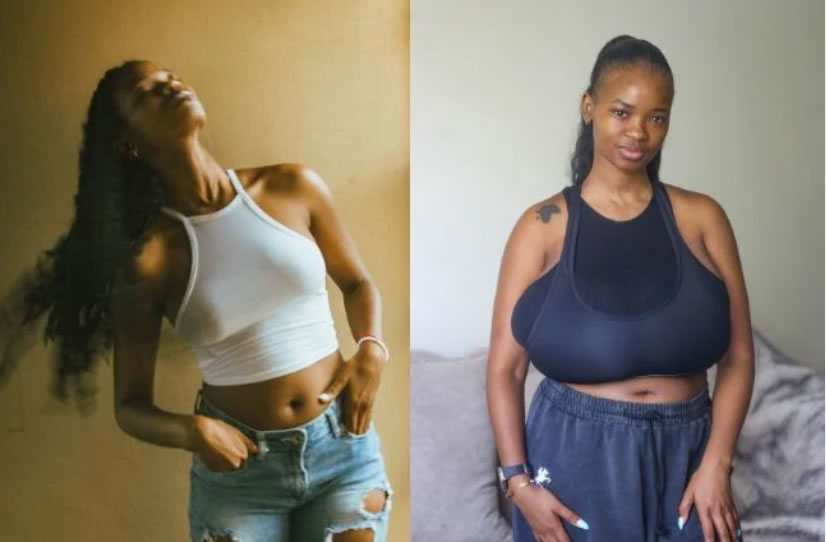
Michelle Sekwena thought her ordeal was finally over after undergoing breast-reduction surgery to treat gigantomastia, a rare condition that causes rapid and excessive breast growth.
But within weeks of the operation, the growth began again.

Michelle, 26, had previously seen her breasts increase from a 32B to a 32G, causing severe pain and affecting her mobility, work and daily life. After raising funds for surgery, she was reduced to a 32C and briefly felt that she had regained control of her body.
The relief did not last.
Her breasts have since grown to a 32E, and doctors have told her that a bilateral mastectomy may be the most effective way to substantially reduce the risk of further excessive growth.
The prospect of another major operation has left Michelle frightened and exhausted. She must first allow a wound beneath her breast to heal while doctors continue running tests to investigate why the condition returned so aggressively.
“It was traumatic,” she says. “I was like, ‘God, what do I do?’”
Despite the pain and uncertainty, Michelle remains determined to continue fighting.
“I don’t see this as permanent,” she says. “I’m going to fight this.”
The condition changed her life
Michelle said the first signs appeared towards the end of 2023. She noticed numbness in her nipple, followed by redness, itching and pain.
“Everything started growing and I was in a lot of pain,” says Michelle, who previously worked as a teacher and is now a sales assistant at a sports store.
Her breasts grew by five cup sizes to a 32G in just over a year. The physical strain caused knee pain, backache and headaches.
The emotional impact was equally difficult. People stared at her, while children sometimes asked whether she was pregnant.
Michelle had enjoyed wearing cropped tops and going to the gym. As her condition progressed, those activities became increasingly difficult.
The first doctor she consulted had never seen a case like hers. Another suggested that she wear a tighter bra to contain the growth, but the garment restricted her breathing.
She was eventually referred to a specialist at a Netcare hospital in Johannesburg in 2024, where she was diagnosed with gigantomastia.
The recommended treatment was breast-reduction surgery. But the estimated cost of at least R150,000 was far beyond what she could afford because she did not have medical aid.
Strangers helped fund first operation
Michelle had been sharing content on YouTube since 2019 and decided to speak publicly about her condition. After someone suggested that she start a BackaBuddy campaign, she decided to try it.
The response surprised her.
“I couldn’t believe that strangers would help me,” Michelle says.
Within two months, she had raised the money needed for the operation.
The surgery took place early the following year. Her breast size was reduced from 32G to 32C, closer to her original size.
Michelle said she felt like herself again — at least for a while.
Then the growth returned.
“I’m so tired,” Michelle says. “Especially when it’s hot – everything is just draining for me.”
Wound adds to health challenges
Michelle recently developed a wound beneath her breast caused by heat and friction. The complication required regular hospital visits for treatment and check-ups.
“Thankfully it’s healing now,” she says.
The wound has made daily life more difficult. Her retail job requires her to stand for long periods, which worsens her back pain. Sweating also leaves her skin itchy and uncomfortable and may increase the risk of further wounds and infection.
Michelle must buy specialised bras designed to support the weight of her breasts. She said she currently wears bras made by Anita, a German company that produces precision bras in larger sizes.
The bras cost between R1,800 and R3,500 each, adding another financial burden as her size continues to change.
Another surgery likely
Michelle’s doctors have told her that the most definitive option may be a complete bilateral mastectomy, which removes nearly all breast glandular tissue.
Before that can happen, the wound beneath her breast must heal. Doctors are also conducting tests and examining her hormones in an effort to understand why the growth returned so quickly after the reduction.
“They’re trying their best to see if maybe they can stop it.”
Medical experts say recurrence after breast-reduction surgery is a recognised complication of gigantomastia. Dr Sarah Nietz, a breast surgeon based at Mediclinic Morningside in Sandton, said some breast tissue remains after a reduction and may enlarge again.
She said recurrence may be associated with hormonal changes, puberty or pregnancy. Because gigantomastia is rare, reliable figures about how often the condition returns are limited.
Dr Laura Thornley, a plastic, reconstructive and aesthetic surgeon who works in private practice and at Charlotte Maxeke Johannesburg Academic Hospital, said bilateral mastectomy may be considered when gigantomastia returns severely and rapidly after reduction surgery.

A mastectomy removes nearly all breast glandular tissue and therefore substantially reduces the likelihood of further excessive growth. However, surgeons cannot guarantee that every breast cell will be removed.
“So recurrence risk is greatly reduced rather than necessarily eliminated,” Thornley adds.
The medical explanations do not determine what treatment is right for Michelle. Her doctors will need to assess her individual condition, wound, test results and risks before recommending further surgery.
Partner provides support
Michelle said her partner, Oscar Machete, 27, had supported her throughout the ordeal.
“He leaves work to come and check on me,” Michelle says. “He dresses my wounds with care, he cries with me, he’s very supportive.”
Her faith has also helped her cope with the physical and emotional demands of the condition.
Michelle said social media had brought both support and cruelty. She has been shocked by some of the comments people have made about her appearance, but tries to respond with humour.
“People say good things and bad and even the bad things make me laugh because they don’t know what it’s like.”
For Michelle, laughter is not a sign that the experience is easy. It is a way of surviving the days when the pain and uncertainty become overwhelming.
Hoping for a way forward
Michelle is once again hoping to raise enough money for the surgery she may need. The cost of treatment, medical appointments, wound care and specialised clothing has placed considerable pressure on her.
Her breasts continue to grow, and she must regularly replace bras as her size changes. Her work also exposes her to heat and long hours on her feet, making the physical symptoms harder to manage.
Doctors are still investigating the cause of the rapid recurrence. In the meantime, Michelle is focused on healing the wound and preparing herself emotionally for another operation.
Her story highlights the challenges faced by people living with rare medical conditions, especially when treatment is expensive and recurrence is possible.
The experts’ comments also underline that no single treatment guarantees that gigantomastia will never return. A bilateral mastectomy may substantially reduce the risk of further growth, but even that procedure cannot eliminate every breast cell or guarantee that recurrence is impossible.
Michelle knows another difficult chapter lies ahead. But despite the pain, the financial pressure and the cruel comments from strangers, she remains determined to reclaim her life.
“I don’t see this as permanent,” she says. “I’m going to fight this.”