

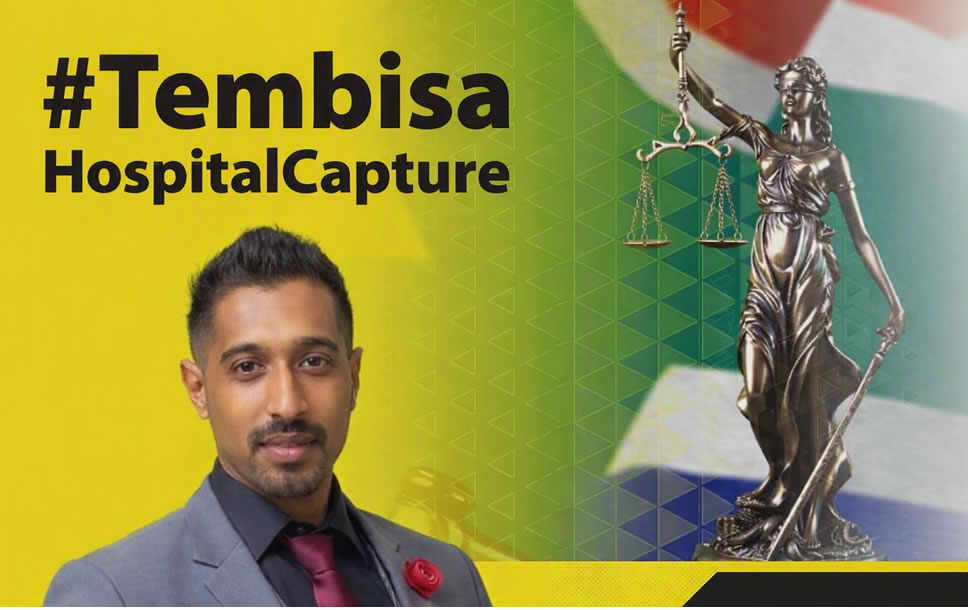
The arrest of alleged tender syndicate boss Stefan Govindraju at OR Tambo International Airport has reopened one of South Africa’s most painful corruption stories — and placed fresh pressure on authorities to explain why the alleged masterminds behind Babita Deokaran’s killing remain out of court.
Hawks detectives reportedly arrested Stefan Govindraju on Friday afternoon as he returned from Seychelles, days before he was expected to appear in court to finalise a negotiated plea and sentencing agreement.
The 37-year-old businessman is accused of being part of the network that allegedly siphoned money from Tembisa Hospital through fraudulent procurement deals. He is expected to appear before the Palm Ridge Magistrate’s Court on Monday, according to the supplied report.
His arrest comes at a critical moment. For more than two years, Govindraju’s attorney says negotiations have been under way between the defence and the State. The proposed agreement would reportedly require Govindraju to plead guilty and explain how his alleged shell-company empire operated, including how officials were allegedly rewarded with cash, jewellery, vehicles and property in exchange for contracts.
But the arrest has also exposed the gap between one suspect being brought before court and the larger corruption network still waiting for accountability.
Arrest Before A Carefully Negotiated Court Appearance
Govindraju had been expected to attend court as part of a planned plea and sentencing process. His lawyer, Kamesh Maharaj, said the defence intended to apply for bail and had been assured that the State would not oppose his release on agreed conditions.
“We intend to apply for bail. We have been assured by the State that his release on bail will not be opposed. We have also reached an agreement concerning the imposition of reasonable conditions pertaining to his release on bail and the timeline going forward with this matter. His passports have been given to the investigating officer. We have been cooperating with the prosecuting authorities and negotiating for in excess of two years leading up to this,” Maharaj said.
The arrest means the court process will now begin under a sharper public spotlight. The Hawks confirmed that a 37-year-old suspect had been arrested at OR Tambo International Airport on 28 August 2026 after returning from overseas. Spokesperson Katlego Mogale did not name the suspect but said he was allegedly linked to a complex investigation into multimillion-rand tender fraud at Tembisa Hospital.
The accused remains entitled to the presumption of innocence. Any plea agreement, if presented to court, must be considered and accepted through the proper legal process.
The Hidden Network Behind The Hospital Deals
The supplied report says an investigation published in 2022 exposed Govindraju as the alleged hidden hand behind a network of 54 shell companies. Those companies allegedly secured about R600 million in tainted Tembisa Hospital deals, making him one of the largest alleged beneficiaries of the R2.3 billion said to have been extracted from the East Rand facility.
The alleged flow of money was not uncovered by chance. The report says Gauteng health department whistleblower Babita Deokaran noticed unusual spending patterns and flagged R850 million in payments considered “possibly fraudulent”. She reportedly halted the outflow while a wider investigation was set in motion.
Nineteen days after raising those concerns, Deokaran was murdered in 2021. The supplied material says that after her death, her report was covered up. Her killing transformed the hospital corruption investigation into something far more serious: a case involving not only suspected financial crimes, but also questions about whether the people who exposed the alleged wrongdoing were deliberately silenced.
|
Key figure or issue
|
Reported allegation or development
|
Current position in the supplied report
|
|
Stefan Govindraju
|
Allegedly linked to shell companies and about R600 million in Tembisa Hospital deals.
|
Arrested at OR Tambo International Airport; expected in court.
|
|
Babita Deokaran
|
Flagged R850 million in potentially fraudulent payments.
|
Murdered in 2021; alleged masterminds remain outstanding.
|
|
Tembisa Hospital
|
Allegedly lost about R2.3 billion through multiple syndicates.
|
Subject of a broad investigation.
|
|
Morgan Maumela
|
Network allegedly received more than R800 million.
|
Reportedly not arrested or charged.
|
|
Rudolph Mazibuko
|
17 companies allegedly extracted more than R280 million.
|
Reportedly not arrested or charged.
|
|
Shell-company network
|
Fake addresses, proxy directors and companies allegedly created to win contracts.
|
SIU investigation reportedly expanded the network to 98 firms.
|
The Contract Factory Allegations
The alleged system described in the report was built to look ordinary from a distance. Proxy directors reportedly controlled several companies formed on the same day, using unusual names and addresses that were allegedly false or meaningless.
The report says that after the identities of some proxy directors were published in an investigative series titled “Silenced”, the directors resigned together and transferred control to Govindraju. The alleged takeover was completed in less than 48 hours.
The directors were reportedly connected to Govindraju through relationships involving lovers, relatives, friends and co-workers. The use of proxy directors, if proven, would have allowed the real beneficiaries to remain hidden while companies competed for public contracts.
One example described in the supplied material is a company that allegedly sold children’s skinny jeans to the hospital for R500 000. The unusual transaction illustrates why the procurement system attracted so much attention. A hospital exists to provide medical care, yet the alleged network appears to have used public money across a confusing range of supplies and companies.
The Special Investigating Unit’s inquiry reportedly widened the known network from 54 companies to 98 fake firms trading simultaneously with Tembisa Hospital. Most of those companies have since become dormant, according to the report.
The Money Trail Is Bigger Than One Arrest
Govindraju’s arrest may represent progress, but it does not answer the central question: how many people benefited from the alleged corruption, and how many of them will face prosecution?
The supplied report names Morgan Maumela, whose network allegedly received more than R800 million, and Rudolph Mazibuko, whose 17 companies allegedly extracted more than R280 million. It says neither man had been arrested or charged at the time of publication.
That uneven picture is likely to intensify public anger. A single arrest can demonstrate that investigators are moving, but it can also highlight how much remains unresolved when other alleged beneficiaries remain outside the criminal courts.
The proposed plea agreement could therefore become a major test of the State’s strategy. If accepted, Govindraju may provide a detailed account of the alleged companies, contracts, payments and officials involved. Such evidence could assist investigators, but only if it is tested, supported by records and followed by further arrests where appropriate.
Five Years After Deokaran’s Killing, The Hardest Questions Remain
Deokaran’s death continues to cast a shadow over the corruption case. Six alleged hitmen were arrested on 27 August 2021, but the person or people who allegedly financed and ordered the killing have not been brought before court, according to the supplied report.
Acting Police Minister Firoz Cachalia recently described the delay as unacceptable. At a memorial service marking the anniversary of Deokaran’s death, he reportedly said:
“From my point of view, five years later, that’s just not good enough.”
Cachalia said he had met Hawks investigators and that they insisted the investigation was not at a stalemate. However, he questioned why the alleged kingpins — the people who financed the killing — had not been brought to justice.
“They reported to me that they are continuing their efforts, but the real question is why the kingpins, the people who financed this brutal murder, haven’t been brought to book,” Cachalia said.
Those words capture the central tension now surrounding the case. The State may be moving against one alleged corruption figure, but Deokaran’s family and the public are still waiting for the people accused of ordering her murder to answer in court.
What Govindraju’s Case Could Reveal
The significance of Monday’s appearance will go beyond the question of bail. The court process may reveal whether the proposed plea agreement is ready, what charges will be admitted, what evidence the State holds and whether Govindraju’s alleged role can be connected to other people and companies.
For South Africans, this is not simply a story about a businessman returning from an overseas trip. It is a story about hospital money, public officials, shell companies, a murdered whistleblower and a justice system that has taken years to reach one alleged participant.
Govindraju has not been convicted of the offences described in the report. The allegations must be proved in court, and any plea agreement must be dealt with according to law. But the case has already raised a question that cannot be ignored: if a public hospital could allegedly be drained through dozens of companies, who else knew, who else profited and who will be held responsible for the violence that followed?