

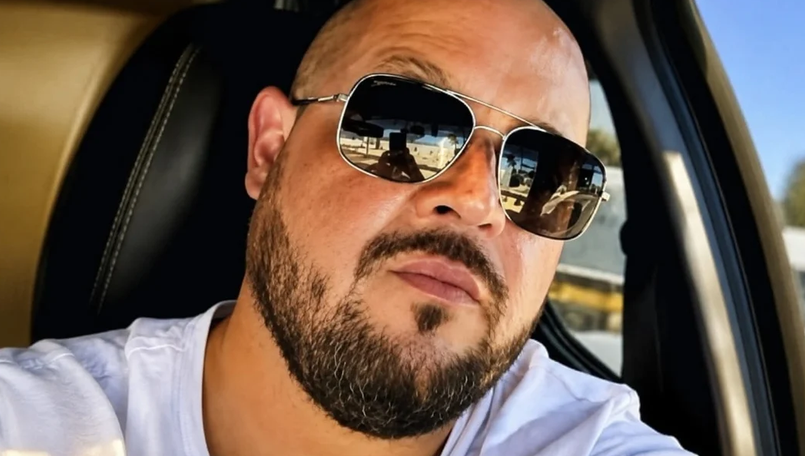
Cornelius van Dalen, the Robertson man shot dead during an armed confrontation with police, has been hailed as a “hero” by a far-right movement that says he shared its ideals.
The Vryburger movement held a small march in Robertson in Van Dalen’s memory after his death and put up small crosses for him. Members carried Vierkleur flags during the gathering.
Van Dalen, 40, was not a member of the movement. However, Vryburger leader Johannes Agenbach said the deceased had supported the same principles as the organisation.
“We regard Van Dalen as a hero, as he stood up for the same type of things we stand up for. That is why I am now also sticking my neck out,” Agenbach said.
The declaration has placed renewed attention on Van Dalen’s beliefs, his confrontation with police and the weapons and material found at his home after the standoff.
Police reportedly recovered an AR-15 assault rifle, a shotgun, two pistols and ammunition at the Top View farm near Robertson. Four Vierkleur flags and a diary listing people Van Dalen regarded as “enemies of the Boerevolk” were also found at the property.
The items were recovered after Van Dalen was killed during a confrontation with a police task team on August 17.
The Standoff At Top View
The confrontation followed an incident on the morning of August 16, when Van Dalen allegedly opened fire at his neighbour Juanita Lourens’ car and threatened other residents of the farm.
Police were called to the property. Van Dalen allegedly fired at officers, prompting the deployment of a specialised task team.
The standoff continued for about 24 hours before the confrontation ended with Van Dalen being shot dead. A member of the task team was wounded in the shoulder during the operation.
The exact sequence of events leading to the fatal shooting remains the subject of investigation. Police have not publicly set out every detail of the operation or said how each weapon was used.
The discovery of the firearms and ammunition has nevertheless become a significant part of the public discussion surrounding the incident.
The AR-15, shotgun and pistols were found at Van Dalen’s residence, along with the flags and diary. The recovery of the diary does not by itself establish that everyone listed was threatened or targeted, and the contents will have to be assessed in the context of the investigation.
Before his death, Van Dalen allegedly claimed on social media that “corrupt” police officers and drug cartels wanted to kill him.
Those claims have not been independently established. They form part of the background investigators may examine as they try to understand his actions and state of mind before the standoff.
Vryburger Movement Claims Him
The Vryburger movement describes itself as an “ethnic nationalist” organisation.
On its website, the movement says: “We believe in the right of every ethnic group on earth to govern themselves in a sovereign territory. Our loyalty, however, lies exclusively with the interests of our own people, and exclusivity is the way forward for us to once again create a future for white people in South Africa.”
The organisation’s decision to honour Van Dalen has drawn attention because of the material found at his home and the circumstances of his death.
Agenbach said Van Dalen was not a formal member but shared the movement’s ideals. He described the march as a tribute to a man who, in the movement’s view, had stood up for the same causes.
The Vryburgers’ public position is rooted in the idea that ethnic groups should govern themselves in separate sovereign territories. The organisation’s statements refer specifically to creating a future for white people in South Africa.
The movement’s language has raised questions about whether Van Dalen’s alleged views were political, personal or linked to a wider ideological network. There is no confirmation that he was part of an organised plot or that the people named in his diary were connected to any criminal activity.
The distinction is important because the presence of political symbols or an ideological statement does not, on its own, establish a criminal offence.
Family Rejects Descriptions Of Him
An acquaintance of Van Dalen’s family said his father had been deeply affected by the death and was upset by descriptions of his son as “schizophrenic” and “mad”.
The acquaintance said Van Dalen was originally from Worcester and had a half-sister and a brother. His mother had died.
He attended school in Johannesburg and was described as particularly skilled at designing trailers. He worked for several engineering firms and at different times lived in Durban and England.
He also bought, refurbished and sold Land Rovers, while continuing with his trailer work.
“Cornel was no boemelaar drifter, as some would claim,” said the family friend.
The friend said Van Dalen had the means to own and maintain valuable equipment and believed the weapon found at the property was evidence that he was not without resources.
“That rifle found at the scene is worth at least R35 000. So he clearly wasn’t without means.”
The family acquaintance’s account presents a different picture from descriptions that portrayed Van Dalen as an isolated or unstable man. However, his background and work history do not explain why he allegedly opened fire or what led to the confrontation with police.
Those questions remain for investigators to answer.
Defamation Disputes
Tersia du Plessis, a woman who said she had been harassed by Van Dalen over an extended period, alleged that she and her husband had won defamation cases against him in 2023.
Her attorney, Philip Venter, said legal proceedings had been initiated to recover a combined R250,000 from Van Dalen’s estate.
The claims form part of the wider history surrounding Van Dalen before the farm confrontation. They have not been linked by police to the shooting or to the weapons found at Top View.
The alleged disputes also show that Van Dalen had been involved in conflicts with people in his community before his death.
It remains unclear whether the claims he made online about police officers and drug cartels were connected to those disputes or whether he believed there was a separate threat against him.
Questions Still To Be Answered
The police investigation will have to establish what happened after Lourens’ vehicle was allegedly fired on, how officers were confronted and what led to the task team’s deployment.
Investigators will also need to examine the weapons, ammunition, flags and diary found at the property.
The diary may provide clues about Van Dalen’s relationships, grievances or fears, but the names recorded in it should not be treated as proof that the people listed were enemies or intended victims.
Similarly, the Vryburger movement’s decision to call him a hero does not establish that Van Dalen was a member or that he acted on behalf of the organisation.
Agenbach’s comments confirm the movement’s admiration for Van Dalen, but there is no public evidence that the organisation directed his actions during the standoff.
The task-team member who suffered a shoulder wound was injured during the operation. Police have not announced further details about the officer’s condition.
Van Dalen’s death has now become a point of mobilisation for a small far-right movement, while his family continues to reject what it considers unfair descriptions of his life.
The investigation, however, remains focused on the events at Top View farm, the alleged shooting at the neighbour’s vehicle, the alleged threats against residents, the confrontation with police and the arsenal recovered at the property.
No further suspects have been identified in connection with the standoff.
The circumstances surrounding the fatal shooting, the legality of the firearms and ammunition, and the meaning of the diary entries remain to be established.