

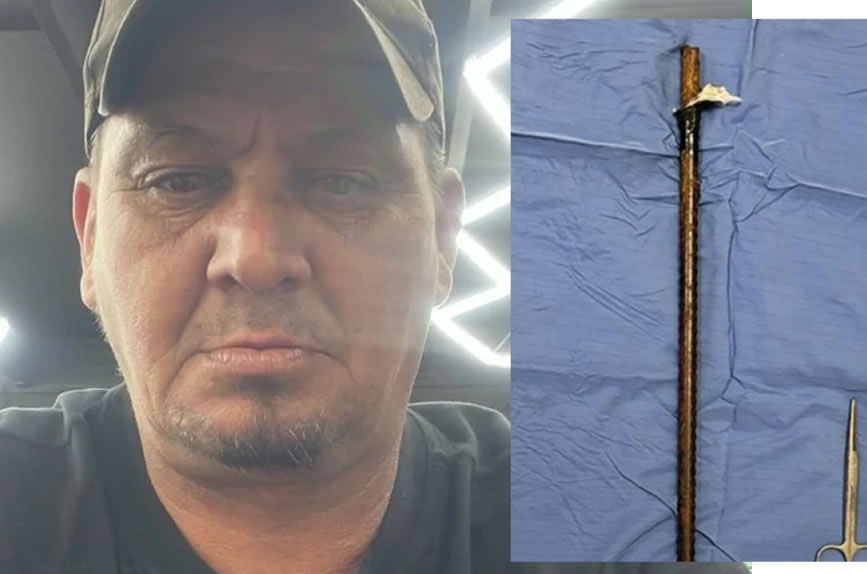
Theunis du Plessis was carrying out a routine job at a Bellville workshop when a ladder shifted beneath his feet and changed the course of his day in an instant.
The 47-year-old motor mechanic had been hanging lights and wanted to finish the final task before heading home. Then the ladder wobbled, and he fell heavily to the floor.
When Theunis tried to get up, his colleagues rushed to his side and warned him not to move.
“Don’t get up,” they told him. “There’s a steel rod sticking through you. Don’t pull it out.”
At first, Theunis did not believe them.
“Ag, nonsense, man,” he said.
But when he looked down, he saw the long black steel rod that had pierced his body. It had entered near his armpit and extended through his shoulder. The rod was about 1.5 metres long.
Theunis said he could not feel it when he landed on it.
“I couldn’t feel the steel rod when I fell on it. The rod went into my arm and it was here, next to my head,” he said.
His colleagues called emergency services, beginning a careful rescue operation that would eventually take him to hospital in Cape Town.
Colleagues Call For Help
Theunis’ colleagues immediately understood that the accident was serious. They kept him from trying to stand or pull out the rod while waiting for paramedics.

“My colleagues called the ambulance services,” Theunis said.
When the ambulance arrived, the paramedics faced a practical problem. The steel rod was too long for them to load Theunis safely into the vehicle.
The fire department was called to the scene and cut the rod shorter. The aim was not to remove it, but to make it possible to transport him while leaving it in place.

The decision to avoid moving the rod unnecessarily was crucial to the next stage of his treatment.
Theunis was taken to Netcare Christiaan Barnard Memorial Hospital in Cape Town, where the trauma team had already been alerted to the unusual injury.
Dr Sanju Sobnach, who works in the trauma unit, was informed while Theunis was being transported.
Sobnach instructed the team not to move or remove the rod before the doctors were ready.
“The team that worked on Theunis immediately understood what they had to do,” Sobnach said.
“When they brought Theunis to us, they ensured he had the best chance of survival.”
Doctors Carefully Remove Rod

At the hospital, Sobnach and the medical team worked slowly and carefully.
The rod had passed through the area near Theunis’ armpit and shoulder, meaning that any sudden movement could have caused further injury. The doctors focused on removing it in a controlled way while monitoring him for bleeding and other complications.
Theunis later recalled the location of the rod in relation to his heart.
“They say it was lying against my heart. It sounds like my ribcage stopped it going through my heart,” he said.
That description reflects Theunis’ understanding of what happened. The exact path of the rod and the medical risks involved were assessed by the trauma team treating him.
After the doctors successfully removed the rod, Theunis needed stitches and remained in hospital for several days.
The hospital kept the rod after the procedure and later placed it in a bag beside his bed.

“When I woke up in hospital the next morning, the doctors had left the rod in a bag next to my bed as a keepsake. I took it home with me,” Theunis said.
The object that had nearly cost him his life became a physical reminder of how close he had come to a fatal accident.
Back At Work A Day After Discharge
Theunis was discharged after spending a few days in hospital.
A day later, he returned to work, initially taking on light duties as he recovered.
His return was quicker than many people might have expected after such a serious injury, but Theunis said he felt fortunate to be alive and determined to resume his normal routine.
His colleagues in Bellville began calling him “Die Hard”.
“Listen, the people in Bellville call me Die Hard now,” Theunis said with a laugh.
The nickname reflects both the shock of the accident and the speed of his recovery. It also captures the way Theunis has chosen to deal with the experience: with humour, gratitude and a determination not to remain defined by what happened to him.
“That was the closest I’ve come to death. I’m okay now, though. And I’m back at it. I’m lucky to be alive,” he said.
A Routine Task Turns Into A Fight For Survival
The accident happened during work that Theunis had done many times before.
Hanging lights in a workshop may have seemed like a routine final task, but the ladder’s movement created a sudden and dangerous chain of events.
The fall itself was only part of the emergency. The rod had to remain in place, the ambulance had to be adapted to carry him and the hospital team had to plan how to remove it without causing further damage.
Theunis’ survival depended on the actions of several people: colleagues who called for help and kept him still, firefighters who shortened the rod, paramedics who transported him and the trauma team that removed it.
The story also demonstrates why people should not attempt to remove an object embedded in a serious injury. In an emergency, movement can worsen bleeding or damage to internal structures. The safest response is to call emergency services and follow the instructions of trained professionals.
Theunis’ colleagues appear to have followed that approach by keeping him from moving and waiting for assistance.
The Rod Becomes A Keepsake
Many people would want to forget an object connected to such a frightening experience.
Theunis chose to keep the rod.
For him, it is a reminder of the moment he survived and of the people who helped him receive treatment.
The rod also gives him a way to explain the accident without having to rely only on words. It is evidence of the unusual circumstances and a symbol of the fact that he walked away from an injury that could easily have had a different outcome.
The physical object is now part of his personal story, kept not as a celebration of the danger but as a reminder of his recovery.
The Importance Of Fast Emergency Action
The accident highlights the importance of acting quickly but carefully when someone suffers a serious workplace injury.
Theunis’ colleagues did not pull the rod from his body or encourage him to stand. They called the ambulance services and waited for trained responders.
The fire department then helped make the journey to hospital possible without disturbing the rod.
At the hospital, the trauma team had been briefed before Theunis arrived. That preparation allowed doctors to focus on stabilising him and planning the removal.
The medical details of each injury are different, and the treatment of one patient cannot be used as a guide for someone else. However, the basic lesson is clear: people should seek emergency assistance and avoid moving an embedded object unless instructed by trained professionals.
Theunis’ case was unusual because of the length and path of the rod, but the response followed a simple principle—protect the injured person and let medical professionals manage the object.
Recovery Brings A New Perspective
Theunis said the accident was the closest he had come to death.
Returning to work so soon afterwards may have helped him regain a sense of normality, although he started with lighter duties while his body recovered.
The experience also appears to have changed how he views ordinary moments.
A task he expected to finish before going home became an emergency that required firefighters, paramedics, surgeons and several days in hospital.
Now, the same man who once dismissed his colleagues’ warning with “Ag, nonsense, man” carries a permanent reminder of the day a routine job nearly ended his life.
His humour has become part of the recovery.
Being called “Die Hard” by people in Bellville is a light-hearted way of acknowledging what happened, but it also reflects the seriousness of his survival.
‘I’m Lucky To Be Alive’
Theunis’ message after the accident is simple.
He is back at work, he has kept the rod and he is grateful to have survived.
“That was the closest I’ve come to death. I’m okay now, though. And I’m back at it. I’m lucky to be alive.”
His story is a reminder that danger can emerge during the most familiar tasks and that the actions taken immediately afterwards can make a significant difference.
It is also a story of teamwork. His colleagues recognised that he needed help, emergency responders adapted to the unusual circumstances and the hospital team treated the injury with caution.
Theunis now has the scar, the stitches and the steel rod to remind him of the accident. More importantly, he has returned to the life and work he feared he might not see again.
For the people around him, the “Die Hard” nickname may bring a smile. For Theunis, it carries a deeper meaning: he survived, recovered and was given another chance to go home after work.