

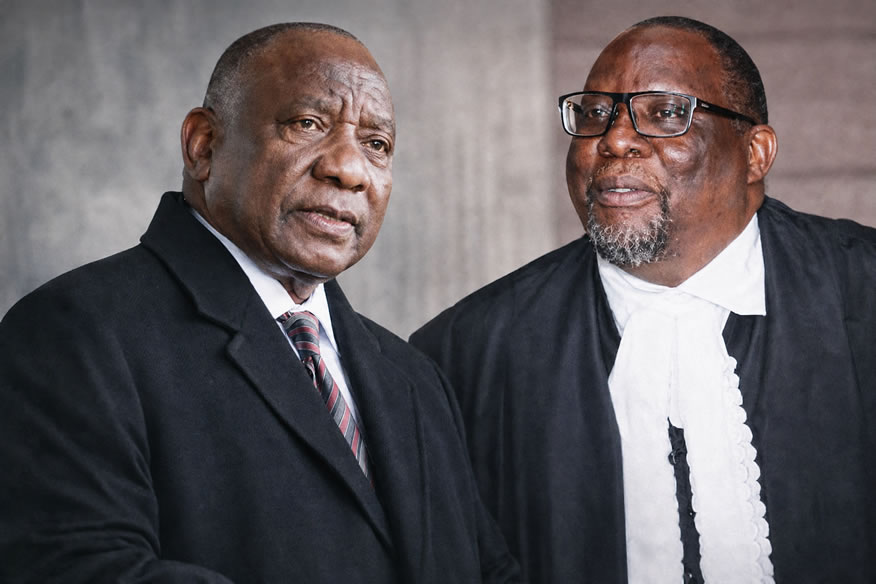
Advocate Thandazani Griffiths Madonsela SC has rejected President Cyril Ramaphosa’s concerns about a possible conflict of interest arising from his recommendation as chief evidence leader for Parliament’s Section 89 Impeachment Committee.
Madonsela maintains that there is no conflict between him and the President and says the facts raised by Ramaphosa had already been disclosed to the committee before it recommended him for the position.
The dispute centres on whether Madonsela can independently assist the committee with evidence linked to the impeachment process, given his previous appointment to the Judicial Service Commission and legal work connected to the African National Congress.
Ramaphosa raised the concerns in a letter to the committee after its majority voted to recommend Madonsela as evidence leader.
The President referred to a “real or perceived conflict of interest” and argued that Madonsela’s removal from the JSC in 2022 could create “a reasonable apprehension” that the senior counsel might harbour a grievance against him and act on it.
Madonsela has now responded by saying that his replacement at the JSC was an ordinary constitutional process, that he had no grievance against Ramaphosa and that the evidence leader would not perform the functions of a judge or decision-maker.
Ramaphosa’s Objection
Ramaphosa’s letter followed the committee’s decision to recommend Madonsela as its chief evidence leader.
The committee’s vote saw nine MPs support Madonsela, seven back Advocate Kate Hofmeyr SC and 11 abstain.
The ANC abstained from the vote. The party later raised concerns that Madonsela had previously provided legal advice on matters linked to the impeachment process.
Ramaphosa then raised two main issues.
The first related to Madonsela’s time on the Judicial Service Commission. Ramaphosa designated Madonsela to the JSC in March 2020, but replaced him in March 2022, shortly after the interviews for Chief Justice.
The President argued that the circumstances could create a reasonable apprehension that Madonsela might feel aggrieved and act against him while assisting the committee.
The second concern related to legal advice that Madonsela had provided to the ANC on impeachment-related matters.
Ramaphosa argued that the advice could have given Madonsela prior knowledge of issues relevant to the inquiry and that this might place him in a different position from another evidence leader approaching the matter without previous involvement.
The President’s concerns remain submissions rather than findings. No court or committee has determined that Madonsela is conflicted.
Madonsela’s Response
In a letter dated 19 August and addressed to senior Parliamentary Legal Adviser Sueanne Isaac, Madonsela said the issues raised by Ramaphosa had already been disclosed to the committee.
He said he had informed the committee about his replacement at the JSC and about his limited role in the legal brief involving the ANC before the committee recommended him.
Madonsela argued that the committee had access to the relevant information when it voted.
He also rejected the suggestion that he carried a grievance against Ramaphosa because his JSC tenure ended.
Madonsela said that when the President relieved him of his duties, he did not respond with hostility. Instead, he wrote to Ramaphosa to express his gratitude.
“I said it was an honour to have been ‘considered worthy of the designation’ and wished the President every success in your service to the Nation,” he said.
Madonsela described his replacement as an ordinary constitutional mechanism through which a tenure ends.
“It requires no reasons and carries no stigma,” he said.
He argued that neither what was said at the time nor the President’s latest letter suggested that he had been removed for a reason that would create a grievance or reflect adversely on him.
“The President appoints, replaces and dismisses office-holders continually. If each person so affected were presumed to bear disqualifying grievances, a substantial part of the senior legal profession would be disqualified from any public function touching him,” Madonsela said.
Legal Brief Involving Mshengu
Madonsela also disclosed a separate legal brief involving Mongezi Ntanga Attorneys and a parliamentary study group assisting Advocate Kwazi Mshengu.
Mshengu is junior to Madonsela and previously served as KwaZulu-Natal MEC for Education.
Madonsela said he received the brief on 5 June and that his role was limited to overseeing drafts prepared by Mshengu.
He was released from the brief on 5 July, before an interdict could be argued, because his other commitments meant he could not devote enough time to the matter.
Madonsela said the limited nature and short duration of the work had been disclosed to the committee.
He further maintained that the ANC had not questioned his integrity or independence.
The dispute over the legal brief is separate from the question of Madonsela’s JSC tenure, although Ramaphosa referred to both issues when raising the possible conflict.
A conflict-of-interest assessment would have to consider the exact nature of the advice, the subject of the work, whether it overlaps with the committee’s mandate and whether the advice created any continuing professional duty.
Madonsela’s position is that the advice related to procedural questions and did not make him an interested party in the substance of the impeachment allegations.
Evidence Leader Says He Is Not A Judge
Madonsela strongly rejected the suggestion that a chief evidence leader would perform a decision-making or quasi-adjudicative function.
He said the evidence leader assists the committee but does not decide the questions before it.
“In my understanding, the Evidence Leader is not an adjudicator. He decides nothing. Questions before the committee are decided by its members (Rule 129N). The Assembly alone decides whether the President is to be removed, and only by a two-thirds majority,” he said.
Madonsela said the chief evidence leader has no vote, makes no findings and makes no recommendations.
The distinction is important because the committee, rather than the evidence leader, will consider the evidence and determine how to proceed.
The National Assembly alone would decide whether the President should be removed, and such a decision would require a two-thirds majority.
The evidence leader’s role is therefore closer to assisting with the organisation and presentation of evidence than making a binding judgment.
Madonsela said this meant the recusal principles applied to judicial officers or adjudicators could not automatically be transferred to the evidence-leader role.
His argument is that a person assisting a parliamentary committee does not decide whether the President is guilty, whether evidence is admissible in a criminal sense or whether impeachment should follow.
Committee Seeks Legal Opinion
The committee has not made a final decision on whether Madonsela should be appointed.
After receiving Ramaphosa’s letter, members voted to seek a legal opinion on the conflict-of-interest question.
The MK Party and EFF opposed obtaining the opinion. Other parties supported or accepted the need for parliamentary legal services to consider the matter.
Committee chairperson Makashule Gana said he did not have enough time to fully consider the President’s letter and wanted to avoid a situation in which the issue was taken to court.
“One of the worst mistakes we can make as a committee is to believe the work we do is beyond scrutiny,” Gana said.
The committee is expected to consider the legal advice at a future meeting.
Opposition parties have accused Ramaphosa of using the objection to delay the impeachment process, but ANC members have rejected that interpretation.
Those claims should be understood as political positions rather than established facts.
Ramaphosa’s supporters argue that the committee must take concerns about independence seriously, particularly where the evidence leader may have had previous dealings with a political party involved in the process.
The committee must now balance the need to avoid a genuine conflict with the need to prevent objections from becoming an indefinite obstacle to its work.
Section 89 Impeachment Process
The committee is responsible for preliminary work connected to the Section 89 impeachment process involving the President and the Phala Phala farm scandal.
The process is parliamentary rather than criminal. Its purpose is to assess whether the constitutional threshold for holding the President accountable has been met.
The committee’s work follows an independent panel report that found Ramaphosa had a prima facie case to answer. The Constitutional Court later directed that the report be referred to an Impeachment Committee.
The President has challenged aspects of the process through the courts.
Public hearings have been halted under a Western Cape High Court interdict, although preliminary work such as appointing an evidence leader may continue.
A separate review application relating to the independent panel report is scheduled for early September.
These legal proceedings are separate from the current dispute over Madonsela’s appointment, but they form part of the wider background to the committee’s work.
The committee cannot remove the President by itself. Any removal decision would ultimately be taken by the National Assembly and would require the constitutionally prescribed majority.
Independence And Public Confidence
The dispute has raised broader questions about how Parliament should appoint people to sensitive oversight roles.
An evidence leader must be able to work independently, organise complex material and assist committee members without favouring the President or his political opponents.
At the same time, a person should not automatically be disqualified merely because they have previously worked in public institutions, advised a political party or been replaced from a constitutional office.
The key issue is whether the earlier work creates an actual conflict or a reasonable perception that the person cannot act impartially in the new role.
Madonsela’s position is that disclosure allows the committee to assess the facts and that the information was already before members when they recommended him.
Ramaphosa’s position is that disclosure alone does not remove the concern if the underlying circumstances still create a reasonable apprehension of bias.
The legal opinion sought by the committee may help clarify how those principles apply to a parliamentary evidence leader who does not vote or make findings.
What Happens Next?
The committee is expected to await advice from parliamentary legal services before deciding whether to proceed with Madonsela’s appointment or consider another candidate.
Madonsela remains the committee’s recommended candidate, but Parliament’s administration must complete the appointment process.
The committee will also have to manage the wider timetable for the impeachment inquiry, which has already been affected by court proceedings.
For Madonsela, the immediate issue is whether his previous work and JSC history prevent him from serving as evidence leader.
For Ramaphosa, the issue is whether the committee can appoint someone whose past dealings may create a real or perceived conflict.
No final finding has been made against either position.
The committee’s next decision will determine whether Madonsela takes up the role, whether another senior counsel is considered or whether the dispute moves into further litigation.