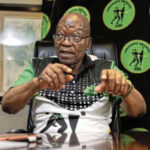
PRETORIA – He is a man who has lived many lives: a convicted bank robber, a bestselling author, a successful businessman, and now, a cabinet minister with a seat at the president’s table. But for Gayton McKenzie, South Africa’s Minister of Sports, Arts and Culture, the one constant in his remarkable trajectory has been controversy.
Two years into his tenure, the conversation surrounding McKenzie has shifted from his inspiring "rags-to-riches" story to a mounting list of eyebrow-raising decisions that have left critics and taxpayers alike demanding answers. From multi-million-rand international trips to the unilateral cancellation of artistic works, McKenzie’s leadership style has become as divisive as his political persona.
The most recent firestorm involves a staggering R31 million expenditure for a trip to the 2026 FIFA World Cup in North America. Details emerged of first-class flights, luxury accommodation, and top-tier hospitality suites for McKenzie and 18 official s. The timing of the revelation could not have been worse, as it coincided with news that 54 young South African athletes were being told they would have to fund their own way to the World Athletics U20 Championships because their annual grant had not been released.
McKenzie’s defence of the R31 million spend was characteristically blunt. While acknowledging it might seem like a vast sum to "ordinary people," he insisted it was "not a lot of money for government" and would generate long-term benefits through international exposure.
However, Leah Potgieter, the Democratic Alliance’s spokesperson on sports, arts and culture, was unimpressed. "The strongest advertisement for South Africa is a national team that can compete without begging for donations," she argued. "The money could have been put to better use supporting a young athlete with access to a functioning development pathway."
This isn't an isolated incident. In 2024, McKenzie drew anger for spending R800,000 on a trip to the Paris Olympics, a move he defended as part of his official duties. Political analyst Solly Moeng suggests that such conduct "smacks of hypocrisy," especially given McKenzie’s past as a vocal critic of government waste.
The minister’s financial decisions have also extended to the core of South African sport. Last year, McKenzie abruptly cut 60% of funding to key sports federations, citing budget constraints. It later emerged that R82 million saved from these cuts was being redirected to fund Video Assistant Referee (VAR) technology for the Premier Soccer League—a move Potgieter described as a "luxury" that should never have been prioritised over grassroots development.
McKenzie’s foray into the arts has been equally contentious. In December 2025, he sparked a censorship row after objecting to the work of South African artist Gabrielle Goliath. Her installation, Elegy, which referenced the deaths of women and children in Gaza, was cancelled for the 61st Venice Biennale after the minister found it "inappropriate." The decision resulted in the South African pavilion standing empty and led to a legal battle that Goliath eventually lost in the Gauteng High Court.
"It’s censorship, plain and simple," Goliath claimed, warning that the ruling created a "dangerous precedent" for political interference in art.
Beyond his ministerial duties, McKenzie’s past continues to haunt his public image. A self-described "career choice" led him to a 17-year sentence for armed robbery at the age of 21. It was inside Grootvlei Prison that he rose to prominence as part of the "Grootvlei Four," smuggling footage of prison corruption to the media—an act that eventually led to his early release in 2003.
His political career, launched with the Patriotic Alliance in 2013, has been built on a populist message that resonates with many, yet his time in office has been marred by scandals. As Mayor of the Central Karoo in 2022, he raised R3 million for service delivery at a gala dinner, but the funds reportedly never reached the municipality’s bank account. Despite court orders to hand over his financial records, McKenzie has yet to fully co-operate.
Even his social media presence has been a source of trouble. Racially offensive posts from between 2011 and 2017 resurfaced last year, forcing the minister to issue an apology for language he claimed no longer reflects the person he has become.
As the Minister of Sports, Arts and Culture, Gayton McKenzie controls an annual budget of R7 billion. While his supporters see him as a disruptor unafraid to shake things up, his critics see a man who has become "tone-deaf" to the very issues that got him elected. In the screwball world of South African politics, McKenzie remains a figure who proves that anything is possible—even if it comes with a R31 million price tag.
For the young athletes still waiting for their grants and the artists facing funding cuts, the question remains whether McKenzie’s "shaking things up" is building a future for South African talent or simply funding a lavish ministerial lifestyle.