

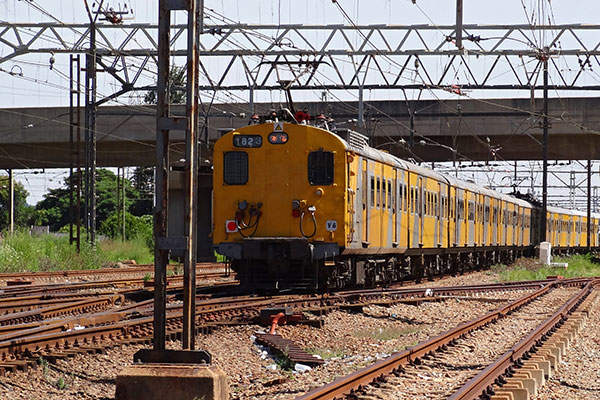
The family of a four-year-old boy who was struck by a moving train near Langa railway station on Tuesday are trying to process what happened, as the child remains alive in hospital receiving treatment and police and community leaders renew calls for closer supervision of children and the relocation of families living near the railway line.
The incident, which occurred as children were reportedly crossing the tracks on their way home to Siyahlala informal settlement in Langa, has reopened familiar concerns in communities living alongside rail infrastructure: the daily risks of crossing lines, the lack of safe pedestrian routes, and the pressure on parents and guardians — particularly when children are left in the care of older siblings.
When contacted, the boy’s father confirmed the incident and said his son was receiving medical care. His identity is being withheld to protect the child’s privacy.
“Yes, brother, it happened. But I am not in the right state of mind to talk about it now. Please call us later,” he said on Wednesday.
Police in Langa say the boy was crossing the railway line with another child from the opposite side. The children were reportedly heading home to Siyahlala, an informal settlement near the line. It is understood that one child crossed safely, but the four-year-old attempted to cross as a train approached and was struck.
Emergency services rushed him to hospital. Police confirmed he survived and remains under medical treatment.
Langa police station commander Colonel Noxolo Ntshiba said she visited the family after the incident and found them still struggling to come to terms with what had happened. She confirmed the child is in hospital and said initial understanding suggests he had been left at home under the supervision of an 11-year-old sibling.
“I can confirm that the child was involved in the incident and is currently receiving treatment in hospital. At this stage, we understand that the boy had been left at home in the care of his 11-year-old sibling. Given the family's emotional state, we did not want to ask too many questions. The mother was distraught, and our priority was to offer support,” she told Vukani.
Ntshiba’s comments reflect the balancing act police often face in cases involving children: the need to establish what happened and whether negligence played a role, while also responding to the immediate trauma of families whose lives have been shaken. Her emphasis, she said, was on providing support in the moment.
But she also issued a broader appeal to parents and guardians, warning that vigilance becomes even more important now that schools have reopened and routines shift again after holiday periods.
“We appeal to parents to ensure that their children attend school and are properly supervised at all times. We all have a responsibility to protect our children and prevent tragedies like this from happening,” she said.
The incident has also drawn political response at ward level, with Ward councillor Lwazi Phakade confirming the strike and describing it as further evidence that the area is unsafe for residential settlement — a long-standing issue in parts of Cape Town where informal homes have expanded along rail corridors.
“This confirms that the area where this informal settlement is located is unsafe. No one should be living there,” he said.
Phakade said the train strike should add urgency to relocation efforts, arguing that delays are leaving families exposed to risks that are entirely foreseeable. He described the incident as one that should never have happened, and one that must not be repeated.
“The continued delays in relocating these families are putting lives at risk. This should be the first and last incident of this kind. People should not be living next to the railway line,” he said.
His comments underline the wider structural challenge that sits behind the incident: even when families understand the danger of the tracks, poverty and housing shortages often leave them with limited alternatives. Informal settlements near rail lines have grown in multiple urban centres, sometimes in areas that were never meant for residential living. In such environments, children walk home from school or play near the tracks, and crossings can become routine — even when they are unsafe.
Police have not said whether the crossing used by the children was an official route, whether there are fences or barriers in the immediate area, or whether a footbridge or level crossing is available. Those details often become central to accountability questions: whether the environment provides safe access, whether warnings are adequate, and whether enforcement is realistic in areas where residents rely on informal pathways to move through the neighbourhood.
At the same time, Ntshiba’s statement that the child may have been left in the care of an 11-year-old sibling points to another reality facing many working families: older children frequently become caregivers when adults are at work or unavailable. In stable environments, that can mean watching a younger child indoors. But in communities close to major hazards — like active railway lines — the margin for error can be dangerously small.
The father’s brief response to Vukani captures the immediate emotional impact on the family. He confirmed what happened but said he was not in a position to speak further, asking to be contacted later. It is a reminder that behind the public calls for responsibility and relocation are families living through fear and uncertainty, particularly while a young child remains in hospital.
While investigators and officials respond, the rail operator’s position remains unclear. At the time of publication, Prasa spokesperson Andiswa Makanda had not responded to requests for comment. Without Prasa’s input, questions remain about what safety measures exist in the area, whether the incident has been formally logged by the agency, and whether any operational or infrastructural changes will be considered.
As the boy continues to receive medical treatment, residents and leaders in Langa are left with a familiar set of concerns: how children are expected to move safely in communities built around hazards, why relocation processes take so long, and what practical steps — beyond appeals — can prevent another child from being struck by a train in an area where tracks run alongside homes.
For now, police have confirmed the child survived, his family remains in shock, and calls are growing for both immediate supervision measures and longer-term housing solutions that would remove families from the dangerous edge of the railway line.