

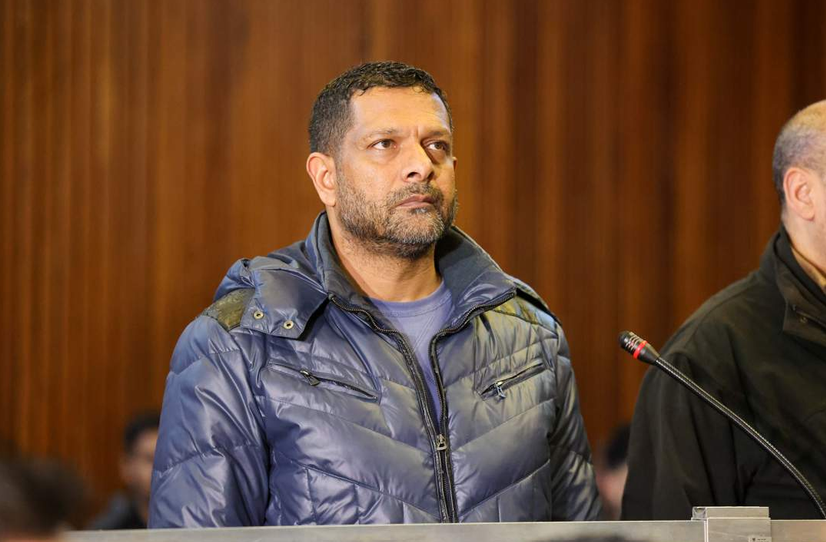
Senior Crime Intelligence head Major General Feroz Khan had reportedly raised concerns about threats to his safety with his legal team — including as recently as Sunday — before he was shot in an apparent ambush in Houghton, Johannesburg, three days before he was due to testify at the Madlanga Commission.
Khan’s legal counsel, advocate Zubair Khan, told News24 that the general’s fears were not new and had been formally recorded in legal documents.
“Safety concerns were raised by him with his legal team as well as in the affidavits that are now before the commission and that were before the court three weeks ago.
“General Khan [on Sunday] even expressed his concern to his attorney and to me while we were preparing for our appearance before the Madlanga Commission,” Zubair said.
Police said Khan was shot at around 23:00 on 3rd Avenue in Houghton when gunmen in a white Mercedes-Benz ambushed him. By Monday, his lawyers said his condition was critical. Zubair rejected speculation that began circulating online, insisting the shooting was real and life-threatening.
“We are particularly concerned about the rumours on social media that this is a staged event, much like what Brown [Mogotsi] went through.
“We can tell you that the general’s condition is critical and life-threatening. It’s being described by his doctors as critical. He is sedated, unconscious and due to undergo further surgery,” he said.
A police report released on Monday added new details from the scene. It said a passerby found Khan hanging out of the Suzuki Baleno he was driving and that Khan indicated he had been shot in the abdomen. The report also stated that no bullet holes were found on the vehicle, and that police found a note at the scene.
According to the report, the handwritten note called for the Investigating Directorate Against Corruption to investigate Colonel Calvin Khorommbi, the investigating officer in the illegal gold-dealing case against Khan, and Crime Intelligence head Lieutenant General Dumisani Khumalo, for defeating the ends of justice or for contempt of court.
When asked about the contents of the police report and the direction of the investigation, Zubair said his team had not been briefed by investigators.
“Regarding the police investigation, they have not given us an update, so we can’t comment on it.”
The attempted hit has also prompted questions about security arrangements around a senior police official — including why Khan was travelling in a Suzuki Baleno rather than an armoured vehicle. Zubair said the choice was part of a deliberate set of precautions intended to reduce risk, rather than a sign of complacency.
He said:
He used different vehicles, different routes, different times to meet with his lawyers at different venues.
As concern grew around whether the shooting was linked to the Madlanga Commission, analysts and oversight figures warned that the case could carry wider implications for witness safety — particularly for those expected to testify about sensitive networks involving policing and organised crime.
Security strategist Andy Mashaile described the incident as “very serious” and said the circumstances warranted a broader “scenario analysis”, pointing to earlier shootings linked to individuals who have been connected, directly or indirectly, to the commission’s work.
“It might be related. I’m not speculating here, but the scenario analysis shows that there could be a pattern. I don’t want to say it’s related to the Madlanga Commission; it could be people who had rough dealings with him, wanting to use the cover of his appearance before the Madlanga Commission,” said Mashaile.
“There will be people who will not want to be outed at the Madlanga Commission, and there will be people who have had dealings with a number of people who are appearing at the Madlanga Commission who have a lot to lose as a result of the evidence and testimony that will be delivered.”
Mashaile said preventing such attacks required practical, immediate improvements to protection around witnesses, including personal security and formal witness protection measures. He also warned he did not believe attempts to target those seen as threats were finished.
“Criminals who may want to hide their tracks will eliminate anyone who poses a threat to them. We are going to see more shootings,” Mashaile said.
“There are many players there, and those players will not want to be exposed. And what will they do? They will eliminate [the witnesses] so that they should not be arrested.”
Crime expert Guy Lamb said the incident had to be viewed against multiple alleged murder attempts involving people linked to the commission’s witness list, as well as the broader reality of organised crime in South Africa.
“We’ve had multiple allegations and incidents of assassination,” he said.
Lamb referenced the case of controversial businessman Brown Mogotsi. In November, Mogotsi claimed gunmen in a white bakkie shot at his vehicle while he was driving in Vosloorus on the East Rand, and that he escaped by turning into another street. Authorities later alleged the incident was staged, citing ballistic evidence tying the firearm used to other serious crimes, and state evidence that the vehicle was stationary and unoccupied when it was shot at.
In December, former Ekurhuleni Metropolitan Police Department officer Marius van der Merwe — described as “Witness D” — was shot multiple times outside his home in Brakpan, Ekurhuleni, with an AK-47. His wife, who was with him at the time, was not injured. An alleged triggerman, Matipandile Sotheni, a former elite police unit member, was arrested in Johannesburg in March.
At the start of the year, 16 shots were fired at the vehicle of Wiandre Pretorius in Boksburg. He survived the suspected hit. Weeks later, he was found dead at a petrol station in Brakpan in what was described as an apparent suicide.
Lamb warned against treating such incidents as unique to one commission, arguing that assassination threats in South Africa have repeatedly intersected with court testimony and criminal cases.
“We also need to look at the larger context of organised crime within South Africa because assassinations are not isolated to the Madlanga Commission. We’ve seen court witnesses giving testimony in relation to organised crime who have been assassinated or targeted.”
He added that it was especially alarming that a senior state official had been targeted, and raised the possibility of surveillance capabilities by organised criminal groupings — drawing a comparison with the assassination of detective Charl Kinnear.
“If we look at the assassination of Charl Kinnear, there’s evidence of organised criminal groupings who have access to individuals who can track cellphones. Kinnear was a relatively senior police official who was being tracked. It’s deeply worrying that organised crime groups were able to access that kind of information. It could be that there was access to Khan’s cellphone or that he was being monitored,” said Lamb.
“This reinforces the need for the Madlanga Commission to continue and the need for greater scrutiny of the police, and greater levels of accountability.”
Parliament’s Portfolio Committee on Police chairperson Ian Cameron said the shooting raised urgent questions and required a thorough investigation. He also argued that safety mechanisms around witnesses should be considered as a matter of course, given the stakes involved.
I think anyone who is considered a witness and who needs to testify should potentially have some kind of checks and balances in place with regard to safety. It’s worrying.
Cameron said witness and whistleblower safety is a weakness in the justice system more broadly, not only for people involved in major commissions.
“Broadly speaking, it’s something that a lot of South Africans have experienced. Many South Africans are terrified to speak out. It just shows that there is real risk and that there is no guarantee of coming out alive on the other side. And that has implications for the justice system if you have no witnesses,” he added.
“There’s little or no witness or whistleblower protection. You can’t blame people for not coming forward. I can tell you personally and even in my official capacity, it’s difficult to understand who you can and can’t speak to, who you can and can’t trust.”
The Madlanga Commission itself confirmed it was monitoring the situation. Spokesperson Jeremy Michaels said in a statement on Monday that they were aware Major General Khan had been shot and that they were in contact with “all necessary stakeholders, including the police”, regarding the matter.
Khan’s shooting now sits at the intersection of multiple pressures: a violent attack on a senior Crime Intelligence figure, a looming commission appearance, and a growing chorus of concern that witnesses may be targeted in a climate where intimidation can reshape what evidence reaches the public record. For investigators, the immediate task is to establish who orchestrated the ambush, what message — if any — was intended by the note found at the scene, and whether the attack forms part of a broader pattern that could place other witnesses in danger.