

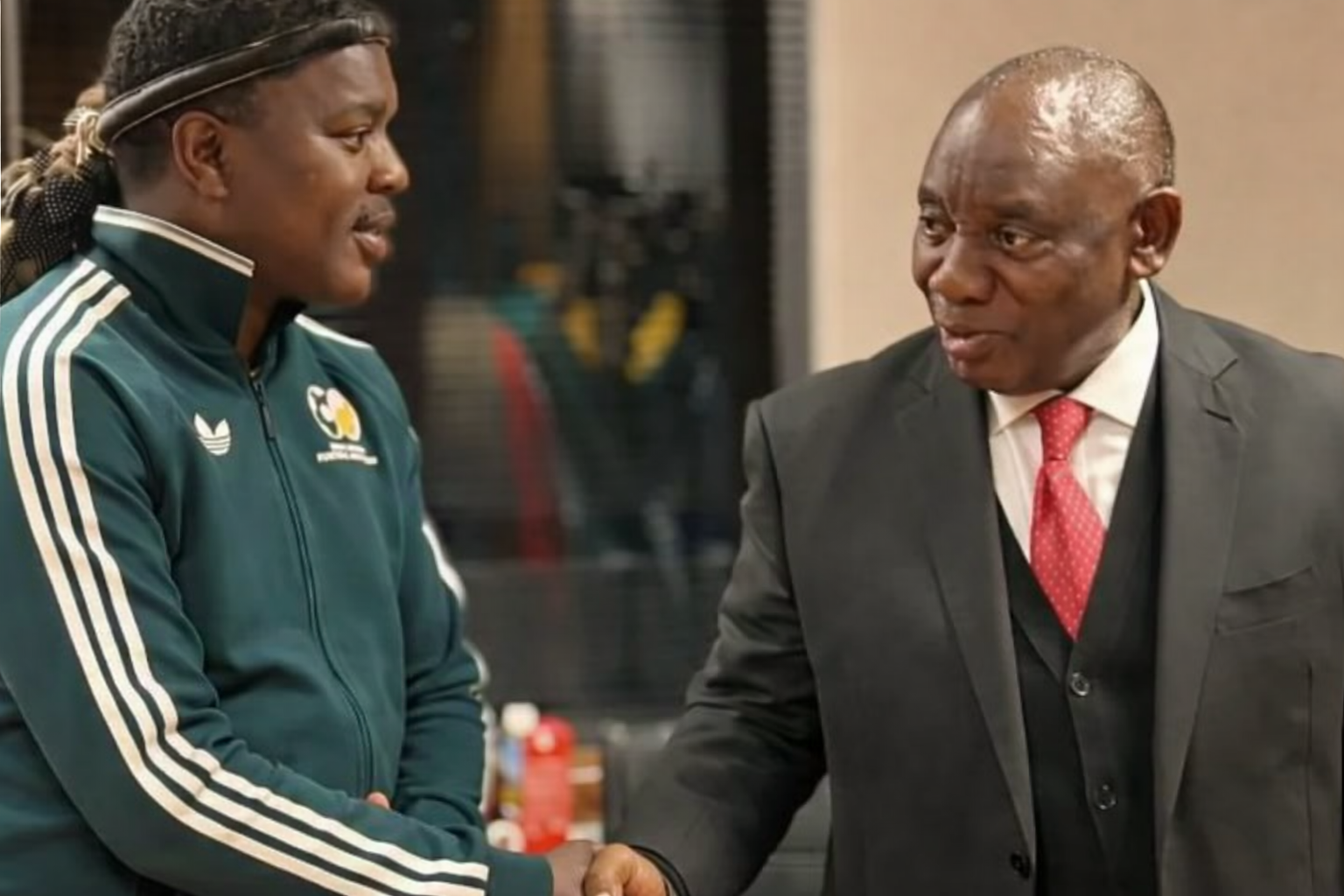
In a significant last-minute bid to calm rising tensions, President Cyril Ramaphosa met with two of South Africa’s most prominent anti-immigration activists just hours before nationwide community demonstrations were set to proceed on 30 June.
The closed-door engagement with Nkosikhona Ndabandaba and Ngizwe Mchunu appeared to signal the Presidency’s preference for dialogue over confrontation as protest organisers prepared to mobilise supporters across several provinces.
Ndabandaba, widely known by his moniker Phakel'umthakathi, leads the Insizwa Ngobunsizwa Development Foundation and has become one of the most recognisable faces of the anti-immigration campaign that has gained traction in KwaZulu-Natal, Gauteng and the Eastern Cape in recent months.
Alongside him, Mchunu — a former radio personality and leader of the Amabhinca Nation movement — has co-led marches demanding stricter enforcement against undocumented migrants. The two men have featured prominently in demonstrations that have drawn both strong support and sharp criticism.
Their meeting with the President came at a delicate moment, with organisers preparing for planned demonstrations and fears mounting that tensions could spill over into further violence.
A Push for Dialogue Over Escalation
The Presidency framed the engagement as part of a broader effort to promote peaceful civic dialogue and to de-escalate tensions that have built up over weeks of protests. Some of those marches have turned violent or resulted in fatalities, heightening concern among authorities and civil society groups.
Rather than addressing the protest movement solely through public statements or law enforcement warnings, Ramaphosa’s decision to meet directly with figures at the centre of the mobilisation marked a strategic shift towards engagement.
The move was widely interpreted as an attempt to prevent further unrest by offering activists an opportunity to present their grievances at the highest level of government.
While details of the discussions have not been made public, the timing of the meeting — in the final hours before demonstrations were expected to begin — underscored the urgency with which government is approaching the issue.
Social Media Reaction and Public Debate
Reaction to the meeting was swift on social media, where debate around immigration, accountability and protest tactics has been particularly intense.
A post by Sihle Lushozi captured the mood among observers who welcomed the sit-down. The caption argued that direct engagement, rather than confrontation, is the appropriate route for resolving disputes.
The post drew a parallel to ongoing diplomatic talks between the United States and Iran, suggesting that even longstanding adversaries can find common ground at a negotiating table.
It also questioned why some commentators appeared excited or alarmed by the meeting, asking pointedly who was actually expected to receive the activists’ memorandum of grievances in the first place.
That question has exposed fault lines within the protest movement itself.
Internal Disputes and Leadership Questions
In recent days, different factions associated with the anti-immigration campaign have traded blame over who set the 30 June deadline and who holds the authority to formally submit demands to government.
The uncertainty has added confusion to a movement that has grown rapidly but appears to lack a clearly defined central leadership structure.
At various points, the protests have drawn backing from civic organisations, traditional leaders and certain political voices. At the same time, human rights groups have condemned aspects of the movement’s tactics, particularly where demonstrations have been accompanied by intimidation or violence.
The lack of clarity around representation has complicated efforts to channel grievances into formal processes. It also raises questions about who legitimately speaks on behalf of protesters and whether any agreement reached through dialogue would be binding across the broader movement.
Government’s Broader Engagement Strategy
The meeting with Ndabandaba and Mchunu forms part of a wider pattern of outreach by the Presidency in the days leading up to the demonstrations.
Government has also engaged traditional leadership structures and the Zulu royal house, reflecting what appears to be a deliberate strategy of using respected cultural and community channels to maintain stability.
By broadening consultations beyond formal political actors, the Presidency seems intent on preventing demonstrations from escalating into unrest.
Officials have consistently maintained that while grievances can be aired through lawful protest, violence and vigilantism will not be tolerated.
A Movement Under Scrutiny
The anti-immigration campaign has gained momentum amid ongoing public frustration over unemployment, crime and service delivery. Organisers have argued that undocumented migration places strain on already stretched public resources.
However, critics warn that targeting foreign nationals risks fuelling xenophobia and undermining constitutional protections.
The weeks leading up to 30 June have seen marches in several provinces, some of which turned confrontational. Reports of intimidation and isolated violent incidents have heightened anxiety in affected communities.
Against that backdrop, Ramaphosa’s decision to engage directly with protest leaders may be seen as an attempt to lower the temperature and avoid further instability.
Uncertain Road Ahead
Whether the dialogue will translate into tangible outcomes remains to be seen. The internal divisions within the protest movement, combined with the scale of public emotion surrounding immigration, suggest that consensus may prove difficult.
For now, the optics of the meeting — the country’s President sitting down with activists at the centre of a contentious campaign — have shifted the tone of the debate, at least temporarily.
As demonstrations proceed, attention will turn to whether the emphasis on dialogue succeeds in maintaining calm, or whether deeper structural tensions will continue to drive confrontation in the weeks ahead.
The coming days are likely to determine whether engagement becomes the foundation for a more structured national conversation on immigration policy — or simply a brief pause in an increasingly charged standoff.