

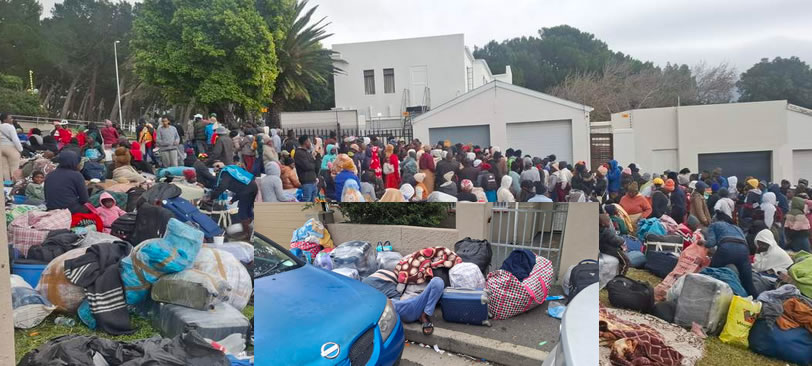
Fear and anxiety have pushed scores of migrants from neighbouring countries into a desperate scramble to leave South Africa ahead of tomorrow’s planned June 30 protest against undocumented foreign nationals, with some camping outside diplomatic missions in Johannesburg as they search for transport and assistance.
In the Johannesburg CBD, the impact was visible on Sunday as many foreign-owned businesses shut their doors, while others hurriedly removed stock and furniture. At bus stations and around consulate offices, migrants queued in large numbers, many saying they feared becoming targets despite repeated assurances from the government.
Some have chosen to stay, but only by retreating from public view. One foreign national, determined to remain in South Africa despite uncertainty, said fear had forced him into hiding.
“I am scared, but I cannot go back home with nothing to show for my time in SA. How will I survive if I return empty-handed? I need to make enough money to start something back home. Until then, I will hide.”
Outside the Zimbabwean consulate offices in Bruma, Johannesburg, hundreds of Zimbabwean nationals waited anxiously for buses home. Suitcases, bags and personal belongings were loaded onto trailers as names were called from passenger lists. Many appeared exhausted and on edge, saying they no longer felt safe remaining in the country as tensions rose ahead of June 30.
One Zimbabwean national, who has lived in South Africa for two years, told *Sowetan* he arrived at the consulate on Saturday afternoon after deciding it was no longer worth risking his life by staying.
“Three buses left at around 8pm, but my name was not on the list.
“As you can see, another bus is loading, but I’m still waiting. I am hopeful that by tonight all of us will be on the road back to Zimbabwe.”
His departure, he said, was not necessarily permanent. He intends returning to South Africa once the situation calms, because this is where he earns the income that sustains his family.
“Being in SA was nice until now that they are chasing us away and threatening to kill us. I just want to go home and be safe until everything settles. I will definitely come back because this is where I make money and take care of my family.”
Among those seeking help is James Macki, one of the Malawian nationals who have been sleeping on the pavement outside the Malawian consulate while waiting for assistance from authorities.
A father of three, Macki said he sends money to his wife in Malawi every month to buy stock for a bicycle repair business he hoped to reopen — an effort aimed at securing a stable future for his family. But he said the fear now gripping migrants had upended those plans.
Macki said Malawians in the communities where many of them live had been warned to leave before the planned anti-foreigner protests.
“They told us, ‘We don’t want your blood on our hands. You must leave’.
“That’s why we are scared and have come here to ask for help to return home.”
Civil society groups assisting those gathered outside diplomatic missions say conditions have become dangerous, particularly for people forced to sleep outside in winter temperatures. Ahmed Ismail, a representative of Ashraful Aid, said migrants spending nights outdoors in freezing weather had created serious health risks.
“Our mobile clinic has treated people suffering from respiratory illnesses after sleeping in the cold. We have also attended to cardiac patients, including one person who was on the verge of suffering a heart attack.”
As the queues lengthened and temporary camps grew, the broader political debate around June 30 has also intensified. Nelson Mandela Foundation spokesperson Verne Harris cautioned that the date being treated as a “deadline” has no lawful standing.
“It’s an arbitrary date that is being used by populists to mobilise people in very worrying ways.”
Developments have not been confined to South African authorities and local civil society responses. On Sunday, the Ugandan government issued a statement announcing that President Yoweri Museveni had directed arrangements to be made for the evacuation of Ugandan nationals from South Africa.
“Currently, 746 Ugandans have voluntarily registered and sought assistance for evacuation due to security and safety concerns, and more are expected to register,” the statement said.
The scenes outside consulates and at bus terminals point to an atmosphere in which fear is shaping decisions in real time: businesses closing early, belongings being hurriedly packed, families separating temporarily, and people sleeping outdoors while waiting for transport.
For some migrants, the choice is between leaving immediately for safety, or staying and risking violence while trying to protect livelihoods built over years. For others, especially those who say they have no savings to restart life back home, leaving now could mean returning empty-handed — a prospect they describe as almost as frightening as staying.
With June 30 hours away, the uncertainty remains. Many migrants say they do not trust that they will be protected on the streets, even as government has repeatedly appealed for calm. In the meantime, diplomatic missions, aid organisations and overstretched transport networks are being pulled into a crisis that is no longer theoretical, but unfolding in queues, shuttered shops and improvised sleeping spaces across Johannesburg.