

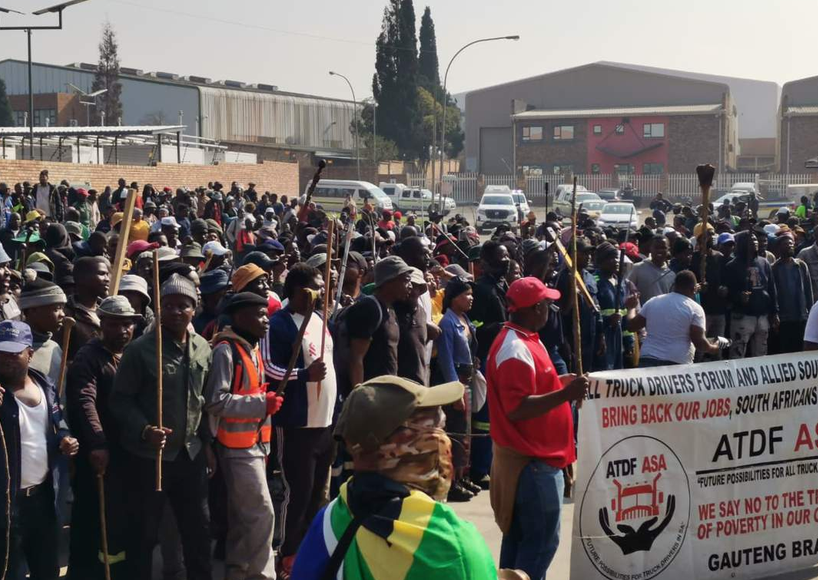
More than 42,000 foreign nationals have applied to register their businesses in South Africa as government intensifies efforts to regulate informal trading ahead of nationwide anti-illegal immigration protests planned for Tuesday, 30 June.
The figures were revealed on Friday during a media briefing in Pretoria by the Inter-ministerial Committee (IMC) on Migration, as tensions continue to mount in several provinces amid calls for undocumented migrants to leave the country.
Committee chairperson and Minister of Justice and Constitutional Development Mmamoloko Kubayi said the Department of Small Business Development (DSBD) had launched an accelerated registration drive to ensure informal traders comply with municipal by-laws and operate with the required permits.
“The cumulative permitting and licensing data as at June 24, 2026 show 100 733 applications received nationally, of which 42151 relate to applications where the owner is a foreign national,” said Kubayi.
“Of the total applications, 26367 were approved, including 6 749 approvals where the owner is a foreign national,” she said.
The figures reflect a significant push by authorities to formalise the informal economy at a time when foreign-owned spaza shops and street traders have increasingly become the focal point of public anger in some communities.
Kubayi said KwaZulu-Natal recorded the highest number of applications and approvals, while Gauteng saw a large volume of applications but comparatively fewer approvals.
The briefing formed part of government’s broader strategy to manage migration in what officials describe as a “controlled and orderly” manner, as anti-migrant demonstrations gather momentum in parts of KwaZulu-Natal and Gauteng.
Protests and mounting pressure
The protests come amid growing concerns about the safety and wellbeing of foreign nationals, particularly undocumented migrants, as hostility linked to anti-illegal immigration campaigns escalates.
Many migrants who arrived in South Africa seeking economic opportunity now say they are living in fear.
Protesters argue that undocumented migrants are taking jobs meant for South Africans, straining healthcare facilities and schools, and failing to contribute to the fiscus through taxes. Demonstrations targeting undocumented migrants have intensified in recent weeks, with organisers insisting that 30 June is the deadline for those without legal status to leave the country.
Anti-migrant organisations March and March, together with more than 20 other civil society groupings, held a media briefing in Midrand on Wednesday where they pledged that their demonstrations would remain peaceful and would not result in violence, looting or loss of life.
The organisations are demanding stricter visa regulations, a review of asylum policies, decisive action against businesses employing undocumented migrants, accountability for corrupt police officers and tighter restrictions on public services for undocumented migrants.
Despite repeated appeals from government for calm, protests have continued to spread, raising fears of further instability.
Joint action plan to formalise informal trade
Kubayi said government departments were working in tandem to bring greater regulation to informal business operations.
She confirmed that the DSBD, the South African Local Government Association (SALGA) and the Department of Cooperative Governance and Traditional Affairs (COGTA) had finalised a joint action plan to accelerate the registration of informal businesses.
A joint interdepartmental nerve centre would be established at both technical and political levels to fast-track compliance and strengthen coordination.
“To add to this effort, COGTA in collaboration with traditional leaders will support municipalities to embark on business licensing activities and strengthen bylaw enforcement in rural areas.”
The minister also highlighted targeted outreach initiatives under the Spaza Shop Support Fund.
“With regards to the implementation of Spaza Shop Support Fund, a total of four (4) Spaza Shop Awareness Campaigns were conducted during June 2026 in Mpumalanga and Gauteng.”
According to Kubayi, the campaigns reached 131 spaza shop owners and participants, with 22 applications completed for support.
The support fund forms part of government’s effort to stabilise township and rural economies while ensuring compliance with business and immigration laws.
Constitutional obligations remain
While acknowledging the depth of public frustration in some communities, Kubayi stressed that South Africa remains constitutionally bound to uphold certain rights, particularly those of children.
“With regards to the delivery of social services such as health, education and other services, South Africa is obliged to protect all children within the republic consistent with its constitutional, and statutory as well as international and regional commitments.
“South African courts have consistently confirmed that these constitutional rights apply to all children in South Africa.”
She added that migration management measures underway were designed to ensure that service delivery remains sustainable and does not disadvantage South African citizens.
“While we are mindful of the concerns raised by various communities with regards to the provision of social services to migrants, we believe that the work that we are doing to manage migration will ensure the provision of such services to migrants is controlled, orderly and manageable and does not disadvantage South African citizens,” she said.
Her remarks underscore the delicate balance government is attempting to strike: responding to public anger over immigration while adhering to constitutional and international obligations.
Security ramped up ahead of Tuesday
In anticipation of the 30 June protests, Acting Police Minister Professor Firoz Cachalia previously announced that R600 million — ordinarily allocated to police stations and community policing — would be redirected towards security operations.
Police visibility has since increased across the country, particularly in identified hotspots, with law enforcement agencies preparing to maintain order and prevent violence.
Authorities say the reallocation of funds will bolster intelligence, crowd management and rapid response capabilities during the demonstrations.
With just days to go before the planned protests, the coming week is expected to test both the state’s migration management strategy and its capacity to safeguard public order.
Government’s message is that registration, compliance and enforcement will be prioritised — but within the framework of constitutional protections.
Whether the combination of regulatory measures, public appeals and heightened security will be sufficient to calm tensions remains to be seen.