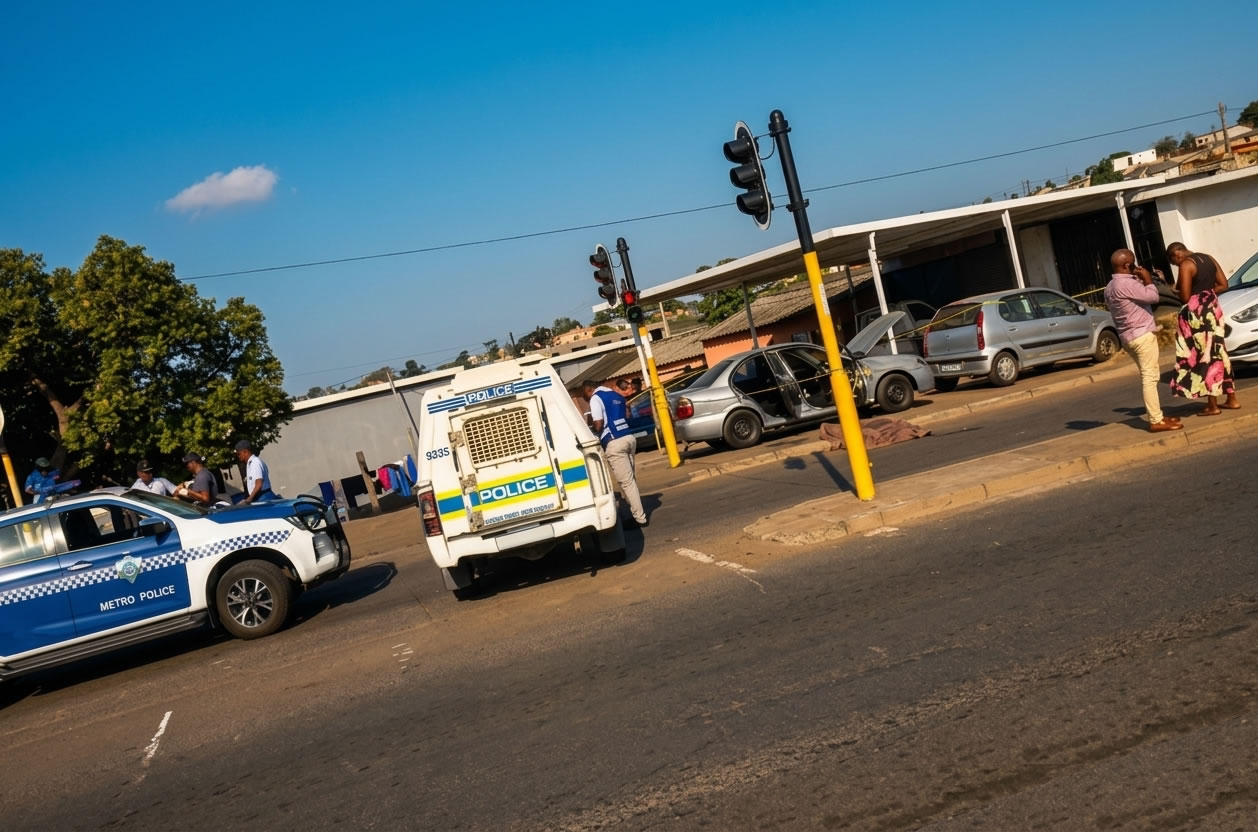
DURBAN – The engine of the white sedan had barely cooled when the first round was chambered. On Malandela Road, a thoroughfare that serves as the frantic central nervous system of KwaMashu, life usually moves at a relentless pace. But on Wednesday afternoon, 24 June 2026, time fractured. A man, whose identity remains withheld by authorities pending the notification of his next of kin, pulled his vehicle to the kerb outside a local tyre shop. He was alone. He was purposeful. He was also, as it would transpire, a marked man.
As he stepped out of the driver’s side, the transition from motorist to victim took mere seconds. Two gunmen, appearing as if from the very vapour of the humid Durban afternoon, closed the distance. There was no demand for a wallet, no struggle for car keys, and no shouted warnings. There was only the clinical, rhythmic percussion of gunfire.
The victim never made it across the threshold of the shop. He collapsed on the pavement, his life’s blood beginning to pool on the sun-baked concrete of Malandela Road. By the time the echoes of the shots had faded into the ambient noise of the township, the two assassins were already gone, reportedly vanishing into a getaway vehicle that had been idling nearby.
The Anatomy of an Ambush
For those who work and live along this stretch of KwaMashu, the violence was both sudden and chillingly familiar. A witness, who had been standing on the opposite side of the road when the shooting commenced, described a scene of absolute disorientation.
"I was on the opposite side of the road when this happened. I didn't notice where the suspects came from, but I heard gunshots and looked up. The man was already lying on the ground and I saw two men running away. Everything happened so fast I was shocked and confused," he said, his voice still carrying the tremor of the afternoon’s events.
The witness noted that despite the high volume of pedestrian traffic and the proximity of other businesses, the gunmen displayed a terrifying level of focus. Only one man was targeted; only one man fell. In the grim arithmetic of KwaZulu-Natal’s contract killings, this was a "clean" hit.
Another witness, an employee at a neighbouring shop, watched the aftermath from behind a security gate. He reflected on the victim's final moments with a sense of grim speculation. "We don't know whether he was going there to buy tyres or something else because he was alone in the car," he remarked. The car remained at the scene, an abandoned shell that served as a silent testament to a journey interrupted.
"We suspect the man was followed from wherever he was coming from and when he jumped out of his car they shot him. I don't think they took anything from him because after they shot him, I heard that they escaped in a car," the employee added.
A Province Under the Gun
The shooting on Malandela Road is not an isolated tragedy but a single data point in a burgeoning crisis of targeted violence across KwaZulu-Natal. Investigative trends in 2026 suggest that the province remains the epicentre of South Africa’s "assassination culture." While national crime statistics released in May 2026 by Acting Minister Firoz Cachalia claimed a marginal decrease in certain violent crime categories, the reality on the ground in townships like KwaMashu tells a different story.
In KZN, the "hit" has become a commodified solution for everything from political rivalries and taxi disputes to business competition and the enforcement of extortion rackets. The clinical nature of the Wednesday shooting—no robbery, no collateral damage, and a swift exit—bears all the hallmarks of a professional hit.
Local community leaders, speaking on condition of anonymity for fear of retribution, suggest that the "protection fee" industry has reached a fever pitch in 2026. Small business owners, including tyre shops, car washes, and tuck shops, are increasingly being squeezed by organised syndicates. Those who refuse to pay the "tax" often find themselves facing the business end of a 9mm pistol in broad daylight.
Recent reports from the South African Police Service (SAPS) indicate that extortion rackets are costing the national economy an estimated R68 billion, with KZN and the Western Cape being the hardest hit. In KwaMashu, the presence of these "business forums"—a euphemism often used for extortion groups—has created an atmosphere of pervasive dread. When a man is gunned down outside a tyre shop, the first question asked by locals is rarely "who was he?" but rather "who did he owe?"
The Policing Paradox
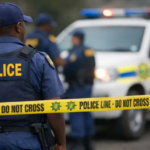
Lieutenant-Colonel Paul Magwaza, the KwaZulu-Natal police spokesperson, confirmed that a murder docket has been opened. "The motive for the killing is unknown," Magwaza stated, a phrase that has become a standard refrain in the aftermath of such incidents. He confirmed that KwaMashu police are investigating the events of 24 June, but as of Thursday morning, no arrests had been made.
The lack of progress in such cases is a significant point of contention for the residents of Durban’s northern townships. The SAPS Third Quarter 2025/2026 statistics highlighted that while police have increased "intelligence-driven operations," the conviction rate for contract killings remains abysmally low. The gunmen are often "imported" from other provinces or even neighbouring countries, completing their grim tasks and disappearing before the first police siren is heard.
Just weeks prior to this incident, a high-profile shootout in another sector of KwaMashu saw four suspected extortionists killed by police. While the authorities hailed it as a victory, the Malandela Road execution suggests that the hydra of organised crime in the area simply grows new heads. The proximity of the shooting to the busy Malandela Road Spar and other retail hubs indicates a total lack of fear among the criminal element. They operate with the confidence of those who know that the law is often several steps behind.
The Cost of Silence
For the people of KwaMashu, the silence that follows the gunfire is the loudest part of the tragedy. On Wednesday, as the police cordoned off the area around the tyre shop, the usual bustle of Malandela Road eventually resumed. Commuter taxis honked, street vendors called out their prices, and the white sedan was eventually towed away.
But beneath the surface of normalcy lies a deep-seated exhaustion. The "simple English" of the street is that people are tired of dying for nothing, and they are tired of watching men executed in the street while the rest of the world looks away.
The investigative trail for the Malandela Road shooting will likely go cold, as so many do. Without a clear motive or a cooperative witness willing to risk their life by testifying against a syndicate, the victim will become another number in the 2026 homicide count.
As the sun set over KwaMashu on Wednesday, the pool of blood outside the tyre shop had been washed away, but the stain on the community’s sense of safety remains. In a province where life is cheap and a hitman can be hired for the price of a used appliance, the question isn't whether it will happen again, but where on Malandela Road the next shadow will fall.
The investigation continues, but for the family of the man who just wanted to fix a tyre, the answers may never come. For now, Malandela Road remains a place where you keep your head down, your eyes forward, and you never, ever stop for too long.
"The motive for the killing is unknown." – Lieutenant-Colonel Paul Magwaza, KZN Police Spokesperson.