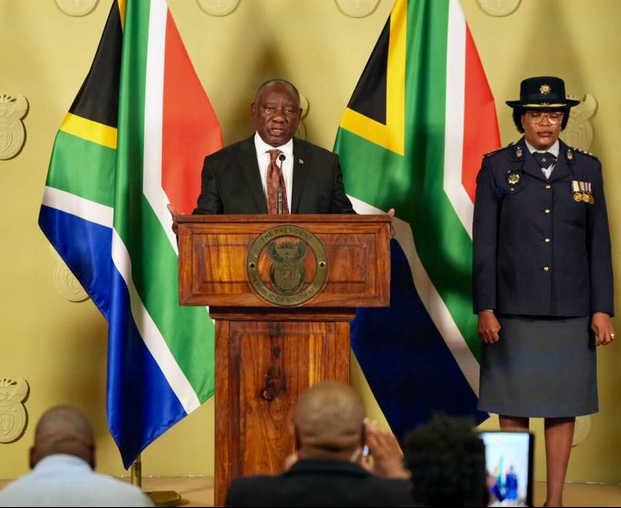
When President Cyril Ramaphosa stood at the Union Buildings on Thursday to announce Lieutenant General Puleng Dimpane as the acting National Police Commissioner, he wasn't just appointing a financial expert to steady a sinking ship. He was rewarding the woman whose forensic persistence effectively ended the career of her predecessor, General Fannie Masemola.
The story of Dimpane’s rise is inseparable from the fall of the "Cat"—alleged underworld figure Vusimuzi "Cat" Matlala—and the R360 million Medicare 24 security and health tender that has left the South African Police Service (SAPS) leadership in tatters.
While the public knows Dimpane as the service’s Chief Financial Officer (CFO), behind the scenes at the Madlanga Commission and within the high-security corridors of the SAPS head office, she has long been identified as the key whistleblower who "nailed" the irregular procurement processes that allowed Matlala to exert a "brotherly" influence over the country's top cops.
The tender in question—a massive R360 million contract for health and security services—was flagged by Dimpane during her tenure as CFO. It was her refusal to ignore the blatant violations of the Public Finance Management Act (PFMA) that set in motion the probe by the NPA’s Investigating Directorate Against Corruption (IDAC). This investigation ultimately led to criminal charges against Masemola and 14 other senior officers, whom Ramaphosa has now placed on precautionary suspension.
"It is vital that the public has trust in the people that the government has appointed," Ramaphosa said during the announcement, flanked by Dimpane. "She has a reputation for professionalism as well as integrity."
That integrity was forged in the fire of the Madlanga Commission, where Dimpane testified about the systemic failures that allowed Matlala’s Medicare 24 to secure lucrative contracts despite being flagged for suspicious activities as far back as the Tembisa Hospital scandal. It was Dimpane who revealed that serious procurement weaknesses were being exploited to funnel millions into private security companies linked to the underworld.
The irony of Dimpane’s appointment is not lost on political observers. For years, she was the "bean counter" who senior commanders allegedly tried to bypass. The Commission heard how Matlala and his associates allegedly used their ties to senior police officers to circumvent supply chain management (SCM) rules, often drafting unauthorized memorandums of understanding to legitimize their operations.
Dimpane’s paper trail was the silver bullet. By meticulously documenting every breach in the SCM system and every non-compliance with the SCM guide, she provided the IDAC with the forensic evidence needed to bring charges of fraud, corruption, and money laundering against the very men she reported to.
Her appointment marks a radical departure from the traditional SAPS promotion path. For the first time, a forensic auditor and internal audit specialist has been given the keys to the kingdom. Ramaphosa noted that Dimpane’s "extensive experience in policing, financial management, and governance" was exactly what the service needed to deal with its "procurement weaknesses."
However, the road ahead for the acting commissioner is fraught with danger. The "Cat" Matlala case has exposed a deep-seated network of corruption that extends from the SAPS supply chain to the underworld. Matlala himself remains behind bars, facing charges related to the R360 million tender, but the "Big Five" cartel he is allegedly linked to still casts a long shadow over the security cluster.
Furthermore, Dimpane must now lead a senior management team that is deeply divided. Some view her as a hero who saved the service from total capture, while others—particularly those still loyal to the suspended Masemola—see her as an outsider who used her audit powers to "purge" the career cops.
The Madlanga Commission’s term has been extended to August, and its final report is expected to further implicate several high-ranking officials. Dimpane will be tasked with implementing whatever recommendations the Commission makes, a process that will likely involve further disciplinary actions and criminal referrals.
"We will up the tempo when it comes to fighting crime," Ramaphosa promised, but he acknowledged that the service is currently in a state of flux, with "too many people in acting positions."
For Dimpane, the transition from being the one who flags the corruption to the one who must dismantle it will be the ultimate test. Her reputation as a whistleblower who couldn't be bought has brought her to the top job. Now, the nation is watching to see if the auditor can become the enforcer.
As the legal case against Masemola and Matlala moves toward a May court date, Dimpane’s first few weeks in office will be scrutinized for any sign of a "clean sweep" of the supply chain management division. If she succeeds, she will have proved that in the modern SAPS, the most powerful weapon against crime isn't a badge or a gun—it’s a clean set of books.