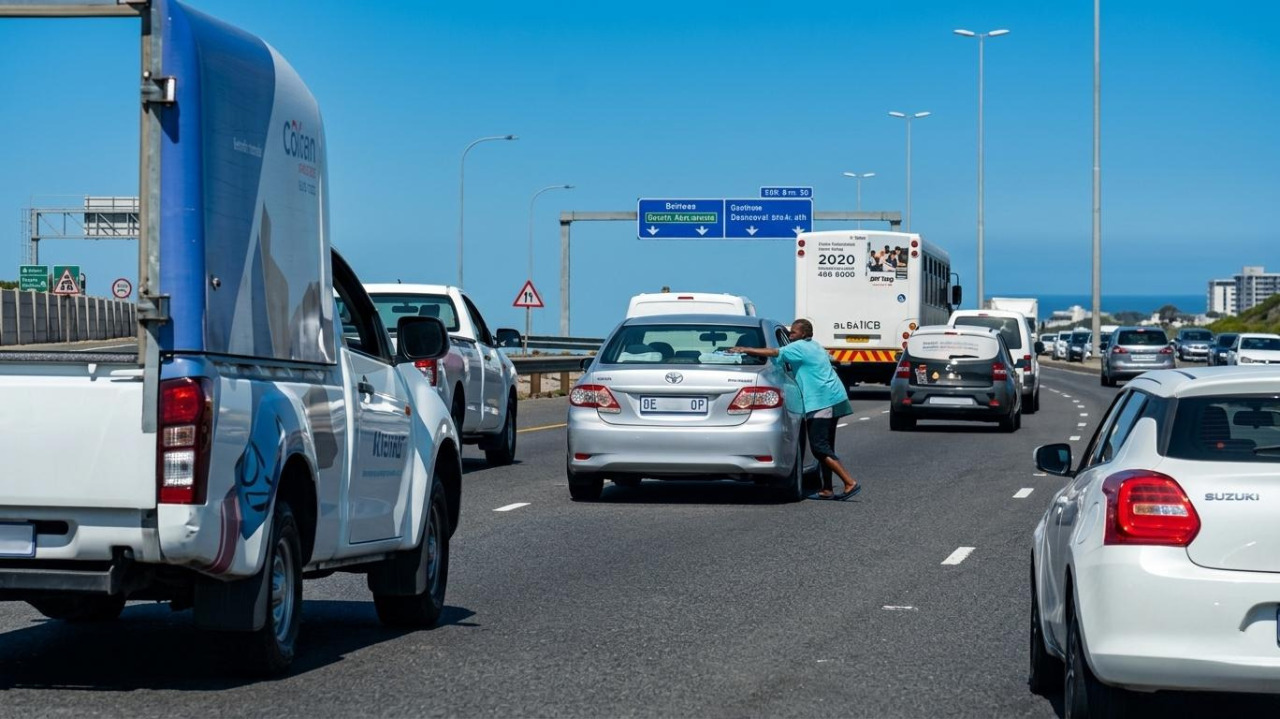
In the sprawling urban landscape of the Western Cape, where the rhythmic hum of traffic often masks the predatory intentions of the opportunistic, a Tuesday afternoon on Vanguard Drive recently transformed into a scene of unexpected retribution. It was roughly 12:30 PM on March 24, 2026, a time when the midday sun typically beats down on the Epping industrial corridor, that a would-be cellphone thief discovered that not every motorist is a passive victim. The incident, which has since become a focal point of conversation across the Cape Flats, saw a suspect snatched from the roadside and taken on a harrowing, high-speed journey that he is unlikely to forget.
The drama began with a classic smash-and-grab manoeuvre. In the heart of Epping, a notorious hotspot for such crimes, a suspect attempted to "try his luck" by snatching a mobile phone from a vehicle. However, the driver, whose identity remains unknown but whose reflexes were undoubtedly sharpened by the daily hazards of Cape Town’s roads, did not flinch. Instead of yielding his property, the motorist reached out, grabbed the thief’s arm with a vice-like grip, and "hit the road." What followed was a "wild ride" along one of the city’s busiest arterial routes, with the suspect "hanging on for dear life" as the vehicle accelerated away from the scene of the attempted crime.
Young OG CPT, a local content creator and musician, was among the witnesses who found themselves following the unfolding chaos. Returning from a gig with several fellow musicians, he watched as the silver lining of a routine drive was replaced by a spectacle of vigilante justice. "A couple of musicians and I were in the vehicle as we were driving on Vanguard Drive when we saw this thing happening," he recalled during an interview. The suddenness of the event was jarring. "And Bang! Here this guy rolled down his window, and I think they took his arm and held it, and just drove and drove."
The pursuit continued for several hundred metres, a distance that must have felt like miles to the man dangling precariously against the car’s chassis. The vehicle eventually reached a bridge near the Vangate Mall side, where the driver finally pulled into the yellow lane. "The driver stopped in the yellow lane. I think they let him go, but we just drove on," Young OG CPT noted, adding that the situation appeared to be entirely under the driver’s control. "There were actually three guys, but then the one guy got stuck in there."
While the footage of the incident has circulated widely, sparking a mix of amusement and approval from a public weary of roadside crime, official channels remain quiet. Sergeant Wesley Twigg, a spokesperson for the South African Police Service (SAPS), confirmed that they have "no record of the incident." This lack of a formal report is a common theme in Cape Town’s battle with smash-and-grab crimes, where victims often feel that the bureaucratic hurdle of filing a case outweighs the likelihood of a conviction.
However, for local leaders like Ward Councillor Angus McKenzie, the incident represents more than just a viral moment. It is a symptom of a broader "fight back" from a community that has reached its breaking point. McKenzie described the event as a "major win" for motorists who have long suffered under the "ongoing issue of smash and grab" on the Cape Flats. "This incident has been seen as a huge win for many people on the fight back that has come from motorists," he stated. Yet, he was quick to temper the celebratory mood with a plea for formal action. "I really wish to use this opportunity to highlight to motorists that they need to report attempted smash and grab and smash and grab incidents and suspicious people who stand on the corners of hotspots."
The Vanguard Drive incident is not an isolated occurrence but rather a dramatic entry in a long-standing chronicle of crime in the Western Cape. According to data from the Metro Police CCTV network, over 215 smash-and-grab incidents were detected between July 2024 and May 2025 alone. The corridor between Bonteheuwel and Langa remains the most significant hotspot, though the "modus operandi" of criminals is constantly shifting as enforcement efforts intensify. Areas such as Leonsdale, Beaconvale, Elsies River Industria, and Epping Industria—where this latest incident occurred—continue to see high volumes of reports.
The nature of these crimes is fundamentally opportunistic. Criminals typically strike during peak hour traffic or over weekends when motorists are more relaxed or distracted. The City’s Safety and Security Mayoral Committee Member, Alderman JP Smith, has frequently highlighted the difficulty in tracking the true scale of the problem. "One of our biggest challenges is that it is nearly impossible to determine the extent of the problem. The CCTV network only detects incidents within the camera footprint, and not all incidents are reported to SAPS," Smith has previously remarked. This sentiment echoes the current situation on Vanguard Drive, where a dramatic confrontation went unrecorded in the official crime statistics.
Recent history in the region provides a somber backdrop to the more "triumphant" narrative of the Vanguard Drive motorist. In December 2025, the community was reminded of the lethal stakes involved in these roadside encounters when a grandmother from Nelspruit, Karin van Aardt, was tragically murdered during a smash-and-grab incident on Jakes Gerwel Drive, just minutes after landing in Cape Town. While an arrest was eventually made in that case, it served as a stark reminder that these are not merely property crimes, but often violent assaults that can end in tragedy.
The frustration of the public is further fueled by the broader crime landscape in the Western Cape. Recent statistics for the 2025/2026 financial year indicate that the province remains an epicentre for violence, with gang-related murders and robberies continuing to plague communities. In such an environment, the sight of a "skelm" (thief) being "taken for a ride" by a intended victim resonates deeply with those who feel the state has failed to provide adequate protection.
In response to the persistent threat, the City of Cape Town has deployed dedicated daily patrols by Metro Police and the Traffic Services' Highway Unit on major routes including the N2, N7, R300, and N1. These "Ghost Units" have seen some success, with recent reports indicating that two smash-and-grab crimes were thwarted on the N2 in a single week. However, the sheer volume of traffic and the number of intersections make total coverage an impossible task.
Councillor McKenzie’s advice to motorists remains consistent: vigilance is the only reliable defence. "We need to ensure that when we are driving in known hotspot areas, we do not have our cellphones out, which includes other personal belongings," he warned. He also appealed to the public to use the emergency number 021 480 7700 to report suspicious activity, stressing that increased reporting leads to a higher "response level" from authorities.
The "dom dief" (dumb thief) of Vanguard Drive may have escaped with his life and his freedom, but he has inadvertently become a symbol of a shifting tide. As the driver stopped in the yellow lane and released the suspect, he wasn't just letting a man go; he was sending a message to the "boewe" (thieves) who haunt the city's intersections. The message is clear: the motorists of Cape Town are no longer willing to be silent participants in their own victimisation.
As the sun sets over the Cape Flats, the traffic on Vanguard Drive continues to flow, a river of steel and glass carrying thousands of stories. Most of these stories are mundane—commuters heading home, musicians travelling to their next gig—but every so often, the river surges. The incident on Tuesday was one such surge, a moment of raw, unfiltered reality that stripped away the veneer of urban order. It serves as a reminder that in a city where the line between safety and danger is often as thin as a car window, the will to fight back is a powerful, if unpredictable, force.
For now, the streets of Epping remain a battlefield of wits and reflexes. The authorities will continue their patrols, the councillors will continue their pleas for reporting, and the criminals will continue to watch for a moment of distraction. But for the man who was "taken for a ride," the memory of that grip on his arm and the blur of the asphalt beneath him will likely serve as a more effective deterrent than any police siren. And for the people of the Western Cape, the story of the driver who wouldn't let go remains a rare, albeit unofficial, victory in a long and wearying war.