

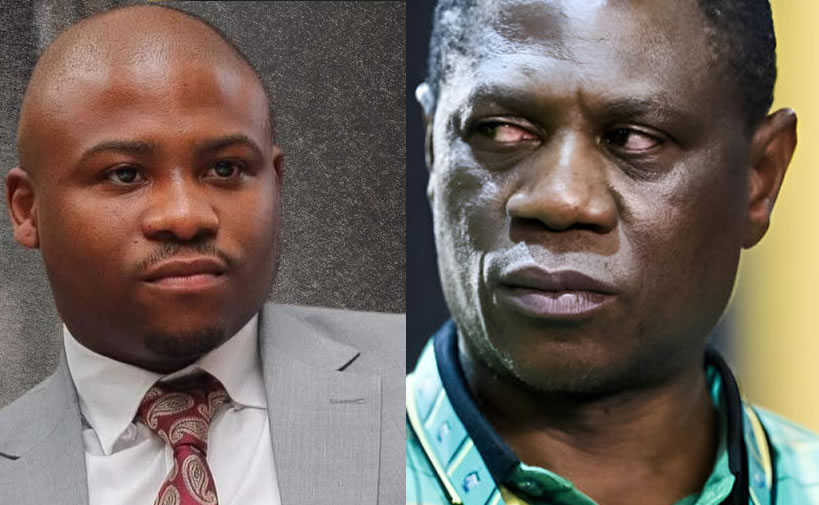
In a decision that has sparked significant public outcry, the Public Protector’s office has cleared companies linked to Deputy President Paul Mashatile’s sons in a R91 million government contract scandal, despite numerous red flags and apparent irregularities in the tender process. The investigation, which focused on contracts awarded to Ngwato and Manzi Group (NMG) and Modipadi Nokaneng for the maintenance of fire suppression systems in Gauteng hospitals, has been sharply criticised for its narrow scope and for seemingly ignoring crucial evidence.
The controversy centres on a series of contracts awarded by the Gauteng Department of Infrastructure Development between 2021 and 2022. While initially believed to involve three tenders, it has since emerged that NMG, a company where Mashatile’s sons Thabiso Mashatile and Tinyiko Mvelase have served as directors, was awarded a total of eight contracts. These companies, NMG and Modipadi Nokaneng, though separate on paper, were found to be deeply interconnected, allegedly sharing office space, staff, and even branding while bidding for the same government work.
A preliminary report from the Public Protector’s office, dated October 2025, concluded it was "likely" to find that three of NMG's contracts were awarded fairly and without political influence. However, this conclusion was reached despite investigators admitting they had not received all the documents related to the most critical contract—a panel to maintain fire detection and suppression (FDS) systems at Gauteng hospitals. The report dismissed this as not a "material omission." Furthermore, there is no indication that the directors of NMG were interviewed or asked to contribute to the probe.
The FF Plus party, which lodged the initial complaint in February 2024, found it suspicious that the Deputy President's sons were appointed as directors around the same time the tenders were awarded. The decision to investigate was seen as a positive step to ensure tender processes were followed lawfully.
The financial figures surrounding these deals have been a moving target, ballooning from an initial R49 million to a staggering R91 million. Together, NMG and Modipadi Nokaneng have been paid R46.6 million and are still owed R44 million by the Gauteng Health Department. Specifically, NMG received nearly R18 million between November 2022 and November 2025, while Modipadi Nokaneng was paid R28.7 million and is owed another R43.9 million.
Adding to the suspicion, some payments were for services completely unrelated to fire systems, including fax machine rentals for a mortuary, unspecified renovations, and water repairs. This has fuelled accusations that the contracts were merely a vehicle for siphoning public funds.
The tender process itself has come under intense scrutiny. For the crucial fire detection and suppression contract, a total of 41 bids were received, but all were disqualified, leaving only NMG and Modipadi Nokaneng as the successful bidders. While the companies did have certified technicians at one point, records from the South African Qualification and Certification Committee (SAQCC) show that as of March 2024, they had no technicians registered. This means any work performed between March 2024 and the contract's end in November 2025 would have been unlawful and contrary to the department's own requirements.
The human cost of this financial saga is stark. While millions were flowing to the connected companies, not a single one of Gauteng's 37 public hospitals was compliant with fire safety laws. This has left patients and healthcare workers in a perilous situation, with dozens of fires causing hundreds of millions of rands in damages at facilities like Charlotte Maxeke and Tembisa hospitals in the past five years. Opposition health spokesperson Jack Bloom highlighted the absurdity of the situation, stating it was suspicious that so much money was spent while hospitals remain unsafe. The Democratic Alliance (DA) has called for an investigation into why these companies were paid millions yet failed to prevent recent fires at Tembisa Hospital.
The scandal has also cast a long shadow over Deputy President Paul Mashatile’s political career and his family's lifestyle. Questions have been raised about his residence in a lavish R37 million Waterfall Estate property, which was purchased by his sons and son-in-law. While Mashatile's office has denied any wrongdoing, stating the property was acquired through normal bank loans and that he resides there for security reasons, the optics have been damaging. His spokesperson, Keith Khoza, has dismissed the allegations as a "concerted 'pressure campaign'" and a "collection of fabrications, exaggerations, innuendo, and outright lies" intended to tarnish the Deputy President's image.
The companies involved have also faced other troubles. An investigation was sparked by NMG's failure to pay R219,000 in settlements to about 12 employees it retrenched in September 2024.
In a letter to one of the workers, Mashatile's son, Tinyiko Mvelase, confirmed the layoffs were related to the company's finances. Meanwhile, Modipadi Nokaneng has reportedly been hit with a R3 million bill from the SA Revenue Service (SARS) for unpaid value-added tax (VAT). Subsequently, a company linked to Thabiso Mashatile, previously known as Modipadi Nokaneng, has been removed from the government's central supplier database, effectively barring it from doing business with the state.
This case has become a potent symbol of the systemic issues plaguing South Africa's public procurement system, where political connections often appear to trump competence and value for money. The perception that politically connected individuals enrich themselves at the expense of essential services like healthcare has led to widespread public anger and demoralisation among healthcare workers. As the country grapples with the fallout from this R91 million scandal, the question remains: if the Public Protector, an office designed to hold power to account, fails to investigate such glaring red flags, who will protect the public's interest?