

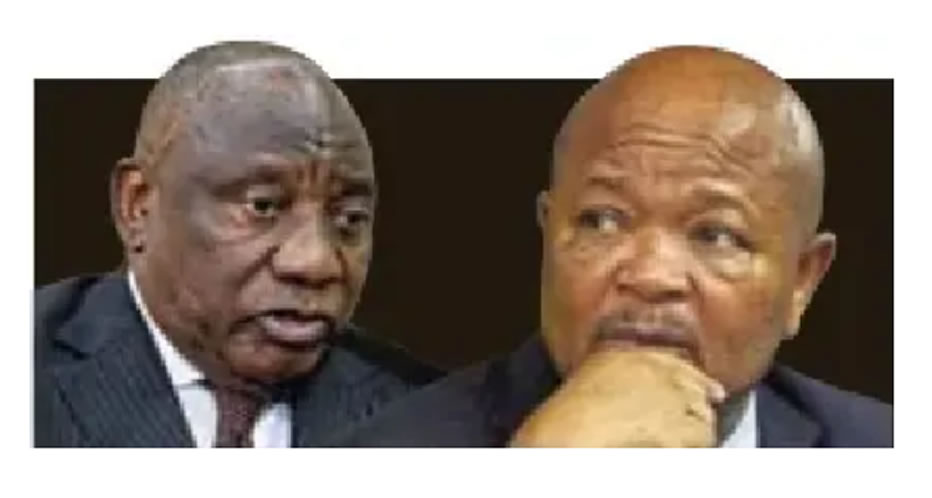
President Cyril Ramaphosa has openly acknowledged that suspended Police Minister Senzo Mchunu has become a significant weight on his administration, describing him as a "political burden to bear". Yet, despite this admission, the President remains steadfast in his refusal to fire the minister until the Madlanga Commission of Inquiry has completely finished its work and submitted a final report.
The President’s stance has sparked intense debate regarding fairness and political favouritism. While Ramaphosa has been praised for acting with uncharacteristic speed in referring 14 other senior officials for criminal investigation following the commission's interim findings, his apparent leniency towards Mchunu has drawn sharp criticism from civil society and political analysts alike.
The Presidency confirmed the difficult position Ramaphosa finds himself in following the findings of the inquiry led by retired Constitutional Court Justice Mbuyiseli Madlanga. Vincent Magwenya, the President's spokesperson, was candid about the situation this week.
"Indeed, there was a finding against the minister but not a recommendation. In the end, minister Mchunu is the president’s political burden to bear," Magwenya told the Sunday Times. "It’s his leadership character that has brought him a lot of criticism, and he accepts the criticism."
The controversy centres on the President’s decision not to subject Mchunu to an immediate probe, despite the commission having made a "finding" against the former minister. Detractors argue the President is protecting an ANC ally—whom some say was being groomed as a successor—while sacrificing "smaller fish".
Ramaphosa caused a stir this week when he referred 14 senior SAPS officials, senior managers at the Independent Police Investigative Directorate (Ipid), and Ekurhuleni metro municipality officials for criminal investigation on Madlanga’s recommendation. Among those referred are Hawks KZN head Maj-Gen Lesetja Senona and Ekurhuleni metro police boss Julius Mkhwanazi, based on prima facie evidence of wrongdoing.
Civil society organisations have been vocal in their disapproval of the disparity in treatment. The Organisation Undoing Tax Abuse (OUTA) has demanded that the President stop wasting taxpayer money on a suspended minister.
"The president must make a decision because he cannot keep him on paid leave all the time," said OUTA chief executive officer Wayne Duvenage. He argued that delaying the decision creates the impression that Ramaphosa is shielding his ally.
"The fact that this minister has already compromised himself by interfering in operational matters is enough for the president to dismiss him," Duvenage noted. "There is far too much smoke and questions for someone who needs to head up an entity that is rotten and needs extremely strong discipline and leadership to fix the SAPS."
The allegations against Mchunu are severe. They stem from explosive claims made by KwaZulu-Natal police commissioner Lt-Gen Nhlanhla Mkhwanazi at a press conference in July last year. Mkhwanazi accused Mchunu of wrongfully disbanding the police’s Political Killings Task Team (PKTT). While Mchunu told the commission he disbanded the team with the President’s approval, evidence presented to the inquiry suggests the unit was closed down to benefit criminal syndicates that had infiltrated the SAPS.
Further complicating matters, a witness known as "Witness E" testified in hiding, implying that Mchunu had interfered with police work.
Mchunu has vowed to fight back. In a statement released to The Mercury, he confirmed he intends to return to the commission to clear his name.
"Yes, the letter released as a media statement is authentic; it is to rebut the claims that have been made. I will be going back to the commission; I do not know when, as you know that in the commission, you are called; you do not just come," Mchunu said.
In his written rebuttal, Mchunu was firm: "I have taken note of the evidence presented by the second witness at the Madlanga Commission on Monday. I deny the allegations he makes about me, including the interactions regarding his statement. I am aware that I am due to appear again at the commission, and I will seek to respond. My lawyers are already dealing with the matter."
Despite the pressure, the Presidency insists that due process must be followed. Magwenya explained that while Ramaphosa has the prerogative to dismiss Mchunu at any time, he wants to act fairly by allowing the minister space to respond to the allegations before the commission.
"What happens to the minister is for the president to decide," Magwenya said. "The president will deal with the minister Mchunu matter at the end of the commission’s work, on the basis of the final report. He wants him to answer all allegations … This is both a due process matter and an accountability exercise."
Magwenya further elaborated on the President’s philosophy regarding the delay. "At an appropriate time, the president will act on minister Mchunu," he said. "At that time, both politically and procedurally, the question of fairness … will be a moot point. He is not under any legal obligation to act fairly — he can dismiss a minister at will — but the president wants to act fairly."
Political analysts, however, believe the hesitation is rooted in internal ANC politics. Professor Mcebisi Ndletyana suggests that Ramaphosa’s characterisation of the Mchunu matter as a "burden" is an acknowledgment that his earlier caution has reached its limits.
"It’s already costing him politically, but he was willing to take that knock initially because [Mchunu] was his political ally," Ndletyana said. He added, "Even though he is a political burden, you need to handle this situation carefully. You don’t want to turn him into an enemy — and that will happen if you throw him to the wolves."
Susan Booysen, another political analyst, echoed these sentiments, noting that Ramaphosa might be concerned about Mchunu’s influence. "He wants to make sure that people who are going to investigate him have all the necessary authority because, although Mchunu is suspended, his influence within the department (of police) stretches very far and wide, and there can be repercussions against people who are acting against Mchunu," said Booysen.
Zakhele Ndlovu from UKZN was more direct about the political calculations. "We know that Mchunu is Ramaphosa’s important political ally. Mchunu was instrumental in getting the CR17 campaign the support it needed in KZN," Ndlovu said.
While the fate of the Minister hangs in the balance, the work of the commission continues to reveal disturbing trends within the justice system. The commission’s preliminary report has highlighted criminality, corruption, fraud, perjury, and even murder within the ranks.
"Well, we can’t comment on individual appearances, except to say what we have witnessed in the course of the commission hearings has been quite disturbing and, worryingly, has eroded public confidence in law enforcement," Magwenya admitted regarding the testimony.
To address the immediate rot, Ramaphosa has directed acting police minister Firoz Cachalia and national commissioner Fannie Masemola to establish a special task team. This team is mandated to follow through on the investigations recommended by the commission.
Magwenya emphasized that the scope is broader than just one man. "In the immediate term, the commission’s work will assist with strengthening the operational capacity of law enforcement agencies. Therefore, the scope of the commission in terms of the envisaged outcomes is much broader than one individual who no longer has any role to play in the sector or the SAPS," Magwenya said.
However, the public remains sceptical. ActionSA councillor Alan Beesley stated it was time for decisive action. "The recent further allegations made against Minister of Police Mchunu are extremely disturbing. In light of these allegations, the President should immediately act and fire the Minister," Beesley said. "One must ask the question: why is the President not acting against Mchunu? In the interim, taxpayers continue to pay for two Ministers and two deputies."
The stakes are incredibly high. Evidence before the commission suggests that criminal elements have spread their tentacles into the top echelons of the police, with leadership figures allegedly striking up relationships with people accused of serious crimes. Witness safety is also a major concern; at least one witness who gave evidence has been murdered, and others live in fear.
Ultimately, Ramaphosa’s strategy appears to be a waiting game. "In any case, Madlanga will submit [the final report] most probably by June, in which case he can just get rid of him," Ndletyana predicted. Until then, Senzo Mchunu remains, in the President's own words, a political burden he is choosing to carry.