

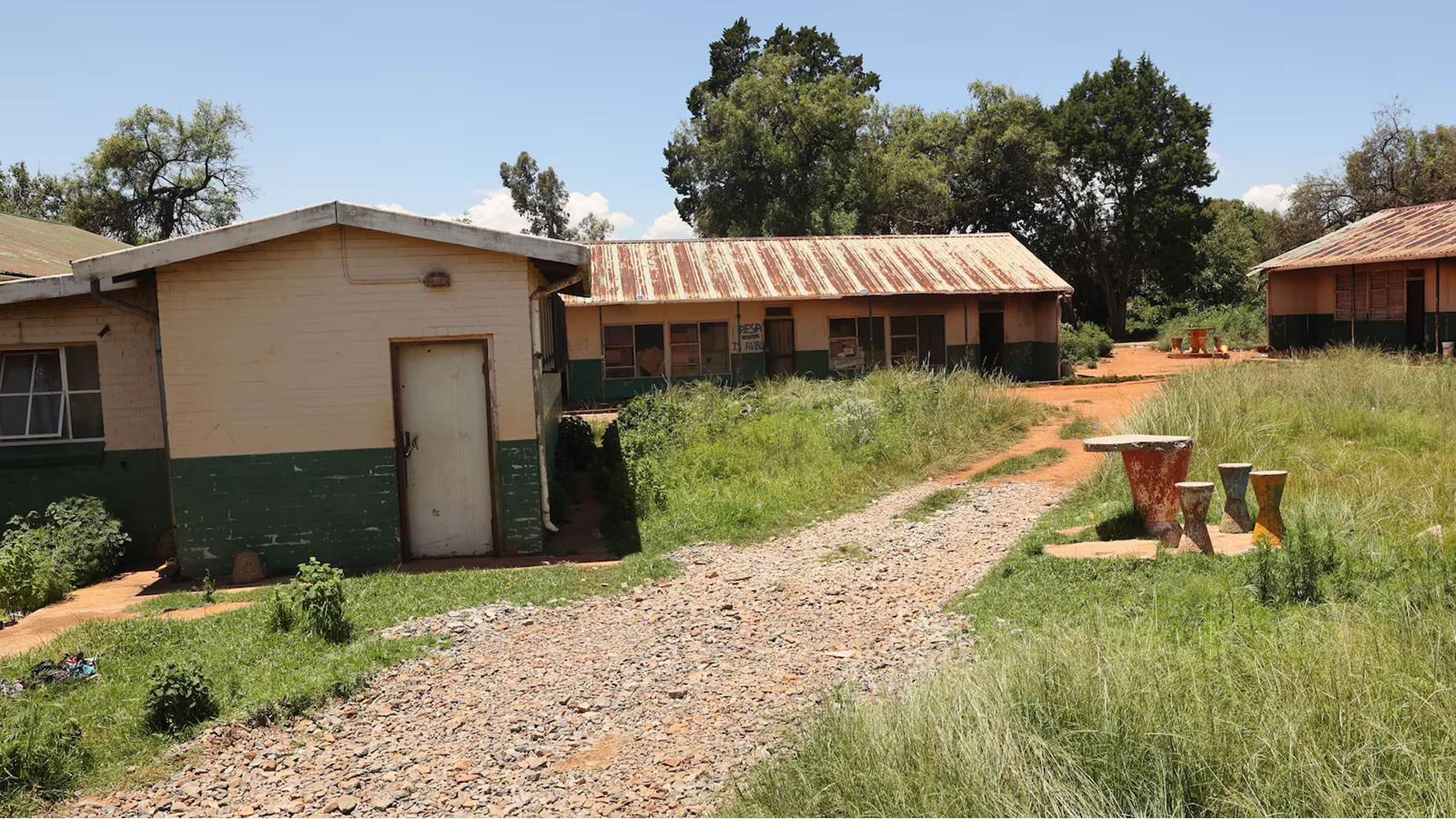
CARLETONVILLE, WEST RAND – In the shadow of the gold-rich reefs of the West Rand, a different kind of education is taking place at the Ekuphakameni Primary School. The classrooms, once filled with the sounds of children reciting their ABCs, now echo with the rhythmic thud of gold-processing equipment and the sharp crack of high-calibre gunfire.
For seven years, this abandoned government property has served as a fortified headquarters for hundreds of illegal miners, known locally as zama zamas. It is a place where the rule of law has been replaced by the rule of the gun, and where a community lives in a state of perpetual fear, caught between the desperation of the miners and the sporadic, often ineffective, raids of the South African Police Service (SAPS).
A Fortress of Illicit Gold
The takeover of Ekuphakameni Primary was not a slow infiltration but a swift conquest. Closed in 2018 due to dwindling pupil numbers, the school sat vacant for barely two months before the first waves of miners arrived. Today, it is a fully functioning, self-contained illegal settlement.
Classrooms have been converted into living quarters, furnished with beds, televisions, and kitchenettes. The principal’s office, once a place of discipline and administration, has been repurposed as a tavern, serving alcohol to the miners after their shifts in the dangerous, unregulated shafts nearby. Outside, on what were once playgrounds, livestock—including cattle, pigs, and even horses—graze amidst the dust and debris of gold processing.
The school is now a "no-go zone" for anyone not affiliated with the mining syndicates. Entering the premises requires strict adherence to a set of unwritten rules.
“If you come in peace, you must drive in with your hazard lights on,” one resident, who asked to remain anonymous for fear of retaliation, explained. “If you come in with your lights on, they think you are coming to cause trouble, and that can lead to violence.”
The miners themselves are defiant. One zama zama, standing near the former school gates, made their position clear: “This is no longer a school. This is our home now. We live here, we work here, and we are not leaving.”
A Community Under Siege
For the residents of the surrounding mining village, the presence of the zama zamas is a daily trauma. The school has become the epicentre of a violent turf war that frequently spills over into the streets.
“Every week, the police come to chase the illegal miners away. We hear gunshots and fighting. They try to push them out, and the miners fight back,” said another resident. The violence is not limited to Carletonville; it is part of a broader wave of illegal mining-related conflict that has gripped the West Rand.
Just 11 kilometres away, in the Sporong informal settlement near Randfontein, the situation reached a breaking point last week. Brazen illegal miners used violence to extort money from residents, forcing over 600 people to flee their homes and seek refuge in a community hall. While many have since returned under heavy police escort, the sense of security is fragile.
Elsie Mokobane, a Sporong resident, described the current atmosphere: “The officers are patrolling the area day and night. There are several police vans here and a minibus full of Amapanyaza [Gauteng Crime Prevention Wardens]. We feel safe, although we are still traumatised by what happened.”
However, in Carletonville, the police presence at Ekuphakameni is seen as a temporary disruption rather than a solution. Residents complain that as soon as the police leave, the miners return, often more aggressive than before.
The Lost Generation
Perhaps the most tragic consequence of the school’s takeover is the impact on the local children. When Ekuphakameni was closed, the pupils were moved to Wedela Primary School, located some 15 kilometres away.
A former pupil, who witnessed the rapid transformation of his old school, spoke of the hardship this has caused. “Wedela is very far from where we stay. We use a government bus every day just to get to school,” he said.
The distance is only part of the problem. Parents live in constant fear that their children will be caught in the crossfire of the weekly battles between the police and the miners. The sight of heavily armed men occupying a place of learning has become a grim, everyday reality for a generation of children in the West Rand.
A Failure of Governance
The situation at Ekuphakameni Primary highlights a significant challenge for the Gauteng government: the management of vacant properties. Across the province, dozens of abandoned government buildings have been hijacked by criminal syndicates or occupied by the homeless, often becoming hubs for illicit activities.
The Mineral and Petroleum Resources Committee Chairperson recently condemned the violent actions of illegal miners in Randfontein, calling for more decisive government intervention. Yet, for the people of Carletonville, these statements feel like hollow promises. They have watched for seven years as their local school was dismantled and turned into a fortress for a multi-billion rand illegal gold industry.
The zama zamas, many of whom are reportedly Basotho nationals, are part of highly organised syndicates that operate with sophisticated weaponry and little regard for local authorities. The illicit gold trade in South Africa is estimated to cost the economy billions of rands in lost revenue every year, but the human cost—the displacement of families, the terrorising of communities, and the loss of educational facilities—is far harder to quantify.
The Ticking Time Bomb
As the sun sets over the West Rand, the hazard lights of vehicles approaching Ekuphakameni Primary blink in the twilight—a silent signal of submission to the new masters of the school. The government’s failure to secure its own property has created a vacuum that criminal elements have been all too happy to fill.
The residents of the mining village are left with a simple, desperate plea for intervention. They want their school back, but more importantly, they want their safety back.
“We are living in a battlefield,” one mother said, clutching her child’s hand as they walked past the school’s perimeter. “How can we expect our children to have a future when their school is a den of thieves and murderers?”
Until the government finds a way to not only evict the illegal miners but also to provide long-term security and repurpose its vacant properties, the classrooms of Ekuphakameni will remain a testament to a state that has lost control of its own land. The gunfire will continue to echo, and the children of Carletonville will continue to travel 15 kilometres to find the peace that should have been on their doorstep.
The story of Ekuphakameni is not just about illegal mining; it is about the erosion of community, the failure of the state, and the resilience of a people who refuse to be silenced, even as the sound of gunshots becomes their new normal.