

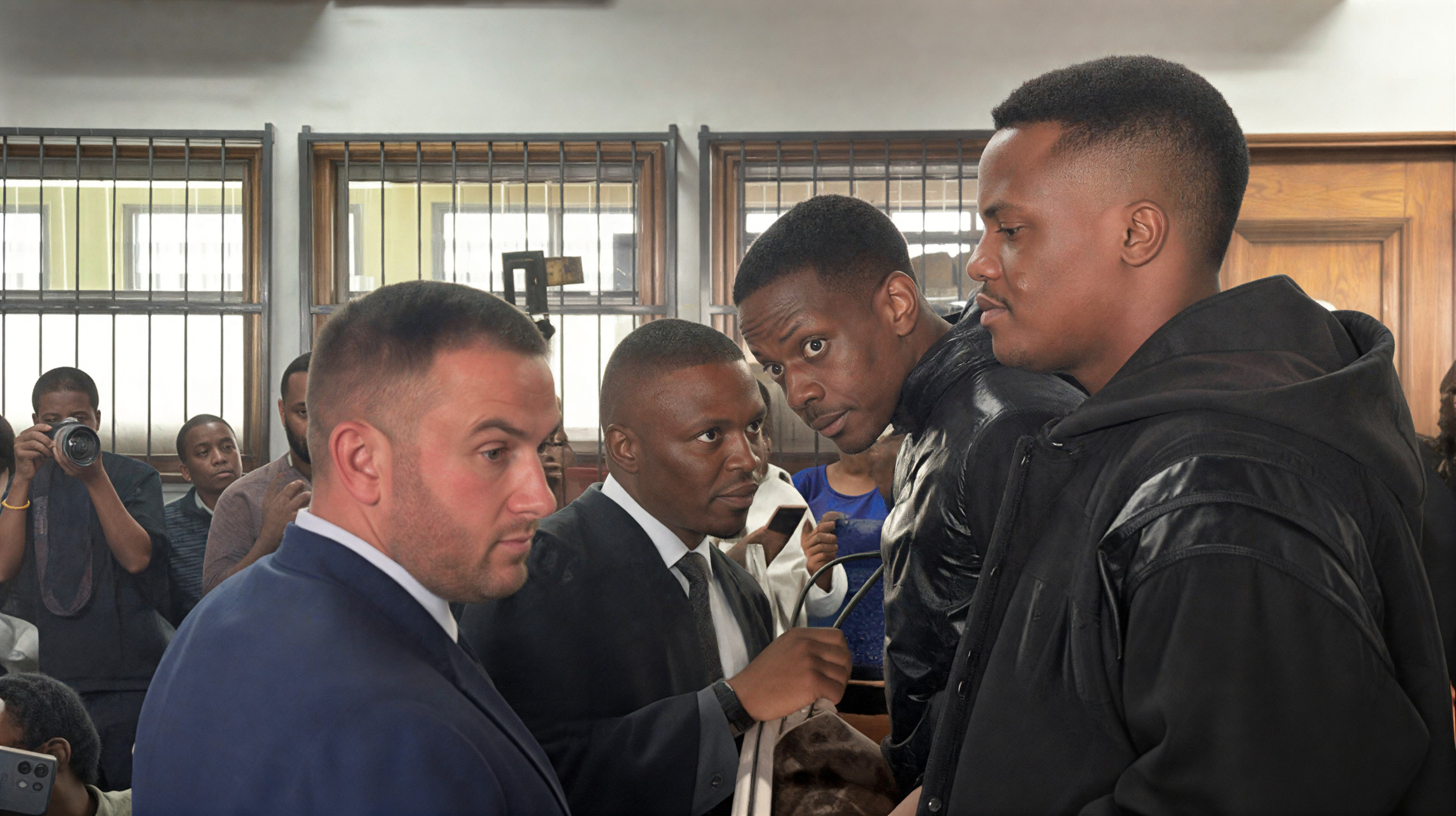
Bellarmine Mugabe and Tobias Matonhodze face the prospect of lengthy jail terms when they return to the Alexandra Magistrates Court for sentencing on Wednesday, after both men pleaded guilty to a range of serious offences linked to two violent incidents in Johannesburg’s northern suburbs.
The pair, both Zimbabwean nationals in the country illegally, abandoned drawn-out negotiations and submitted a last-minute Section 112 application under the Criminal Procedure Act, which allows an accused to plead guilty without a formal plea bargain with the State. But prosecutors say their late plea and partial admissions do not go nearly far enough to warrant leniency.
The State is pushing for direct imprisonment, arguing that despite the guilty pleas on charges that include attempted murder and firearm offences, the men have not fully cooperated with investigators – notably failing to reveal what happened to the gun used in the shooting.
The most serious charges stem from a violent incident at a Hyde Park residence, where a man was shot and wounded. Prosecutors say this was not a random act, but part of a pattern of criminal conduct, and that attempts were later made to neutralise the case through an alleged payoff.
Hyde Park shooting and alleged payoff
The duo is accused in relation to two incidents, one of which centres on a shooting at their Hyde Park home.
One of which involved shooting a man at their Hyde Park residence.
The court has since been told that the victim was paid money in an apparent effort to make the case disappear.
The court has subsequently been told that the victim was paid in an attempt to make the charges go away.
That allegation – that someone injured in a violent crime was compensated in return for dropping charges or softening their stance – has added a further layer of concern for prosecutors, who argue it speaks to an attempt to “defeat the ends of justice”, one of the counts now on the charge sheet.
Initially, proceedings in the matter were plagued by postponements and delays, with no plea agreement reached between the accused and the State.
After weeks of delays and without a plea agreement with the State, the duo brought a Section 112 of the Criminal Procedure Act application, which allows them to enter a guilty plea.
Under Section 112, a court can accept a guilty plea if it is satisfied that the accused understands and admits all the elements of the offence. The move can speed up proceedings, but does not automatically guarantee a lighter sentence – particularly where the State believes cooperation has been limited and key facts remain obscured.
What the men admitted – and what they did not
In their formal admissions, the two men took different levels of responsibility.
Mugabe pleaded guilty to two charges, pointing of what is believed to be the firearm in the incident before the shooting and being in the country illegally.
Matonhodze, by contrast, admitted to a broader set of offences.
While Matonhodze pleaded guilty to attempted murder, being in the country illegally, illegal possession of a firearm and defeating the ends of justice.
The State has stressed, however, that neither man has “pointed out the weapon used in the attempted murder”, a step prosecutors view as an important test of genuine remorse and cooperation. Without the firearm being recovered, investigators have fewer avenues to confirm crucial details such as ballistics, prior use in other crimes, or the chain of custody.
The State argued for lengthy direct imprisonment for the accused, saying that despite pleading guilty to some charges, including attempted murder and firearm violations, they have not pointed out the weapon used in the attempted murder.
Prosecutors say this failure, coupled with the alleged payment to the victim and the fact that both men are in the country unlawfully, undercuts any claim that they are truly taking responsibility.
The State said that only direct imprisonment is appropriate for the two, as they have shown no remorse nor cooperated with the investigation.
Defence pushes for suspended sentences or fines
In mitigation, the defence painted a very different picture. Counsel for the two argued that the court should consider alternatives to jail, such as suspended sentences or substantial fines, especially in light of their immigration status and personal circumstances.
In mitigation of the sentence, the defence argued that a suspended sentence or a hefty fine would be a sufficient sentence for the two who are in South Africa illegally.
The argument is that a stringent, suspended sentence – hanging over their heads – would act as a powerful deterrent, both for them and for others in a similar position, while still recognising their decision to plead guilty.
He said that this would serve as a deterrent that will hang over the 29 and 32-year-old Zimbawean nationals.
The men are 29 and 32 years old, respectively, and have no formal right to be in South Africa. The defence has suggested that, after serving any sentence the court deems fit or complying with a suspended sentence, they may face deportation.
However, the State appears unmoved by these submissions, telling the court that the seriousness of the offences, the presence of a firearm, and the alleged attempt to undermine the justice process demand custodial sentences.
Illegal stay, firearms and justice concerns
The case has drawn attention not only because of the Hyde Park shooting, but also because it highlights several overlapping issues: the presence of illegal firearms, the status of foreign nationals in conflict with the law, and the integrity of the criminal justice system when victims are allegedly paid off.
By pleading guilty to “defeating the ends of justice”, Matonhodze has effectively admitted to conduct aimed at interfering with or obstructing the legal process, though court documents have not yet spelt out every detail of that charge in open session.
For Mugabe, the admission that he pointed “what is believed to be the firearm in the incident before the shooting” underlines his role in escalating the situation, even if he did not pull the trigger. Prosecutors say these roles are intertwined and must be treated with appropriate seriousness.
As the sentencing date approaches, the court must now weigh two competing narratives: one from the defence, which portrays Mugabe and Matonhodze as remorseful, young and capable of rehabilitation under the cloud of a suspended sentence; and one from the State, which insists that they have “shown no remorse nor cooperated with the investigation” and that only prison terms will properly reflect the gravity of their crimes and protect the public.
On Wednesday, the Alexandra Magistrates Court will decide which of these views prevails – and how heavily the attempted murder, firearm violations, illegal stay and alleged payoff will count against Bellarmine Mugabe and Tobias Matonhodze when sentence is finally handed down.