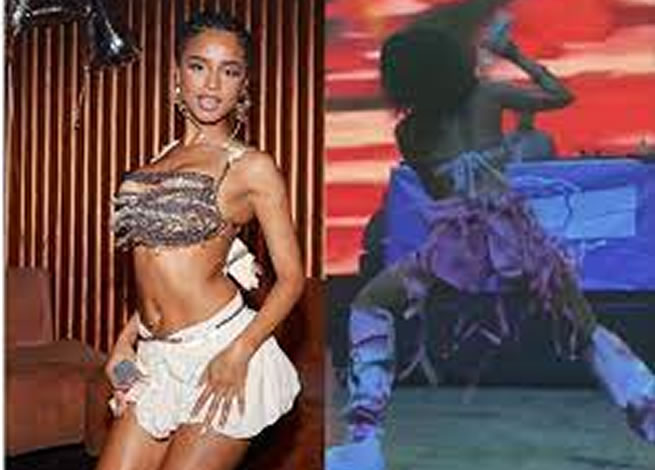
American singer and actor Tyrese Gibson has entered the heated international debate over how South Africans talk about race, publicly defending Grammy-winning singer Tyla after she faced criticism — particularly from American audiences — for identifying as Coloured.
The controversy flared up again after Tyla appeared on Apple Music’s “The Ebro Show”, where she spoke about the backlash that followed earlier interviews in the United States, and how she was forced to explain an identity label that, in her South African context, is widely understood — but abroad can be interpreted as offensive.
In the United States, the word “Coloured” is generally treated as outdated and derogatory, in part because of its association with racial segregation and discriminatory laws. In South Africa, however, Coloured refers to a distinct ethnic and cultural community shaped by colonial history, slavery, migration, and apartheid classification — a community with its own lived identity that many South Africans use as a matter of fact rather than insult.
Tyla’s comments in the interview speak to the culture shock of taking a South African identity label into a global entertainment market where historical meanings are different, and where audiences can interpret a word through a completely separate racial lens.
She told “The Ebro Show” that her first encounters with American backlash left her rattled, not because she wanted to stir controversy, but because she had never had to justify her identity in that way.
“Initially it was very difficult because prior to 'The Breakfast Club', I did answer that question and already I started getting backlash. And I was like, ‘Whoa’, I don’t know what else to say about it because I never had to explain myself,” she said.
“You know, I was just always myself and living. At the time, 22 years of my life, all I knew was that I’m Coloured and that’s what I was told.”
Her phrasing is telling: she described Coloured not as a label she adopted strategically, but as the reality she grew up with — an identity “that’s what I was told”, reinforced socially and culturally in South Africa where racial categories have long carried political and economic weight.
Tyla went on to explain that travelling internationally forced her to confront the reality that racial terminology is not universal, and that words carry different historical baggage depending on where you are.
“When I was able to travel the world and learn more about the world, I then learned just how big the world is and how different each country is. How different the context is. So when I learned about what it means here, I was like, ‘Whoa’, this is going to be a difficult conversation to have.”
In other words, she said she began to understand the American response — not because she changed her identity, but because she realised how deeply the word is tied to US racial history. She also acknowledged that South Africans have their own racially offensive terms, which helped her appreciate why certain language can be triggering elsewhere.
But she also resisted the idea that her South African identity should be erased in order to satisfy a foreign context. She framed Coloured as culture and community, while also affirming a broader Black identity.
“I know that being Coloured is my culture. It exists in my context but I’m also Black,” she said.
It is this balancing statement — asserting a specific cultural identity while also affirming Blackness — that has kept the debate alive. For some critics, the issue is whether Coloured is being used as a distancing mechanism from Black identity; for many South Africans, it is simply a description of community and history. Tyla’s words suggest she is navigating both realities: the South African lived meaning of Coloured, and the international interpretation shaped by different histories.
After the interview circulated, Tyrese Gibson responded publicly on social media, questioning what he called “selective outrage” and expressing concern about the impact online criticism may have had on Tyla’s career.
“I didn’t say anything but I was definitely shocked at the beatdown online and found myself feeling sad to see her career take a hit,” he wrote.
Gibson then broadened the conversation, comparing reactions to Tyla’s use of “Coloured” with the way racial slurs are used within the Black community in the United States — and how, he argues, people can normalise language internally while condemning it externally.
“Are we Coloured? Or are we n****s? Because we say it every day. Then we’re in our feelings when anybody else says it. Selective outrage?”
His argument, while likely to provoke strong reactions, was aimed at exposing what he believes is inconsistency: outrage directed at Tyla for using a South African identity term, while derogatory language is often used casually within other communities.
Gibson also invoked the Nation of Islam as an example of a community he says avoids using racial slurs when referring to other Black people.
“I have never heard a soldier from the Nation of Islam refer to their fellow Black man as a n****. They always say ‘my brother’ or ‘my sister’.”
He argued that derogatory language has been absorbed into everyday speech in the United States, and suggested that this reflects a deeper psychological victory for racism.
“The white man has done a real one on us and now we refer to ourselves as the derogatory name that they created for us. I’m guilty of it myself… But the selective outrage is amazing.”
In defending Tyla, Gibson urged critics — particularly Americans unfamiliar with South Africa’s racial history — to educate themselves about apartheid and its legacy before judging how South Africans describe their identities.
“I’ve been to South Africa at least eight times. Do your research on apartheid. All of the trauma that apartheid inflicted and is still inflicting to this day on Africans.”
He ended his comments with a sharp final line, aimed at those he believes are speaking without global context.
“It’s been said, never ever listen to the opinion of people who have never had a passport.”
The debate around Tyla has become a case study in the reality of global fame: when an artist crosses borders, the language that shaped them at home is suddenly interpreted through another country’s history. Tyla’s comments suggest she is not abandoning her South African identity label — but she is learning how to explain it in a world where the same word can land very differently, depending on who is listening.